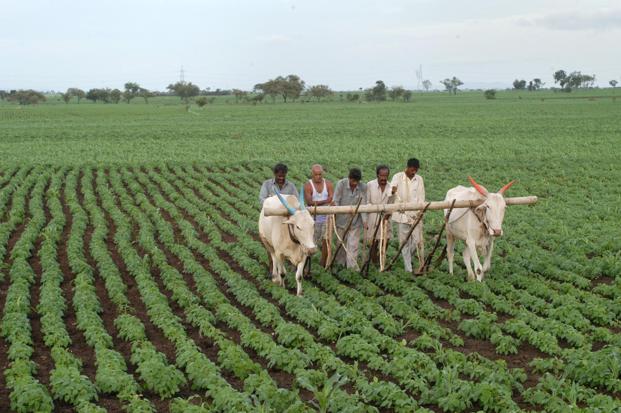
At a time when wholesale price inflation has touched the highest in three decades, there is distressing news on the farm front. Within a span of a week, three farmers have burned their standing crop or the harvested produce at three different locations across the country. The crops are different, but the reason for putting it on fire is the same – failure to get a fair price that covers the actual cost farmers had incurred in its cultivation.
On Dec 11, an angry Chakalu Venkateswarlu, hailing from Kurnool district in Andhra Pradesh, put on fire the 25 bags of onions (each weighing 50 kg) that he had brought to the Kurnool Agricultural Market Yard, when he found the best price being offered to him was Rs 500 per quintal (Rs 5 per kg). Realising that such a low price did not even cover his cost of production, transportation cost and the mandifee, the frustrated farmer preferred to sprinkle petrol on his produce and put it on fire.
Four days later, another farmer from Dhone mandal in Andhra Pradesh, put his 3 acres under banana plantation to fire when the prices in the wholesale market effectively crashed to Rs 2 to Rs 3 per kg. Mallikarjuna claims that he had spent about Rs 5 lakh in cultivating bananas, but when the prices fell so low at the time of third harvest, he felt defeated. All that he had earned from marketing his crop was not more than Rs 1.5 lakh. Out of exasperation therefore he was left with little choice but to burn the plantation.
In Madhya Pradesh, a couple of days later, an irate Shankar Sirfira, a farmer from Deoli, burnt 160 kg of garlic that he had brought to the Mandsaur market yard. In the video clip that went viral on the social media, he was heard saying that he had spent Rs 2.5-lakh on cultivating garlic but all he got in the market was Rs 1-lakh. This did not even cover the cost of cultivation. He said all he wanted from the government was to ensure a fair price to farmers.
The three painful incidents that I have highlighted above may appear to be isolated but are a reflection of the deeper agrarian distress that prevails. There are tens of thousands of farmers cultivating the same crops who are lashed with the same ferocious blow from markets but whose despair, dismay and hopelessness goes unrecorded. When prices crash, economists blame it on supply demand disequilibrium but fail to see the human suffering it unleashes. Not only in India but globally too, the volatility of the markets has destroyed livelihoods, and increasingly forced farmers to abandon farming, sell of their lands and migrate to the cities looking for menial jobs.
This is no less than mayhem. Take the case of America, where the farm gate prices have been on a steady decline since 150 years thereby gradually pushing farmers out of agriculture. With a hollow disquiet prevailing in the countryside, not only have farm suicides increased but so has mental distress. In the US alone, from where we borrow the failed market reforms in agriculture, as many as 915,725 farm workers and their families are being treated for depression at the Migrant Health Centres that have been set up nationwide. This is happening at a time when hardly 1.5 per cent of the US population now remains in farming. While there may be complex reasons behind the mental health challenges that farmers and farm workers are faced with, fluctuating commodity prices remains on the top.
But for policy planners and media especially business journalists’ mayhem occurs only when equity indices plunge, when stock markets ends at a lower level. This is how the economic design is cast. While a dominant section of the mainline economists rue the slide in stock markets, they spare no effort in welcoming the low farm prices that eventually leads to increased farm indebtedness, pushing more and more farmers to migrate to the urban centres.
No wonder, the daggers are already out against any possible move to provide farmers with a guaranteed income by way of a legal sanctity for Minimum Support Price (MSP) for 23 crops for which the prices are announced every year. Some senior economists, who themselves get a guaranteed salary packet linked to inflation every month, are the ones to talk about the virtues of free markets for farmers, which they believe would lead to price discovery. Although I have earlier talked in these columns of how the markets in case of highly commercial products like chocolate and coffee have left millions of primary growers of cocoa beans and coffee bean in Africa and Latin America to live in misery, the case of banana value chains squeezing farmer’s income is no less of an eye-opener. A study shows for every Euro worth of purchase by European consumers, banana producers in Latin America, from where the fruit is imported, receive only 5 to 9 per cent of the end price.
It is the primary producers who play a strenuous role, working the hardest, and yet their share of income in the agricultural value chains is the lowest, not even covering the cost of production. And let’s not forget. For the three commercially important crops – coffee beans, banana and cocoa beans – there is no MSP, nor is there any APMC mandis that we can point our fingers to. It is the big multinationals operating in a competitive environment that actually thrives on sucking farmers’ wealth. Imagine, if the global agricultural chains had set an example by guaranteeing a minimum economic price covering the cost of production plus a reasonable share of profits, farming too would have been a profitable enterprise.
Instead of leaving it to exploitative market forces, as the international evidence has conclusively shown, the time is ripe for India to usher in a new set of ingenious farm reforms that begins by first ensuring a living income for farmers. Guaranteeing an economically-viable livelihood to 50 per cent of the country’s population is the way to bridge the great economic divide. #
After the sudden withdrawal of the three contentious farm laws last week, the debate has now shifted to whether there is a need to provide farmers with an assured Minimum Support Price (MSP) or leave them to face the vagaries of the markets. While protesting farmers are demanding MSP to be made a legal right, fears are being expressed that any such move will lead to an economic crisis.
In the heated deliberations that have followed in the media, what is lost is the need to come to grips with the severity of the continuing farm distress that has prevailed over the past few decades. Looking beyond statistical figures, what is not being appreciated is that these are not just numbers; it is human lives that we are talking about. With or without the proposed farm laws (which have now been withdrawn) the challenge is how to pull these millions out of abject poverty and hunger. Take for instance the report of the Economic Survey 2016 which had shown the average annual income of a farmer in 17 States of India, which means roughly half the country, at a paltry Rs 20,000. In other words, farmers in half the country were somehow surviving on less than Rs 1,700 a month.
More recently, the report of the Situational Assessment Survey 2019, released in September, points to a severely distressed agriculture. Accordingly, the average income of a farmer from crop cultivation alone (not adding non-farm income) comes to a meager Rs 27 per day. This is at a time when the country harvests a record 308 million tonnes of foodgrains and another 325 million tonnes of fruits and vegetables. According to the FAO, in a report released in Mar 2021, the gross value of food production in India stands at $ 400,722, 025 million. With farmers producing so much of economic wealth for the country, what remains unexplained is why the annadata is living in misery.
Using the outdated market principles, mainline economists would shift the blame on low crop productivity, and the absence of market dynamics that does not allow for price discovery. Let’s first take a look at the productivity dimension. In Punjab, the food bowl of the country, the total crop productivity (of wheat and paddy crop rotation in a year) exceeds 11 tonnes per hectare, which is among the highest in the world. And yet, Punjab has turned into a hotbed of farmer suicides. Every third farmer in Punjab is living below the poverty line, and had a record 16,600 farmers and farm workers committing suicide in the 15 year period, between 2000 and 2015. This only shows that despite high productivity levels, farm crisis persists.
If you are still not convinced, let’s look at America. At the risk of sounding repetitive, it needs to be known that despite high productivity levels across crops and regions, and the prevalence of free markets in agriculture for over a century, US farming is fast heading towards extinction. In 2020 alone, farmers were saddled with a bankruptcy of $ 425 billion, and the median farm income had remained in the negative for more than a decade. The rate of suicide in rural America is 45 per cent higher than urban centres. A report in Down to Earth magazine shows that almost 40 per cent of the farm income is coming from federal subsidies.
In these trying circumstances, when markets have failed everywhere to increase farm incomes, the belief that markets would do wonder for Indian agriculture is utterly misplaced. Another argument that I often hear is that given the small landholdings in India (86 per cent holdings are less than 5 acres) farmers will be unable to get a higher price given the lack of bargaining power. Well, if that is so I fail to understand why in Australia, where the average arm size exceeds 12,000 acres, have 25 per cent farms closed down in the past 30 years. The rate of suicide among male farmers in Australia is twice that of other sections of the society. In France, in early March, farmers had hung suicide dolls on trees outside Parliament to draw attention to the severe agrarian distress that farmers were faced with.
Given the distressing experience of markets failing to buttress farming in the developed countries, the demand for making MSP a legal right for Indian farmers makes great economic sense. What the farmers are asking is not for the government to purchase the entire produce, but to ensure that no trading takes below the MSP announced. This is what even the Commission for Agricultural Costs and Prices (CACP) had suggested in one of its recent policy reports. It is not a welfare measure as some economists are suggesting, but is the real reform that agriculture is crying for. Studies have shown that the additional economic burden will not exceed Rs 1.5-lakh crore to Rs 2.5-lakh crore per year. But more importantly, the surge it will provide to country’s economy is something that has not been talked about.
Considering that nearly 50 per cent of the workforce is employed in agriculture, a vibrant agriculture will certainly lead to higher economic growth. Since only six per cent farmers get the benefit of MSP, and remaining 94 per cent farmers are dependent on markets, making it obligatory for the trade to buy at the price announced will mean higher returns for the farmers. If the 7th Pay Commission, which benefited the government employees, could be seen as a booster dose for the economy, higher income in the hands of the farming population will create a huge rural demand, thereby acting as a rocket dose for the economy. With more purchasing power, the industry would also stand to benefit. At the same time, a guaranteed price to farmers will help bridge the growing inequality that the country is witnessing.
A guaranteed price has the potential to provide stable income for farmers, and help restore dignity in farming. That’s the freedom Indian farmers desperately need. Reducing the pressure to create more employment opportunities in the cities, making MSP a legal right is the only pathway to rebuild agriculture and thereby achieve the Prime Minister’s vision of Sabka Saath Sabka Vikas.
Source: Farmers Protest Anniversary: Make MSP a legal right to rebuild agriculture, writes Devinder Sharma.Financial Express. Nov 26, 2021. https://www.financialexpress.com/india-news/farmers-protest-anniversary-make-msp-a-legal-right-to-rebuild-agriculture-writes-devinder-sharma/2376420/
Protesting farmers celebrating the repeal of the three contentious farm laws.
Pic courtesy: Reuters.
The sudden repeal of the three contentious farm laws provides a historic opportunity to rethink, reinvent and redesign the future of Indian agriculture, laying the foundations for an evergreen revolution. Once the festivities and celebrations are over, it is imperative for the political leadership to recast the economic design with the underlying objective of making agriculture a powerhouse of economic growth.
Neoliberal economists will cry hoarse but making agriculture profitable, economically viable and environmentally sustainable is the crying need of the times. At a time when the world is waking up to the urgency of transforming the unhealthy and unsustainable food systems, India has the ability to provide a roadmap that is ecologically safe, as well as healthy for the people and planet. With Prime Minister Narendra Modi’s bold but belated initiative in withdrawing the proposed market reforms in agriculture, the first step towards a reformative agriculture has already been taken.
Why I say reformative is because the proposed market reforms in agriculture have failed across countries and continents. From the United States to Australia, from Chile to the Philippines, markets have only added to the prevailing agrarian distress. If in the US, Canada and elsewhere markets have only increased farm indebtedness, succeeded in pushing small farmers out of agriculture, and turned farming into a major contributor of greenhouse gas emissions, to believe that the same markets would perform a miracle in India was a fallacy. In North America, despite higher investments, technological innovations, high productivity and the evolution of sophisticated international value chains, farm incomes had been on a steady decline for over 150 years. So much so that in 2018, the US Department of Agriculture had worked out that farmers share in every dollar of end consumer price had dropped to just eight cents, pushing farmers increasingly towards extinction.
Whether the decision to withdraw the farm laws in India were taken in view of the impending State elections or for economic reasons knowing that markets have failed to enhance farm incomes anywhere in the world is certainly a subject of public debate, but the fact that the so-called reforms have been set aside paves the way for revitalizing agriculture, bringing back the pride in farming. The perseverance demonstrated by protesting farmers, who had braved the weather extremes for a year, while staying put at the borders of New Delhi, had drawn the nation’s attention to the plight of the farming community. It is time to build on the policy space so created, and redesign a healthy and vibrant farming system that is everlasting.
The decision to take back the controversial laws is a battle half won. Withdrawing the laws means a return to status quo, which means no respite from the severe farm crisis that farmers were living with. It is certainly a victory in the first lap for farmers, but the race is still not complete. Unless farmers are assured of a living income, the supply demand principles that many economists believe leads to price discovery, will only end up further exploiting them. Food systems transformation cannot take place without first guaranteeing farm income. That’s the reform that agriculture, not only in India but globally, is desperately looking for.
Considering that on an average farmers get nearly 40 per cent less in market price compared to the Minimum Support Price (MSP) that the government announces for 23 crops, they do not even recover the production cost. As I have often said, when farmers undertake cultivation they do not even realize they are actually cultivating losses. Except in areas where MSP regime is implemented for wheat and paddy, farmers in the rest of the country do not even know what they have been deprived of. That’s what the Economic Survey 2016 had officially acknowledged, stating that the average farm income in 17 States of India, which means roughly half the country, was only Rs 20,000 a year. The Situational Assessment Survey 2019 has worked out the average farm income from crop cultivation at a paltry Rs 27 a day.
Making MSP a legal right for the farmers, meaning that no trading be allowed below the benchmark price, is the real reform that Indian agriculture needs. This is the second step of the reformative agriculture that I talked about. With more money in the hands of farmers, agriculture will not only become economically viable, but the country’s GDP will also gallop. This will not only strengthen rural livelihoods thereby reducing the employment pressure on the cities, but create a huge rural demand that will revitalize the rural economy and thereby fast forward the wheels of development. It is therefore time to reverse the flawed economic design that was built on sacrificing agriculture for the sake of the industry. Replace it with an economics that works for the people, needing investment on the human capital.
Guaranteeing MSP will still leave a sizeable farming population out. For those small and marginal farmers who have no marketable surplus, but are significant players in ensuring household food security, the entitlements under the PM Kisan Samman Nidhi scheme will have to be accordingly raised.
Farmers’ movement in India, perhaps the largest and the longest in the world, has drawn global attention, and rightly so. Knowingly or unknowingly, protesting farmers have managed to shake up but also challenge an outdated economic thinking that relied on keeping agriculture perpetually impoverished. This is no less an achievement, and if followed with an honest appraisal and rethinking it has the potential to sow the seeds of an evergreen revolution. If I remember correctly, this term was coined by the eminent agricultural scientist Dr M S Swaminthan, and entails a production system that utilizes traditional knowledge, amply available biodiversity, and farm practices that do not destroy the environment.
Redesigning the farming systems, bringing markets closer to farmers, and developing a food distribution system that provides for household nutritional security is absolutely essential. But this cannot be achieved by people who created the crisis in the first place. It needs a fresh thinking, a fresh approach.
To make this possible, let’s begin by first providing farmers with a living income. #
We all know it by now. Agriculture was the saviour during the gloomy days of the pandemic. Not only that an individual household got its regular supply of food during the lockdown, and those who could not afford were supplied with free rations, but agriculture also kept the wheels of economy moving. At a time when the economy had slipped by 23.9 per cent in the first quarter of the 2020 financial year, agriculture was the only bright spot registering a gross-value added (GVA) growth of 3.4 per cent.
All through the year, agriculture provided a solid foundation. Despite the Covid-19 disruptions, and at a time when all other sectors of the economy were struggling, desperately counting the emerging green shoots, the country achieved a record foodgrain production of 308.65 million tonnes. The bumper harvest reaped in 2020-21 was higher by 11.15 million tonnes over what was achieved in the previous year. In addition, the country also produced 329.9 million tonnes of fruits, vegetables, and aromatic and plantation crops, including spices; around 204 million tonnes of milk, and 36.10 million tonnes of oilseeds.
Simply put, farmers produced economic wealth for the country. Not only during the pandemic, but what needs to be appreciated is that year after year, farmers have toiled hard to bring food to our table. From a stage when India was living in a ‘ship-to-mouth’ existence, and that was not too far distant in the mid-1960s, the role Indian farmers have played in turning the country food self-sufficient is widely recognised. Agriculture has taken a quantum jump, increasing food production six times in seven decades, between 1950-51 and 2020-21.
A vibrant agriculture is what sustains a growing economy. But to believe economic growth alone can address issues of hunger and malnutrition is nothing short of delusion. As the UN Food and Agriculture Organisation (FAO) itself acknowledges that ‘economic growth is necessary but not sufficient to accelerate reduction in hunger and malnutrition’, a study published in the scientific journal The Lancet shows a reduction in malnutrition by a maximum of 6 per cent even if the economic growth soars by 10 per cent. On the contrary, a well-fed nation builds up an efficient and productive manpower which is required to attain a higher economic growth.
Since 1950-51, if measured in terms of population growth, four more India’s have been added. From 359 million in 1950-51, India’s population has multiplied roughly four times to 1.4 billion. Agriculture not only kept pace, defying the predictions of the Malthusian catastrophe, but has also produced an unmanageable surplus. Not only producing enough to feed the nation, the rise in the per capita availability of foodgrains, fruits, vegetables and milk also helped in meeting the challenges of malnutrition and hidden hunger. That hunger still persists in some parts of the country is not because of any shortfall in food production but is the outcome of the twin problems of access and distribution.
If growth and prosperity is the central theme of Adam Smith’s seminal work An inquiry into the nature and cause of the Wealth of Nations, it has to be accepted that the remarkable transition in Indian agriculture is what has essentially not only added but led to the wealth of the nation. As the second largest producer in the world of essential foods like wheat, rice, fruits, vegetables, and crops like cotton and groundnut and being the largest producer of milk, jute and pulses, the long strides taken by farmers to shatter all records however has not translated into higher incomes. Growth, in this case, has not led to prosperity on the farm.
The invisible hand that Adam Smith talked about has actually failed to provide living incomes for farmers, not only in India but across the globe. One doesn’t need to apply sophisticated economic models to find out how farm incomes have actually been squeezed over the years, and how free markets have sucked income from farmers. Instead, as the citation for this year’s Nobel Prize in Economics admits: “.. Conclusions about cause and effect can be drawn from natural experiments.” Agreeing, I feel there is no need for economists to hold econometrics studies when conclusions can be drawn easily from the available evidences.
FAO has estimated India’s gross value of crop production in 2018 (report released in Mar 2021) at $ 289, 802, 032 million, and that of gross food production at $ 400, 722, 025 million. When it comes to the gross value of agricultural production at current prices, India stands second in the world, next to China, with a gross value of $ 418, 541,343 million. Now before you get lost in the maze of production statistics, what is important to ascertain here is the enormous economic wealth that farmers produce and eventually what agriculture sector generates.
In other words, farmers too are wealth creators.
It therefore requires a change in economic thinking, which has traditionally banked on the assumption that only businesses – small and big – are wealth creators. The obscene wealth inequality that prevails is the result of this outdated economic thinking. Otherwise I see no reason why at a time when gross value of agricultural production since 1999 has grown at an average annual rate of 8.25 per cent, farmers should be at the bottom of the ladder. In America, the share of a farmer in every food dollar in 2018 has plummeted to just eight per cent. In India, the latest Situation Assessment Survey for agricultural households computes income from crop cultivation at only Rs 27 per day.
There is enough evidence to show how free markets have devastated farming across the globe. This has to change. It can only happen when we begin to treat farmers’ not simply as primary producer but also as wealth creators, and ensure their contribution in wealth generation is adequately compensated. To sustain billions of farm livelihoods across the globe, and to celebrate the role farmers play in wealth creation, a beginning has to be made by guaranteeing an assured and profitable price for farmers. #
* Banana is the cheapest fruit available. It also happens to be the most eaten fruit in Europe and North America. Largely being traded, most banana imports come into Europe from Ecuador, Colombia, Costa Rica and Dominican Republic. Looking at the so-called efficiency of the value chains that operate, all that the growers earn is anything between 5 to 9 per cent of the end consumer price.
* Coffee is the world’s largest traded commodity providing livelihood to at least 60 million people in more than a dozen countries. But every time you drink a cup of coffee, don’t forget the coffee bean grower gets only a few pence of the price you paid. In India, for the Rs 250 you pay for a cup of coffee in any of the trendy kiosks, farmer gets only Rs 1.
Strange, isn’t it? For agricultural commodities that are traded globally, and result in massive profits for every player in the agri or food value chain, it is invariably the primary producer – a farmer – who gets to bear the brunt. With a meager share in the end consumer price, they are left with little or no money to sustain their families. Eventually, most farmers end up either committing suicide or abandon farming to move to the cities looking for a menial job.
This is happening at a time when food value chains are expected to increase competitive performance, and in turn make it profitable for all the collaborators down the line. Makes sense, isn’t it? But then how come while each of the participants in the value chain, and that includes transporter, processor, retailers to name a few ends up raking huge profits from the business enterprise, it is invariably the primary producer who is left pauperized?
To begin with, let’s first try to know what a food value chain means. According to the website of the Ministry of Agriculture, Food and Rural Affairs of the province of Ontario in Canada, ‘a value chain can be defined as a strategic partnership among inter-dependent businesses that collaborate to progressively create value for the final consumer resulting in a collective competitive advantage’. By linking production, processing and marketing activities, the value chains end up ensuring that each of the participant gains economically.
I am no expert in value chains, more specifically the food value chains. My interest in the role value chains play to link the primary producer with market demands actually arose from curiosity. Every time farm gate prices came down, take the example of wheat price, it is hailed as a sign of efficiency. But every time the price of value added product from wheat goes up, bread is an example, no one would like to call it a sign of inefficiency. It is taken as a natural progression, an outcome of an economic design that thrives essentially on increasing demand, and thereby consumption, to achieve economic growth.
The wheat example I gave above needs a bit of explanation. Sometimes back I read an interesting analysis by a Canadian author and critic Darrin Qualman. Interestingly, he explains that while the price of wheat in Canada (adjusted for inflation) has come down drastically over a period of150 years, from $ 30 per bushel in 1867 to $ 5 per bushel in 2017, the retail price of 60 loaves that are produced from a bushel of grain actually increased by $ 50 in past four decades, between 1975 and 2015. The question he asks is something to really ponder over. Why is efficiency measured only in terms of reducing the price of wheat for the farmers?
Take another example of the banana value chain. A study by BASIC and the Make Fruit Fair campaign of Banana Link tells us that hypermarkets and supermarkets are the two dominant players in the value chain, walking away with 35 per cent and 33 per cent of the food sale in Europe. But if we look at the various stages of production and distribution, the most strenuous role is played by the banana growers who toil hard for about 9 months in a year. And yet, in the end, the growers get a price that is not even enough to cover the cost of production. If that is the way we measure efficiency of a value chain, isn’t it time for disruption?
I can go on and on with examples that illustrate how farmers have been ruthlessly exploited over the period by the so-called efficient food value chains. With concentration of power in the hands of big agribusiness companies, the little margins that farmers were earlier getting is being further squeezed by the big players. Regretting the trend, the US National Farmers Union states that four largest meatpackers control 55 per cent of poultry, 66 per cent of pork, and 85 per cent of beef processing. “These corporations dominate what is grown and how it’s produced, all while paying farmers as little as possible.”
The US Department of Agriculture’s food dollar series makes it explicitly clear. In 2016, the Economic Research Service of USDA showed that farmer’s share in the end consumer price, measured in terms of a dollar worth of food purchase, averages 14 cents. This was the lowest since 1993 when the series began. With such low incomes, it is quite obvious that farming becomes economically unviable, forcing farmers to quit in large numbers. That is exactly what happened in America, and that’s the trend that is being followed globally. Nevertheless, what becomes abundantly clear is that at the very foundation of the agrarian crisis that prevails in America, and also for that matter what has brought tens of thousands of farmers protesting at the borders of New Delhi for over ten months now, is the devastation wrought by the exploitative food value chains.
There is nothing sacrosanct about the way agri value chains are designed. Business and management schools, nationally and internationally, must acknowledge that food vale chains need an overhaul. It calls for disruptions on a big scale. Let us not shirk away from that responsibility. The value chains need to be made more responsible towards the primary producer, the very foundation on which the chains operate. That is why the demand for a guaranteed farm price is so crucial to sustain farm livelihoods. The food value chains should be left to adjust accordingly. #
In an address to Congress, US President Joe Biden stated: “Trickle down economics has never worked. And it’s time to grow the economy from the bottom and the middle out.” This is probably the first time any US President has acknowledged the failure of a dominant economic thinking that is ostensibly behind much of the socio-economic crisis the world is faced with.
Trickle down is surely an outdated economic concept. So much so, that it should have been erased from the economic thought process by now. And yet, it continues to be part of the economic curriculum and whether we like it or not helps formulate the global economic policies thereby acerbating inequality, and continuing to keep the world in grip of poverty and hunger.
Whether the US President’s acknowledgement will bring about a change in the way the World Bank/IMF as well as the credit rating agencies have been promoting policies that hinges on to the failed trickle down theory, only time will tell. But let us hope economic institutes, including business and management schools, initiate a debate on how to shift to more realistic policies that “grow the economy from the bottom and middle out” as Joe Biden had envisioned.
Similarly, there are several other economic concepts and hypothesis that should have been discarded by now. After all, economics is a progressive science and it should move with changing times, improving on ideas with new learning’s. Holding on to outdated ideas, and teaching young students the same outgrown concepts leads to building up a generation of economists whose economic orientation leaves much to be desired.
This becomes more relevant in the context of the ongoing debate on the three central farm laws. The predominant economic thinking that free markets leads to better price discovery for farmers, given the supply demand equilibrium, has actually failed to translate into higher incomes for small farmers across the globe. To be told that less the population in farming, the higher will be the farm incomes; and bigger the land holdings the higher will be the bargaining power thereby enhancing farm incomes, too has failed.
While economists refuse to acknowledge that these hypotheses are perhaps outdated and need to be discarded, the same is being reiterated as the possible way to double farm incomes in India. Given that roughly 50 per cent of the workforce, directly or indirectly, is engaged in agriculture in India, it is amusing to read a report that says policy makers believe that increasing the rate of farm migration from the existing 1.81 per cent to 2.4 per cent per year in India will automatically lead to higher farm incomes. If this was indeed true, I wonder why the same economic thought has failed to hold true for farmers in the developed countries.
As I have often said, in the United States, farming population has come down to 1.5 per cent, and the average farm size has increased to over 440 acres. Still, farm incomes are on a steep decline. This defies the economic theories that we were made to believe. Just to give you an idea, the wheat price farmers get is much less than what they were getting 150 years back at the time of the American Civil War. More recently, while the median farm income has remained negative for some years, farmers were saddled with a bankruptcy of $425 billion in July 2020. Let me reiterate, the rate of farm suicides in America is 45 per cent higher in rural areas compared to urban centres. If the markets were so good, there is no reason why agricultural subsidies should in reality substantiate farm incomes to the tune of 40 per cent.
In neighbouring Canada, where the farming population has shrunk to about 1.7 per cent, and the farm size has grown enormously, farmers are indebted to the tune of roughly $102 billion. Clearly shows that the popular economic understanding that farm incomes go up when the population in farming drops, and as the farm size grows, has not worked here either.
This is not only true for North America. Europe is no better. In Sweden, since 1990, the numbers of farms have declined by 30 per cent. While the farm size increased, the number of farmers has come down to less than 2 per cent. Despite the dominant economic thinking envisaging higher farm incomes when the proportion of farm population drops, farm incomes too have slumped there. According to the 2018 Common Agriculture Policy (CAP) Strategic Plan of the European Commission, 54 per cent of the average farm income in Sweden is made up by subsidy support. With a direct income support, which is double than what an average European Union farmer receives, Swedish farmers are able to supplement farm incomes reaching some level of parity.
The same holds true for France, Germany, Denmark, Belgium, Ireland, Spain and UK to name a few of the EU’s major agricultural players. Europe provides a farm subsidy support of $ 100 billion, and yet farm protests against falling incomes are only increasing.
That free markets have failed to prop up farm incomes in the rich developed countries clearly shows that something is fundamentally wrong in our economic thinking and approach. We can argue about the virtues of markets till the cows come home, but the fact remains that market principles we learnt in our economic courses have failed to translate into higher farm incomes, the only visible beneficiary being the agribusiness companies. How will the same market principles work for small farmers in India, constituting 86 per cent of the farming population, remain a dilemma?
This calls for an economic rethinking. To make farming a viable proposition, perhaps US President Joe Biden needs to include farm income parity or guaranteed farm incomes as the guiding principle for boosting ‘the economy from the bottom and middle’. #
Devinder Sharma, a distinguished food and trade policy analyst has been a voice to listen to during the farmers’ agitation as he eloquently opens up numerous threads of discussion on the complicated story of Indian agriculture. It is a saga that many of us in urban India do not understand or even care about as it does not directly affect our livelihoods and our lifestyle. Trained as an agricultural scientist, he began as a journalist with the Indian Express. He quit journalism to research issues close to his heart. Some of them were on sustainable agriculture, biodiversity, intellectual property rights, food security and poverty, biotechnology and hunger, and the implications of the free trade paradigm for developing countries. In a candid interview with The Leaflet’s Editor-in-Chief RAMESH MENON, he says that it is high time we looked at the travails of 600 million people who are involved with farming with more understanding and empathy. The following are excerpts from the conversation.
——–
You have been travelling to the sites where farmers are agitating. What is the sense you got?
The first thing is that the impression that many have created saying that the farmers have been misled into agitating is absolutely not true. Farmers know why they are battling a severe winter in the open. They just feel that with the new farm laws that have been passed, they need to be heard. The pain they have been living with needs to be appreciated. They have suffered long enough. This protest is an outcome of the compounded anger built over years. What the farmers are now looking for is an assured income by way of an assured price.
Farmers understand not only these laws but also the political economy behind them. That the farmers can decipher the laws and understand the intricacies has come as a surprise for the policymakers.
What is really striking is their amazing resolve of returning home only after the laws are repealed. They have repeatedly said: Bill wapsi, ghar wapsi. They have come with their families, they have dug in and said they will stay here as long as the government wants them to. They have come with bags and baggage, food supplies, tents and warm clothing.
Farmers understand not only these laws but also the political economy behind them. That the farmers can decipher the laws and understand the intricacies has come as a surprise for the policymakers.
At Singhur and Ghazipur borders, I noticed there were so many women and teenagers among the protesting farmers. There were very elderly farmers in their eighties and seventies with their grandchildren. I have never seen any protest like this anywhere in the world.
The resilience of the farmers is amazing. Each one is doing something there for each other. The bonhomie and spirit to call attention to the problems in agriculture are striking.
What you are saying is what Punjabi culture stands for. Just read any of the Punjabi scriptures. It is all about sharing and caring. It is not surprising to those who have seen Punjabis how they live their lives.
Punjab’s culture is agriculture. This is what most of us have not understood. Look at the protest sites. They are so supportive and helpful to each other. There are men and women cooking for thousands, they have even set up a library for those who want to read, there are scores of volunteers cleaning up, organising the protest, distributing blankets and clothes and doing everything to keep the protest going. Even those who are coming for the protest from the villages do not come empty-handed. They bring something to distribute as they know what the suffering is all about. Punjabis all over the world are supporting the protest.
We probably missed reading their inherent strength. Nobody believed that a protest could carry on like this for so long.
Source: The Quint
Government spokespersons have been saying that it is only the farmers from Punjab and Haryana who are protesting.
What is wrong with Punjab and Haryana farmers protesting? These farmers know that the Minimum Support Price (MSP) will ultimately go away and the mandis will become redundant. In any case, to say that rich farmers from Punjab are protesting is also wrong.
Farm households in Punjab carry a debt of Rs 1–lakh crore. A house to house survey by three public sector universities – Punjab Agriculture University, Ludhiana; Punjabi University, Patiala and Guru Nanak Dev University, Amritsar – had shown that between 2000 and 2015 more than 16,600 farmers and farm workers had committed suicide. Every third farmer in Punjab is below the poverty line. Therefore to say this is a protest by rich farmers is awfully wrong.
To the question of why farmers in other parts of the country are not protesting, the answer is that majority of India’s farmers have never received MSP. Only 6% of farmers get MSP in India, and the remaining 94% are dependent on markets. These farmers do not even know what they have been missing all these years.
Even Sharad Pawar had acknowledged this when as agriculture minister, he had told parliament that 71 percent of Indian farmers do not know what is MSP, they don’t understand the concept behind MSP.
Now, farmers are slowly getting aware.
What are the implications of this agitation?
It has an impact not just on India but has tremendous international implications. Once Indian farmers provide a model, the rest of the world also would like to follow that. Therefore it has huge implications.
Farmers in the United States and Europe are also facing a severe agrarian crisis. They are being driven out of agriculture despite getting huge subsidies. This is happening in rich countries that had adopted market-oriented agricultural reforms some six to seven decades back. Europe provides 100 billion dollars in subsidies out of which 50 percent goes as direct income support. Despite this, one farmer quits agriculture every minute in Europe. In the US, since the seventies, 93 percent of the dairy farms have closed down. But milk production has gone up as the corporates have got into dairying and set up mega-dairy farms.
But after the UK dismantled the Milk Marketing Board, which regulated prices, prices crashed. Today, there are just about 8,000 dairy farms left. Dairy farmers are struggling to cover up their cost of production. What does this tell you? It tells you that market-oriented agriculture invariably comes at the cost of small farmers.
The crisis has been there for several years. I remember a tragic farm suicide in America, I can’t ever forget that. About 13 years ago, one dairy farmer first shot each of his 51 cows and then he shot himself. This shows the distress that prevailed.
If markets are so good why would the US provide 62,000 dollars as a subsidy to farmers? Why should Europe provide such huge subsidies? Take the case of the dairy sector in the United Kingdom. In the nineties, there were about 32,000 dairy farms in the UK. But after the UK dismantled the Milk Marketing Board, which regulated prices, prices crashed. Today, there are just about 8,000 dairy farms left. Dairy farmers are struggling to cover up their cost of production. What does this tell you? It tells you that market-oriented agriculture invariably comes at the cost of small farmers. Remember, when Richard Nixon was the US President, and this was in the early seventies, his agriculture secretary had said: “Get big or get out.”
Even the Director-General of Washington DC-based International Food Policy Research Institute has suggested that India should follow a policy of: “Move up or move out.”
But the bigger question is if we move a large section of small farmers out of agriculture what do we do with 50 percent of our population engaged in agriculture where 86 percent of our farmers own less than five acres? Why do we have to abandon them and not instead make agriculture sustainable? Why are we copying failed policies from the west?
At a time when we have jobless growth, why do we want jobless agriculture? Why do we entrust corporate to produce food when our farmers are capable of doing it?
You mean to say market-oriented agriculture has failed to prop up farm incomes.
Well, policymakers are saying that these reforms will help increase farm incomes. It will increase the bargaining power of small farmers, and thereby help enhance their incomes. But a study by the London School of Economics has shown that similar reforms in Kenya, where farmers have small holdings, have failed and pushed farmers deeper into crisis.
I remember a report of the United Nations Conference on Trade and Development (UNCTAD) which had concluded that between the mid-eighties and mid-2000, a period of 20 years, the output price globally had remained static if you adjust for inflation. Rich countries compensated farmers with subsidies. Poor countries had no money for subsidies.
Because the intelligentsia, the academia and the media failed to stand for farmers, they realise they have to stand for themselves.
Another study by the Organisation for Economic Co-operation and Development (OECD) along with ICRIER had estimated that said that between 2000 and 2016-17, Indian farmers lost Rs. 45 lakh crores. That meant it every year farmers lost approximately Rs 2.64 lakh crore. was lost! It happened at a time when 94% of farmers were dependent on markets.
Globally too farmers have suffered the markets. Farmers all over the world are hurt by the volatility of the market.
Take for instance the coffee industry. It has a turnover of 102 billion dollars. There are around 50 to 60 million coffee farmers in the world. For the last 13 years, the prices of coffee beans have been depressed. As a result, a majority of these coffee farmers have an income level of less than 1.9 dollars a day which falls within the acute poverty line according to the United Nations.
Look at cocoa. The confectionery industry is worth 210 million dollars. The cocoa farmers get only 1.3 dollars a day which is less than the price of an average chocolate bar that you buy. This is at a time when bulk of cocoa and coffee were traded on the commodity exchanges. Imagine if these farmers had MSP. Wouldn’t their livelihoods would have been much better?
Alright. But what are the agitating Indian farmers so angry about?
Farmers are angry over the neglect and injustice they have faced over the past few decades. They fear that these farm laws have been designed for the corporate, not for farmers. The compound anger of all these years is perhaps what is coming out.
Look at their plight. There are reports every now and then of farmers throwing tomato, potato and onions on the streets. See what they get for their produce. In Madhya Pradesh, farmers got one rupee for a kilo of bhindi while in the urban market it was selling for Rs. 40 a kilo. Look at the brutality of the markets.
We should we aiming at reforms that provide more income in the hands of small farmers, making agriculture sustainable and economically-viable thereby achieving the Prime Minister’s vision of Sabka Saath Sabka Vikas.
Economic Survey 2016 told us that the average income of a farming family in 17 states of India is only Rs. 20,000 a year, which means less than Rs. 1,700 a month. Have we ever pondered how are these farming families surviving? Hasn’t society at large failed to stand up for the farmers? Did we ever call for economic justice for farmers?
Because the intelligentsia, the academia and the media failed to stand for farmers, they realise they have to stand for themselves. After all, farmers also have families to look after. They have to take care of the education and health expenses of their family. They also want to live a better life.
All that the Farmers are essentially asking for is an assured price for their crops. They want MSP as a legal right for 23 crops for which MSP is announced every year. Farmers too need an economically viable system to survive.
What kind of reforms do you envisage?
Instead of borrowing from abroad, our emphasis should be on creating our own models, banking on our own strengths, our own needs and requirements. We should we aiming at reforms that provide more income in the hands of small farmers, making agriculture sustainable and economically-viable thereby achieving the Prime Minister’s vision of Sabka Saath Sabka Vikas.
First, make MSP a legal right for farmers. The delivery of MSP has remained confined to primarily two crops – wheat and paddy – and that too predominantly in Punjab and Haryana, where farm incomes are relatively higher than the rest of the country. It is time to extend this to the entire country, and to all the 23 crops for which MSP is announced every year. This means basically upping the benchmark prices to ensure that no trading takes place below MSP. This means the private trade too will need to make purchases at MSP or above. It does not mean that the government will have to procure everything.
Secondly, to ensure smooth marketing, the network of APMC regulated markets needs to be expanded to reach every nook and crook. Against the 7,000-odd PMC mandis that exist today, we need a network of 42,000 APMC mandis if a mandi has to be provided in a radius of five kms. We also know that there are problems with the working of APMC mandis. The mandi structure needs to be reformed, not thrown away. Regulated markets are absolutely essential for price discovery.
And finally, we need an alternative system that can provide more money in the hands of farmers. In America, as per the US Department of Agriculture, farmers share in every food dollar a consumer spends is only 8 percent. Why emulate a system that aggravates agrarian distress? What we need is to learn from our own Amul dairy cooperative design that provides at least 70 percent share of the end consumer price to farmers. We need to launch a nationwide programme to replicate the Amul model to vegetables, fruits and pulses.