Showing posts with label farmers protests. Show all posts

Wednesday, March 24, 2021

Markets fail to provide farmers with higher income


Inflatable suicide dolls hung on trees outside the French Parliament by farmers.
Pic courtesy -- TRT World

It’s difficult to imagine. At a time when free markets are generally believed to provide farmers with a higher price thereby enhancing farm incomes, the farm gate price for wheat in Canada happens to be much lower in 2017 than what it was 150 years back in 1867. This is not only true for Canada. Even in the US, as per media reports, farmers say the price they receive for wheat is much lower than what was prevalent at the time the four year American Civil War ended in 1865. 

So what happened to markets? After all, wheat is a staple food and its demand, considering the population boom the world has witnessed in the past 150 years, has grown exponentially over the centuries. According to the UN Food and Agricultural Organisation (FAO), wheat production forecast is pegged at 780 million tonnes in 2020-21, an increase of 7.5 million tonnes this year. Given the food insecurity the world is faced with, FAO considers the cereal production estimates (including that for wheat) to be positive.    

Now before you wonder how this could be possible, given the fact that economic curriculum in colleges and universities teaches us that markets provide the rightful price, take a look at an analysis by the US National Farmer Unions (NFU) which explains how the continuously declining peanut prices since 1965 had pushed three out of four peanut farmers out of business in America, and that too at a time when peanut consumption was on the rise. Defying the supply demand logic, the peanut prices slumped from $1 per pound in 1965 to less than $0.25 per pound in 2020, a drop of more than 75 per cent. And if you are still thinking it probably happened because of surplus production, a Washington Post report tells us how just three companies, controlling the entire peanut market, had actually fixed the purchase price. After a lawsuit filed by 12,000 peanut growers, these companies finally agreed to pay $103 million in compensation for deliberately keeping the prices low.   

Peanut is no exception. This kind of match fixing has been going on for decades. Whether in America, Europe or India, what the farmers need to understand is that the match is already fixed. It is not without any reason that market prices, when adjusted for inflation, have remained frozen or have been on a decline over the years. 

Coming back to the issue of wheat prices, a Canadian author, critic and writer, Darrin Qualman, has in an insightful series of blog posts explained how the prices have been on a steep decline since 1867. Adjusted for inflation, the price of wheat per bushel (27 kgs) was close to $30 in 1867. Like on a ski slope, the average price had continuously been on the downward slide ever since. With global emphasis shifting to agricultural exports in the mid-1980s, the prices began to slump further. In 2017, the wheat price collapsed to a little over $ 5 per bushel. The price a Canadian wheat farmer sold his wheat for in 2017 was less by $25 per bushel than what his great grandfather sold it for 150 years back. 

No wonder, while small farmers abandoned agriculture in large numbers, the average size of a Canadian farm has grown to 3,000 acres with the big farms several times larger. While the number of farmers declined drastically, the economic argument in support of market reforms claiming that farm incomes go up when the number of farmers recedes too has turned out to be untrue. America has lost more than 5 million farms in the in less than 100 years, and Australia has lost 25 per cent of its farms between 1980 and 2002. Economists will say this is a healthy development, and will make farming profitable. But surprisingly, the speed at which farmers across the globe have got out of agriculture hasn’t increased farm incomes but on the contrary it has only worsened the agrarian crisis.   

This is the same flawed argument that Niti Aayog too is promoting, saying that farm incomes will double when the number of people on the farm comes down. If this be true, I don’t understand why in Canada, for instance, the farm debt should be exceeding $102 billion, more than double than what it was in 2000. In US, where hardly 1.5 per cent of the population remains in agriculture, farm debt has multiplied to a staggering $ 425 billion in 2020. In France, with only 7 per cent workforce employed in agriculture, more than 44 per cent farmers carry a debt burden of Euro 400,000 and 25 per cent farmers earn less than Euro 350 per month, less than the poverty line. 

While farmers have been denied the rightful price, the consumer prices have been on the rise. In another blog, Darrin Qualman explains that while the price of a bushel of wheat in Canada and US has remained static since 1975, the retail price of loaves of bread produced from each bushel in the US had increased by $ 50 on an average, from $25 in 1975 to a little over $75 in 2015. The same holds true for other food products as well. How can efficiency be only measured in terms of reducing farm gate prices whereas the food processing and retail giants continue to increase prices, walking away with a larger share of the end consumer price? If the markets were efficient, why the food processing and retail giants continue to thrive in inefficiency? 

There is nothing sacrosanct about markets. To believe that markets provide farmers with a higher price is an outdated economic thinking (and education). Markets have historically failed to prop up farm incomes anywhere in the world, a fact that economists failed to acknowledge. Demanding no trading to be allowed below the MSP, protesting farmers are actually seeking a historic correction in economic policy and thinking. This holds the future for a reverberating agriculture, and a new economic design that provides for Sabka Saath, Sabka Vikas. #

Markets have failed to prop up farm incomes. The Tribune. Mar 19, 2021 https://www.tribuneindia.com/news/comment/markets-have-failed-to-prop-up-farm-incomes-227289?fbclid=IwAR0IiGibi8oR20ULhS4y6KWFNsV99V2-H2t7uxnesiQefqKuMFOce7eOuZc

READ MORE - Markets fail to provide farmers with higher income

Saturday, March 6, 2021

Learn from Spain: Make trading below cost of production illegal


Protests by Spanish farmers
Pic courtesy -- trans.info

Shaun Diver is a sheep farm manager in Ireland. He has 240 sheep on his farm. Last month, he sold 455 kg of sheep’s wool at a price of Euro 67. Tagging the receipt, he tweeted angrily: “It costs Euro 560 to shear these 240 sheep. This is wrong, seriously wrong. ”  

This reminds me of a farmer from Maharashtra’s Ahmednagar district who in Dec 2018 sold 2,657 Kg of onions at a price of Re 1 per kg. After adjusting the transportation cost, labour charges and market fees incurred, Shreyas Abhale was left with only Rs 6 to take back home. To register his protest at the brutality of the markets that farmers are faced with, he had sent a money order of Rs 6 to the Chief Minister. But nothing changed. 

These are not just two exceptional cases. World over, farmers are actually struggling to make both ends meet, barely able to sustain their livelihoods. Victim of unfair prices, market manipulation, farmers continue to suffer ruthless exploitation at the hands of food supply chains. Even the US National Farmers Union acknowledges: “Over the past several decades, policymakers have weakened price supports for American farmers, resulting in a never-ending cycle of overproduction and low prices that has pushed tens of thousands of small- and mid-sized farms out of business.” 

That’s the reason why 20 big players according to the Organisation for Economic Cooperation and Development (OECD) as per media reports have provided farmers with a direct income support of $475 billion per year between 2015 and 2017 so as to meet the price shortfall farmers suffered. A clear indicator that supply demand criteria of determining the right price for farmers produce had left farmers high and dry. 

No wonder, for decades farmer protests in most countries had remained focused on the need to provide a guaranteed price. But only recently, coming after months of protests by Spanish farmers, Spain has emerged as the harbinger of a global initiative – moving towards a new normal – by bringing in a law that prohibits sale of food below the cost of production. This is exactly what the farmers everywhere wanted. The historic initiative – to penalise retailers and wholesalers for the sale of food that results in losses for the farmers – will not only reset the food supply chain template but strengthen small scale agriculture. 

The reverberations will certainly be felt across the continents. Already France and Germany have introduced laws to stem the flaws in the food supply chain practices but these were considered to be not strong enough. In France, for instance, a 2018 Ordinance to amend an existing law to prohibit reselling below the actual price, allowing a 10 per cent increase in retail food prices did not see a rise in farmer’s income as expected.

To prevent what it calls ‘destruction of value in the food supply chain,’ Spain has gone ahead and taken a lead by legalising what farmers had always been fighting for -- guaranteeing a price that covers the cost of production -- a definite decision that political leadership across the globe had shied away from. So far the effort has been to protect consumers (and the industry) at the cost of farmers.  In other words, it is farmers who have been subsidising the consumers and corporate all these years.

Bringing in amendments to improve the functioning of the existing 2013 food supply chain law, Spain had made suitable amendments (under the new ‘Royal Decree-Law 5/2020’), which became effective Feb 27, 2020. The objective is to ensure “that the price agreed between the primary agricultural, livestock, fishery or forestry producer or a group thereof and its primary purchaser covers the effective cost of production.” On the need to work out the ‘effective cost of production’, Spanish lawmakers can perhaps learn from the Indian experience.

Nevertheless, for those violating the provisions, in other words selling below the cost of production, stringent penalties have been enshrined ranging from Euro 3,000 to 100,000 that can increase to Euro 1 million in severe cases. France had earlier announced a punitive fine of Euro 75,000.    

To the question that ensuring cost of production to farmers would force the supply chains to pass the additional cost to consumers, Marita Wiggerthale, senior policy advisor with Oxfam Germany, said that as the implementation has begun recently there are no analyses of the impact on consumer prices. Earlier, at the time of introducing the new law, Luis Planas, the Minister of Agriculture, Fisheries and Food had told media that if everyone ‘takes responsibility for food chain’ the retail prices will not surge. His French counterpart, Didier Guillaume, too had earlier appealed to supermarkets to stop the practice of extracting 30 to 40 per cent margin on food products.

Spain’s new law will also have greater implication for India, especially at a time when protesting farmers have been seeking repeal of the central laws and demanding minimum support price (MSP) to be made a legal right for farmers, ensuring that no trading takes below this price. What it effectively means is ensuring a minimum assured price that covers the cost of production plus profit for all the 23 crops (not only for wheat and paddy) for which MSP is announced. And like in Spain, making MSP a legal instrument does not mean the state has to procure the entire produce. It only raises the price band for farmers, making it obligatory for private trade to ensure fair price delivery to farmers.

Experience shows unless farm incomes are connected with realistic food prices, it is futile to expect farming turning into a profitable venture. The claim that increased private investments will bring enhanced incomes to farmers hasn’t worked either. Nor has unregulated markets ensured a higher farm price. Like in Spain, to penalise any trading below MSP will go a long way in making farming overcome agrarian distress and become an economically viable proposition. Spain’s new law therefore holds promise.#     

It's changed for Spanish farmers. The Tribune. Mar 3, 2021. https://www.tribuneindia.com/news/comment/its-changed-for-spains-farmers-219714 

READ MORE - Learn from Spain: Make trading below cost of production illegal

Thursday, February 18, 2021

'At a time when we have jobless growth, why do we want jobless agriculture?' -- My interview


 Devinder Sharma, a distinguished food and trade policy analyst has been a voice to listen to during the farmers’ agitation as he eloquently opens up numerous threads of discussion on the complicated story of Indian agriculture. It is a saga that many of us in urban India do not understand or even care about as it does not directly affect our livelihoods and our lifestyle. Trained as an agricultural scientist, he began as a journalist with the Indian Express. He quit journalism to research issues close to his heart. Some of them were on sustainable agriculture, biodiversity, intellectual property rights, food security and poverty, biotechnology and hunger, and the implications of the free trade paradigm for developing countries. In a candid interview with The Leaflet’s Editor-in-Chief RAMESH MENON, he says that it is high time we looked at the travails of 600 million people who are involved with farming with more understanding and empathy. The following are excerpts from the conversation.

——–

You have been travelling to the sites where farmers are agitating. What is the sense you got?

The first thing is that the impression that many have created saying that the farmers have been misled into agitating is absolutely not true. Farmers know why they are battling a severe winter in the open. They just feel that with the new farm laws that have been passed, they need to be heard. The pain they have been living with needs to be appreciated. They have suffered long enough. This protest is an outcome of the compounded anger built over years. What the farmers are now looking for is an assured income by way of an assured price.

Farmers understand not only these laws but also the political economy behind them. That the farmers can decipher the laws and understand the intricacies has come as a surprise for the policymakers.

What is really striking is their amazing resolve of returning home only after the laws are repealed. They have repeatedly said:  Bill wapsi, ghar wapsi. They have come with their families, they have dug in and said they will stay here as long as the government wants them to. They have come with bags and baggage, food supplies, tents and warm clothing.

Farmers understand not only these laws but also the political economy behind them. That the farmers can decipher the laws and understand the intricacies has come as a surprise for the policymakers. 

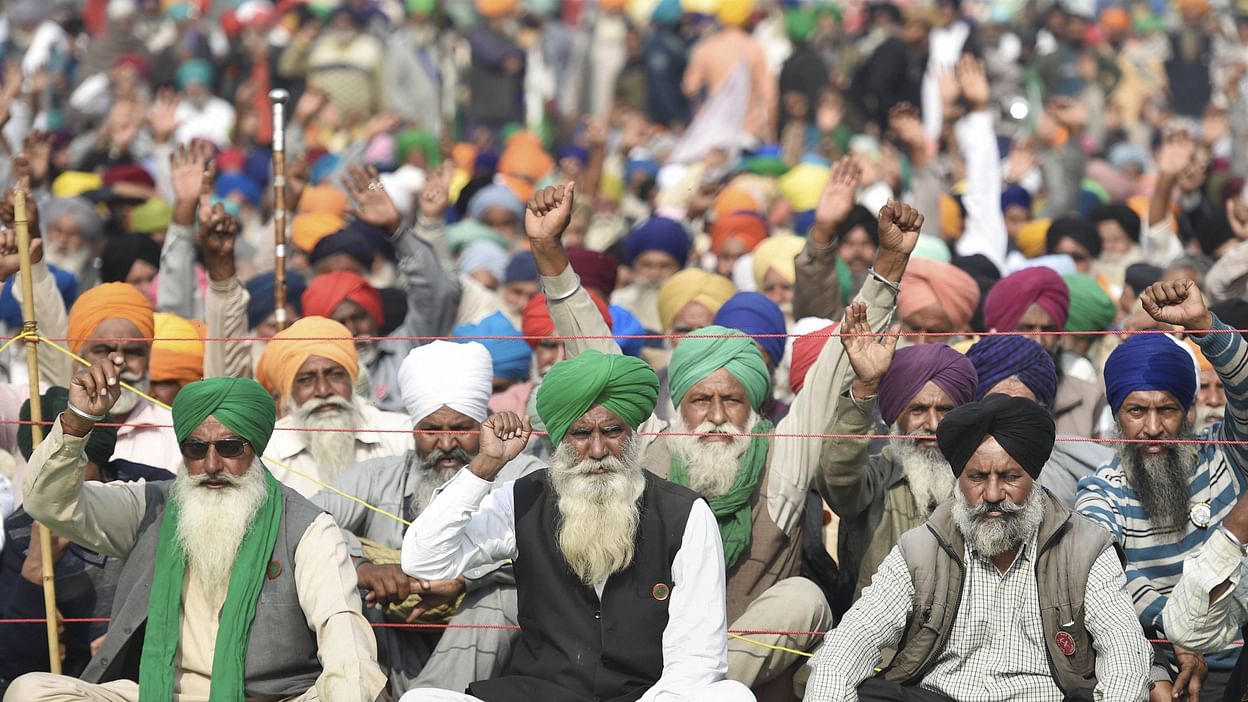
At Singhur and Ghazipur borders, I noticed there were so many women and teenagers among the protesting farmers. There were very elderly farmers in their eighties and seventies with their grandchildren. I have never seen any protest like this anywhere in the world.

The resilience of the farmers is amazing. Each one is doing something there for each other. The bonhomie and spirit to call attention to the problems in agriculture are striking.

What you are saying is what Punjabi culture stands for. Just read any of the Punjabi scriptures. It is all about sharing and caring. It is not surprising to those who have seen Punjabis how they live their lives.

Punjab’s culture is agriculture. This is what most of us have not understood. Look at the protest sites. They are so supportive and helpful to each other. There are men and women cooking for thousands, they have even set up a library for those who want to read, there are scores of volunteers cleaning up, organising the protest, distributing blankets and clothes and doing everything to keep the protest going.  Even those who are coming for the protest from the villages do not come empty-handed. They bring something to distribute as they know what the suffering is all about. Punjabis all over the world are supporting the protest.

We probably missed reading their inherent strength. Nobody believed that a protest could carry on like this for so long.

Source: The Quint

Government spokespersons have been saying that it is only the farmers from Punjab and Haryana who are protesting.

What is wrong with Punjab and Haryana farmers protesting? These farmers know that the Minimum Support Price (MSP) will ultimately go away and the mandis will become redundant. In any case, to say that rich farmers from Punjab are protesting is also wrong.

Farm households in Punjab carry a debt of Rs 1–lakh crore. A house to house survey by three public sector universities – Punjab Agriculture University, Ludhiana; Punjabi University, Patiala and Guru Nanak Dev University, Amritsar – had shown that between 2000 and 2015 more than 16,600 farmers and farm workers had committed suicide. Every third farmer in Punjab is below the poverty line. Therefore to say this is a protest by rich farmers is awfully wrong.

To the question of why farmers in other parts of the country are not protesting, the answer is that majority of India’s farmers have never received MSP. Only 6% of farmers get MSP in India, and the remaining 94% are dependent on markets. These farmers do not even know what they have been missing all these years.

Even Sharad Pawar had acknowledged this when as agriculture minister, he had told parliament that  71 percent of Indian farmers do not know what is MSP, they don’t understand the concept behind MSP.

Now, farmers are slowly getting aware.

What are the implications of this agitation?

It has an impact not just on India but has tremendous international implications. Once Indian farmers provide a model, the rest of the world also would like to follow that. Therefore it has huge implications.

Farmers in the United States and Europe are also facing a severe agrarian crisis. They are being driven out of agriculture despite getting huge subsidies. This is happening in rich countries that had adopted market-oriented agricultural reforms some six to seven decades back. Europe provides 100 billion dollars in subsidies out of which 50 percent goes as direct income support.  Despite this, one farmer quits agriculture every minute in Europe. In the US, since the seventies, 93 percent of the dairy farms have closed down. But milk production has gone up as the corporates have got into dairying and set up mega-dairy farms.

But after the UK dismantled the Milk Marketing Board, which regulated prices, prices crashed. Today, there are just about 8,000 dairy farms left. Dairy farmers are struggling to cover up their cost of production. What does this tell you? It tells you that market-oriented agriculture invariably comes at the cost of small farmers.

The crisis has been there for several years. I remember a tragic farm suicide in America, I can’t ever forget that. About 13 years ago, one dairy farmer first shot each of his 51 cows and then he shot himself. This shows the distress that prevailed.

If markets are so good why would the US provide 62,000 dollars as a subsidy to farmers? Why should Europe provide such huge subsidies? Take the case of the dairy sector in the United Kingdom. In the nineties, there were about 32,000 dairy farms in the UK. But after the UK dismantled the Milk Marketing Board, which regulated prices, prices crashed. Today, there are just about 8,000 dairy farms left. Dairy farmers are struggling to cover up their cost of production. What does this tell you? It tells you that market-oriented agriculture invariably comes at the cost of small farmers. Remember, when Richard Nixon was the US President, and this was in the early seventies, his agriculture secretary had said: “Get big or get out.”

Even the Director-General of  Washington DC-based International Food Policy Research Institute has suggested that India should follow a policy of: “Move up or move out.”

But the bigger question is if we move a large section of small farmers out of agriculture what do we do with 50 percent of our population engaged in agriculture where 86 percent of our farmers own less than five acres? Why do we have to abandon them and not instead make agriculture sustainable? Why are we copying failed policies from the west?

At a time when we have jobless growth, why do we want jobless agriculture? Why do we entrust corporate to produce food when our farmers are capable of doing it?

You mean to say market-oriented agriculture has failed to prop up farm incomes.

Well, policymakers are saying that these reforms will help increase farm incomes. It will increase the bargaining power of small farmers, and thereby help enhance their incomes. But a study by the London School of Economics has shown that similar reforms in Kenya, where farmers have small holdings, have failed and pushed farmers deeper into crisis.

I remember a report of the United Nations Conference on Trade and Development (UNCTAD) which had concluded that between the mid-eighties and mid-2000, a period of 20 years, the output price globally had remained static if you adjust for inflation. Rich countries compensated farmers with subsidies. Poor countries had no money for subsidies.

Because the intelligentsia, the academia and the media failed to stand for farmers, they realise they have to stand for themselves.

Another study by the Organisation for Economic Co-operation and Development (OECD) along with ICRIER had estimated that said that between 2000 and 2016-17, Indian farmers lost Rs. 45 lakh crores. That meant it every year farmers lost approximately Rs 2.64 lakh crore. was lost! It happened at a time when 94% of farmers were dependent on markets.

Globally too farmers have suffered the markets. Farmers all over the world are hurt by the volatility of the market.

Take for instance the coffee industry. It has a turnover of 102 billion dollars. There are around 50 to 60 million coffee farmers in the world. For the last 13 years, the prices of coffee beans have been depressed. As a result, a majority of these coffee farmers have an income level of less than 1.9 dollars a day which falls within the acute poverty line according to the United Nations.

Look at cocoa. The confectionery industry is worth 210 million dollars. The cocoa farmers get only 1.3 dollars a day which is less than the price of an average chocolate bar that you buy. This is at a time when bulk of cocoa and coffee were traded on the commodity exchanges. Imagine if these farmers had MSP. Wouldn’t their livelihoods would have been much better?

Alright. But what are the agitating Indian farmers so angry about?

Farmers are angry over the neglect and injustice they have faced over the past few decades. They fear that these farm laws have been designed for the corporate, not for farmers.  The compound anger of all these years is perhaps what is coming out.

Look at their plight. There are reports every now and then of farmers throwing tomato, potato and onions on the streets. See what they get for their produce. In Madhya Pradesh, farmers got one rupee for a kilo of bhindi while in the urban market it was selling for Rs. 40 a kilo. Look at the brutality of the markets.

We should we aiming at reforms that provide more income in the hands of small farmers, making agriculture sustainable and economically-viable thereby achieving the Prime Minister’s vision of Sabka Saath Sabka Vikas. 

Economic Survey 2016 told us that the average income of a farming family in 17 states of India is only Rs. 20,000 a year, which means less than Rs. 1,700 a month.  Have we ever pondered how are these farming families surviving? Hasn’t society at large failed to stand up for the farmers? Did we ever call for economic justice for farmers?

Because the intelligentsia, the academia and the media failed to stand for farmers, they realise they have to stand for themselves. After all, farmers also have families to look after. They have to take care of the education and health expenses of their family. They also want to live a better life.

All that the Farmers are essentially asking for is an assured price for their crops. They want MSP as a legal right for 23 crops for which MSP is announced every year. Farmers too need an economically viable system to survive.

What kind of reforms do you envisage?

Instead of borrowing from abroad, our emphasis should be on creating our own models, banking on our own strengths, our own needs and requirements. We should we aiming at reforms that provide more income in the hands of small farmers, making agriculture sustainable and economically-viable thereby achieving the Prime Minister’s vision of Sabka Saath Sabka Vikas.

First, make MSP a legal right for farmers. The delivery of MSP has remained confined to primarily two crops – wheat and paddy – and that too predominantly in Punjab and Haryana, where farm incomes are relatively higher than the rest of the country. It is time to extend this to the entire country, and to all the 23 crops for which MSP is announced every year. This means basically upping the benchmark prices to ensure that no trading takes place below MSP. This means the private trade too will need to make purchases at MSP or above. It does not mean that the government will have to procure everything.

Secondly, to ensure smooth marketing, the network of APMC regulated markets needs to be expanded to reach every nook and crook. Against the 7,000-odd PMC mandis that exist today, we need a network of 42,000 APMC mandis if a mandi has to be provided in a radius of five kms. We also know that there are problems with the working of APMC mandis. The mandi structure needs to be reformed, not thrown away. Regulated markets are absolutely essential for price discovery.

And finally, we need an alternative system that can provide more money in the hands of farmers. In America, as per the US Department of Agriculture, farmers share in every food dollar a consumer spends is only 8 percent. Why emulate a system that aggravates agrarian distress? What we need is to learn from our own Amul dairy cooperative design that provides at least 70 percent share of the end consumer price to farmers. We need to launch a nationwide programme to replicate the Amul model to vegetables, fruits and pulses.

Source: At a time when we have jobless growth, why do we want jobless agriculture? The Leaflet. Jan 21, 2021 https://www.theleaflet.in/at-a-time-when-we-have-jobless-growth-why-do-we-want-jobless-agriculture-devinder-sharma/?fbclid=IwAR2L2c3BVX1RN_34lwcwsPTZPWncTT6UTTOpTF9swXAarljiw51ZwHJb_uQ#


READ MORE - 'At a time when we have jobless growth, why do we want jobless agriculture?' -- My interview

Saturday, January 2, 2021

MSP provides farmers with a price assurance -- My Interview.


A day ahead of another round of talks between farmers and the Union government, agriculture expert Devinder Sharma tells The Indian Express how the current protests are being watched across the globe and how India can rebuild its agri economy by using assure price.

What is your take on the three farm laws that the Centre terms as a great reform in the field of agriculture?

These market-driven agricultural reforms have been prevalent in the United States for more than 6 to 7 decades. If the markets were so good I see no reason why American farmers should be saddled with a bankruptcy of USD 425 billion this year. The farm incomes have been on a steep decline, if adjusted for inflation, since the 1960s.

No wonder, despite massive farm subsidy support, the rate of suicide in rural America is 45 per cent higher than the urban areas. The point I want to emphasise is that the so-called ‘market efficiency’ in the US is actually built on massive federal support being provided year after year.

Not many people know that the US comes with a Farm Bill every five years. It makes budgetary provisions for subsidy and investment in agriculture for the next five years. For instance, the Farm Bill 2018, expiring in 2023, makes a provision for providing USD 867 billion in food and agriculture support for the next ten years. And yet, despite these Farm Bills, American farmers have been faced with a 50 per cent drop in net farm incomes since 2013 except for this year when an additional subsidy of USD 32 billion was given for the farm sector.

What about other rich countries?

Before every WTO Ministerial Conference the massive agricultural subsidies being provided by the rich countries become a bone of contention. The richest trading block — the Organisation for Economic Cooperation and Development (OECD) — continues too provide mammoth farm subsidies. Despite opposition from the developing countries, these rich countries have not done away with these subsidies because that is what sustains their agriculture, and not markets.

In 2018, OECD countries provided a subsidy support of USD 246 billion, with European countries alone providing USD 100 billion. On the other hand, China has emerged as the biggest farm subsidiser, providing USD 212 billion in 2016.

If all the ‘green box’ subsidies, which in WTO parlance means non-trade distorting subsidies, are withdrawn, a 2007 study had shown that agricultural exports from US, Canada and European Union would drop by 40 per cent. In other words, even the so-called competitiveness of farm exports of the developed countries hinges on subsidy support.

Even the Director General of the Washington-based International Food Policy Research Institute had made a similar policy prescription for India, suggesting: “Move up or move out”. It only tells us that the market reforms are built on moving small and marginal farmers out of agriculture. Considering that 86 per cent India farmers are small, owning less than 5 acres, what India needs are measures to make small farming viable.

Let me illustrate. Since the 1970s, 93 per cent of US small dairy farms have closed down, with 50 per cent or almost 35,000 licensed dairies pulling down the shutter since 2003 because milk prices declined, failing to even recover the cost of production. But instead of milk production declining, it has in fact gone up. Small dairy farmers were out, and corporates took over, setting up mega-dairies. The same is happening in the UK and Europe. The shape of things to come is already before us.

What support are farmers getting from our government compared to the US or other developed nations?

On an average, an American farmer gets a subsidy of USD 62,000 every year. Compared with this, an Indian farmer gets a paltry USD 282. If you take a look at the Producer Subsidy Equivalent (PSE) index, it gives you a clear idea as to how the rich country farmers continue to be subsidised. Besides, as I said earlier, there are numerous other ways farming is protected in developed countries, and farmers receive a number of other privileges too. For instance, Swiss farmers receive family allowance and also get rebate on petrol and diesel costs.

In India, we are made to believe that farmers receive huge subsidies and therefore have no reason to complain. This is a fallacy. Except for direct income support of Rs 6,000 per year by way of PM Kisan scheme, what Indian farmers receive are indirect subsidies on fertiliser, pesticides, and other inputs. These are in reality subsidies to the manufacturers, and also to the consumers by helping in keeping food prices low. Indian farmers need a safety net rather than making Indian agriculture completely dependent on the market.

Even when it comes to farm loan waivers, there is a clear-cut bias that prevails. While economists remain quiet when it comes to massive write-offs of bad debts of corporates by nationalised banks, which totals Rs 7.9-lakh crore between 2014 and 2019, a lot of hue and cry is made when bad farm loans are waived. Strangely, a former Chief Economic Advisor had even said that writing-off corporate NPAs leads to economic growth. But when farm loans are waived, they are blamed for credit indiscipline and upsetting the national balance sheet. That clearly shows we have socialism for corporates and capitalism for farmers.

Punjab’s farmers are at the forefront of farmers’ protests. Many have called Punjab’s farmers a pampered lot, claiming they have been enjoying huge subsidies. How do you see this?

Punjab is the food bowl of the country. Punjab’s farmers have helped make food security possible at an affordable price in India. They worked very hard to reach a productivity level 5.1 tonnes and 6.6 tonnes per hectare in wheat and paddy, respectively, which is among the top in the world. Therefore to call them lazy or pampered is a reflection of the contempt that the elite carries towards farmers.

It is wrong to treat farmers as a burden. Farmers have in fact subsidised the nation by keeping farm prices low. They have produced a record harvest year after year despite being denied the rightful price. Otherwise, I see no reason why Punjab, with such high productivity levels, should be a hotbed of farm suicides. A study had shown that 16,600 farmers and farm labourers committed suicide between 2000 and 2015. Every third farmer in Punjab is below poverty line.

If Punjab’s farmers are indeed pampered and enjoying huge subsidies, then why do 97 per cent of rural households continue to be in debt? That’s a question nobody wants to answer. We have deliberately kept agriculture impoverished over the decades by keeping farm incomes low.

When farmers are placing a demand for rightful income by the way of making MSP legal, what does this mean actually? And why is it being said that it will put an additional burden of Rs 17 lakh crores on the government exchequer?

MSP in reality is a saviour. It provides farmers with price assurance. Like you and me, they too want an assured income. What is wrong in that? Farmers are asking for making MSP a legal right for all the 23 crops for which MSP is announced every year. Basically what they are asking is to raise the benchmark on which trading takes place. This doesn’t mean that everything has to be procured by the government. Private trade too should purchase at MSP. But unfortunately, a fear psychosis is being created by saying that the government will need an additional Rs 17 lakh crore to procure everything.

Take the example of Kerala. It has fixed a floor price of 20 per cent above the production cost for 16 vegetables. It has also made a provision of Rs 35 crore for the purpose but hasn’t yet utilised a single penny out of it. The reason is simple. Market prices so far are prevailing higher than the floor price announced. The government will only enter when prices fall below the floor price.

This is exactly what will happen when MSP is legalised for 23 crops. It is only when prices fall below MSP that the government will be expected to intervene.

Government says that the three Acts will give real freedom to the farmer but farmers are not to buy this. Why?

The real ‘azadi’ for farmers will be when he knows that wherever and to whomsoever he sells his produce to, he knows that at least he will get a price equivalent to MSP. To make this possible, the challenge is to expand the existing network of 7,000 APMC regulated mandis to cover the entire country. We will need 42,000 regulated mandis if a mandi has to be provided in a five km radius.

Farmers need regulated markets closer to the farm. That will enable him to avoid distress sale and to seek real ‘price discovery’.

In the paddy marketing season that ended, unscrupulous traders from Bihar transported more than 50 lakh tonnes to Punjab. This was because in the absence of regulated markets and the failure of state to procure at MSP. Bihar farmers were forced to sell at Rs 1,000 to 1,200 per quintal in the local markets whereas in Punjab farmers at least got the MSP of Rs 1,888 per quintal. This only shows that if Bihar had not thrown away the APMC Act in 2006 and had instead set up a network of mandis as in Punjab, and also provided farmers with MSP, farm incomes would have been much higher.

Take another example of maize, where prices have ruled between Rs 700 and Rs 1,200 per quintal across the country against the procurement price of Rs 1,850 per quintal. This clearly shows that MSP is the real price discovery. In any case, let’s not forget that an OECD-ICRIER study had shown that in the 16 years period, between 2000 and 2016-17, India farmers suffered a loss of Rs 45-lakh crore of being denied the rightful price. Economic Survey 2016 had reported average farm incomes in 17 states of India, which means roughly half the country, to be only Rs 20,000 a year. This is at a time when only 6 per cent farmers were getting MSP and the remaining 94 per cent were dependent on markets.

The time has therefore come to ensure that trading does not take place below MSP. After all, how long can farmers suffer the consequences of distress sales and the resulting loss to their livelihoods?

This has to change, and change for the better. Agriculture is surely in dire need of reforms. But that does not mean borrowing blindly market-driven ideas from US/Europe where markets have failed to prop up farm incomes. What India needs is to build on its own requirements and capitalise on its strengths. To come out with a policy design that ensures an assured income to farmers by way of an assured price coupled with direct income support. In addition, there is a need to replicate the Amul dairy cooperative model for vegetables, fruits, pulses and oilseeds.

How is the agitation being viewed across the globe?

The iconic farmer movement is being closely watched across the globe. Even in developed countries, farmers are keen to know how India expands on the mechanism of MSP as a policy instrument to provide an assured income in the hands of farmers.

Source: 'Farmers need assured income, even rich nations pump massive subsidies in agriculture': Agri Expert Devinder Sharma. Indian Express. Dec 30, 2020. 

https://indianexpress.com/article/cities/chandigarh/farmers-need-assured-income-even-rich-nations-pump-massive-subsidy-into-agriculture-agri-expert-devinder-sharma-7125360/ 

READ MORE - MSP provides farmers with a price assurance -- My Interview.

Monday, February 10, 2020

'Thalieconomics' gets it wrong


This is where the problem lies. The 27-page long chapter on the economics of a plate of food in India, which according to the Economic Survey 2020 is an attempt to quantify what a common person pays for a thali across India, only leads us to one conclusion: the cost of producing cheap food on the plate is being borne entirely by farmers.

“What better way to make economics relate to the common person than something that s(he) encounters every day – a plate of food?”says the introduction to the chapter. Sounds interesting, isn’t it? After all, Thalieconomics, as the chapter is titled, makes an effort to show case to the urban educated how the economic policies have been able to effectively keep food inflation under control thereby keeping their household budget within means. But in the bargain, it very cleverly hides the misery that millions of farmers who produce that cheaper food are living with.  

Only four years back, the Economic Survey 2016 had pointed to the miserable condition of farmers. Accordingly, the average farm income in 17 States of India or roughly half the country was a meagre Rs 20,000 a year. In other words it means that a farm family was somehow surviving on less than Rs 1,700 a month, which I have often argued is not even enough to rear a cow. This in reality is the hidden cost of producing cheaper food. To keep the consumers visibly happy, the entire burden has been very conveniently passed on to farmers. In reality, it is the producer who is actually subsidising the consumer, a fact that policy makers simply want to ignore.

But before we dwell any further, let’s first look at what Thalieconomics intends to convey. Trying to address the questions that often crops up at ‘dinner table conversations in Lutyens Delhi or in roadside Dhaba in the hinterland’ the Economic Survey 2020 goes into an elaborate statistical exercise to bring out how over the years the vegetarian thali as well as the non-vegetarian thali has become easily affordable. It uses the National Institute for Nutrition (NIN) dietary guidelines and data from Consumer Price Index (CPI) for Industrial Workers from around 80 centres across the country to construct the average price of a vegetarian and non-vegetarian thali. Assuming that an average household of five consumes two thalis a day, Thalieconomics tells us that while an average household saved Rs 10,887 per year on vegetarian meals and for the non-vegetarians the gain was Rs 11,787 per year.

The gain is not as big as the Economic Survey 2020 wants to convey. Even after such a meticulous statistical exercise – which even goes to the extent of calculating the cost of ingredients like spices that are used in preparation of sabzi, dal and non-vegetarian items -- what comes out is that post 2015-16 the average gain is merely Rs 3 per thali. To make it look big, this figure was multiplied with the average number of persons in a household and the number of days in a year to present a respectable annual saving figure for a family. Based on the average yearly increase in salary of an industrial worker, it tells us that the affordability of a vegetarian thali between 2006-07 and 2019-20 has increased by 26 per cent and the non-vegetarian thali by 18 per cent.

Now where the Economic Survey 2020 has gone wrong is to attribute the increasing affordability of a thali to ‘many economic reforms measures introduced since 2014-15 to enhance the productivity of the agricultural sector as well as the efficiency and effectiveness of agricultural markets for better and more transparent price discovery’. If this was true, I see no reason why farmer protests across the country should be growing. In 2014, the National Crime Record Bureau (NCRB) had recorded 687 farm protests; increasing to 2,683 in 2015, and further surged to 4,837 in 2016. Just in two years, farmer protests had grown by seven times. Even thereafter, although no official data is available, the number and intensity of farmers’ protests have only multiplied. Remember the peaceful long march in Maharashtra? Remember recurring events of farmers dumping tomato, potato and onion on the streets?

If agricultural markets had performed efficiently leading to a better price realisation, the Chief Economic Advisor (CEA), under whose guidance the Economic Survey is prepared, should explain how and why farm incomes have been on a downhill path crashing down to a 14-year low in 2018. Consumer food price index the same year had come down to minus 2.65 per cent. When food prices decline, the policy makers rejoice but it is the farmers who suffer the devastating consequences of a drastic slump in incomes. After all, they too have families to support. They too have to meet the household expenses, maintain their livelihoods and let’s not forget they have the same kind of aspirations as the people in the cities. But denying them a rightful price for their produce and that too year after year is what has led to a deepening agrarian crisis. As I have always maintained, when a farmer undertakes crop cultivation what he does not realise is that he is actually cultivating losses. 

Instead of a theoretical construction of the economics of a thali, Economic Survey would have done a greater justice by focusing on the terrible agrarian crisis that prevails. It could have at least made an attempt to understand how farmers have been actually subsidising the national economy. An OECD-ICRIER study for the period 2000-01 to 2016-17 has shown that while farmers got low prices, suffering a cumulative loss of Rs 45-lakh crores in 16 years, the consumers gained by paying 25 per cent less for food. While farmers incurred a loss of about Rs 2.65-lakh crore every year to ensure that urban consumers could afford a cheaper thali, the reason why agriculture is in a severe crisis becomes crystal clear.

To keep food prices low, farmers are actually being penalised to grow food. It is high time appropriate income support policies are put in place to compensate farmers for the low commodity prices. #  

"Thalieconomics' gets it wrong. The Tribune. Feb 8, 2020
READ MORE - 'Thalieconomics' gets it wrong