Showing posts with label Indian farmers. Show all posts

Friday, November 26, 2021

To rebuild agriculture, make MSP a legal right for farmers.


Pic courtesy: Reuters

After the sudden withdrawal of the three contentious farm laws last week, the debate has now shifted to whether there is a need to provide farmers with an assured Minimum Support Price (MSP) or leave them to face the vagaries of the markets. While protesting farmers are demanding MSP to be made a legal right, fears are being expressed that any such move will lead to an economic crisis.

In the heated deliberations that have followed in the media, what is lost is the need to come to grips with the severity of the continuing farm distress that has prevailed over the past few decades. Looking beyond statistical figures, what is not being appreciated is that these are not just numbers; it is human lives that we are talking about. With or without the proposed farm laws (which have now been withdrawn) the challenge is how to pull these millions out of abject poverty and hunger. Take for instance the report of the Economic Survey 2016 which had shown the average annual income of a farmer in 17 States of India, which means roughly half the country, at a paltry Rs 20,000. In other words, farmers in half the country were somehow surviving on less than Rs 1,700 a month.

More recently, the report of the Situational Assessment Survey 2019, released in September, points to a severely distressed agriculture. Accordingly, the average income of a farmer from crop cultivation alone (not adding non-farm income) comes to a meager Rs 27 per day. This is at a time when the country harvests a record 308 million tonnes of foodgrains and another 325 million tonnes of fruits and vegetables. According to the FAO, in a report released in Mar 2021, the gross value of food production in India stands at $ 400,722, 025 million. With farmers producing so much of economic wealth for the country, what remains unexplained is why the annadata is living in misery.  

Using the outdated market principles, mainline economists would shift the blame on low crop productivity, and the absence of market dynamics that does not allow for price discovery. Let’s first take a look at the productivity dimension. In Punjab, the food bowl of the country, the total crop productivity (of wheat and paddy crop rotation in a year) exceeds 11 tonnes per hectare, which is among the highest in the world. And yet, Punjab has turned into a hotbed of farmer suicides. Every third farmer in Punjab is living below the poverty line, and had a record 16,600 farmers and farm workers committing suicide in the 15 year period, between 2000 and 2015. This only shows that despite high productivity levels, farm crisis persists.   

If you are still not convinced, let’s look at America. At the risk of sounding repetitive, it needs to be known that despite high productivity levels across crops and regions, and the prevalence of free markets in agriculture for over a century, US farming is fast heading towards extinction. In 2020 alone, farmers were saddled with a bankruptcy of $ 425 billion, and the median farm income had remained in the negative for more than a decade. The rate of suicide in rural America is 45 per cent higher than urban centres. A report in Down to Earth magazine shows that almost 40 per cent of the farm income is coming from federal subsidies.

In these trying circumstances, when markets have failed everywhere to increase farm incomes, the belief that markets would do wonder for Indian agriculture is utterly misplaced. Another argument that I often hear is that given the small landholdings in India (86 per cent holdings are less than 5 acres) farmers will be unable to get a higher price given the lack of bargaining power. Well, if that is so I fail to understand why in Australia, where the average arm size exceeds 12,000 acres, have 25 per cent farms closed down in the past 30 years. The rate of suicide among male farmers in Australia is twice that of other sections of the society. In France, in early March, farmers had hung suicide dolls on trees outside Parliament to draw attention to the severe agrarian distress that farmers were faced with.

Given the distressing experience of markets failing to buttress farming in the developed countries, the demand for making MSP a legal right for Indian farmers makes great economic sense. What the farmers are asking is not for the government to purchase the entire produce, but to ensure that no trading takes below the MSP announced. This is what even the Commission for Agricultural Costs and Prices (CACP) had suggested in one of its recent policy reports. It is not a welfare measure as some economists are suggesting, but is the real reform that agriculture is crying for. Studies have shown that the additional economic burden will not exceed Rs 1.5-lakh crore to Rs 2.5-lakh crore per year. But more importantly, the surge it will provide to country’s economy is something that has not been talked about.  

Considering that nearly 50 per cent of the workforce is employed in agriculture, a vibrant agriculture will certainly lead to higher economic growth. Since only six per cent farmers get the benefit of MSP, and remaining 94 per cent farmers are dependent on markets, making it obligatory for the trade to buy at the price announced will mean higher returns for the farmers. If the 7th Pay Commission, which benefited the government employees, could be seen as a booster dose for the economy, higher income in the hands of the farming population will create a huge rural demand, thereby acting as a rocket dose for the economy. With more purchasing power, the industry would also stand to benefit. At the same time, a guaranteed price to farmers will help bridge the growing inequality that the country is witnessing. 

A guaranteed price has the potential to provide stable income for farmers, and help restore dignity in farming. That’s the freedom Indian farmers desperately need. Reducing the pressure to create more employment opportunities in the cities, making MSP a legal right is the only pathway to rebuild agriculture and thereby achieve the Prime Minister’s vision of Sabka Saath Sabka Vikas

Source: Farmers Protest Anniversary: Make MSP a legal right to rebuild agriculture, writes Devinder Sharma. Financial Express. Nov 26, 2021. https://www.financialexpress.com/india-news/farmers-protest-anniversary-make-msp-a-legal-right-to-rebuild-agriculture-writes-devinder-sharma/2376420/

READ MORE - To rebuild agriculture, make MSP a legal right for farmers.

Sunday, October 10, 2021

How twisted TV debates are vilifying farmers


Pic courtesy: agronicfood.com

As the Supreme Court takes suo moto notice, a comparatively longer horrific video clip that has surfaced clearly shows a Union Minister’s convoy mowing down peaceful protesters at Lakhimpur Kheri in Uttar Pradesh. While protesting farmers were hit from behind, killing four and leaving several injured, another four died in the violence that followed. 

While this ghastly incident has caused outrage across the country, it has also exposed the diabolic face of the society wherein all efforts are being made by a dominant section of the educated (and the media) to shift the blame on the farmers for stone pelting leading the drivers of the cars to lose balance and hit them. If the videos had not appeared, this biased thinking would have certainly gained acceptance or at least created confusion among a large section of the general public. In fact, the ease at which such kinds of insinuation are being casually thrown at farmers brings out the discrimination, contempt and bitterness that prevail against the farming community. 

Call it rural urban divide or a digital divide or reflections of the growing disconnect with the farming population at large, but an underlying feeling of bitterness and indignation is quite visible. In any conversation, you just have to scratch a bit and the bitterness they harbour spills out. Farmers are considered to be a burden on the society, living on freebies and subsidies. “Why are farmers allowed to protest in cities, obstructing traffic and causing inconvenience to people,” I am often asked, with some going to the extent of even saying that farmers live on the taxes the middle-class pays.   

Often in response to my tweets wherein I share reports of farmers committing suicide, a few trolls go to the extent of retorting: “These people in any case should have died. They are a scum of the society.” While it renders me speechless, at the same time it shows the hard feelings and enmity that prevails. Take the case of protesting farmers at the borders of New Delhi, besides being hurled with choices abuses, an effort has also been made to brand the farmers movement as a handiwork of khalistanis, 'terrorists' and ‘anti-national’ forces. As if this is not enough, the more you watch TV debates, the more you get dismayed. Most anchors and panelists, who probably cannot distinguish between wheat and barley plant, are the ones who will tell you about the virtues of the three central laws that the farmers oppose. 

The hostility that prevails is the outcome of a hugely discriminatory narrative that has been created. It actually stems from an economic design that relies on sacrificing agriculture for the sake of the industry. It relies on keeping food prices low so as to keep economic reforms viable, to force people from the rural areas to increasingly migrate to cities which are in need of cheap labour. For at least four decades, farm incomes have either remained static or declined. This has kept food prices low for the urban population, and has also kept inflation under control. 

The latest Situational Assessment Survey 2019 has clearly shown that farm income from crop cultivation alone has come down since the time the last survey was held in 2013. The average income of a farmer has been computed at Rs 27 per day, which I find is less than what a lactating cow can provide. This is primarily because farm gate prices have been deliberately kept low. I have often explained how the wheat price has increased by 19 times in 45 years period, between 1970 and 2015, while the basic pay and DA of government employees had gone up by 120 to 150 times, and that of college and university lecturers/professors by 150 to 170 times in the same period. 

For the same reasons, Economic Survey 2016 told us that the average income of farmers in 17 states of India, which means roughly half the country, stood at a paltry Rs 20,000 a year. In other words, farming families were living on less than Rs 1,700 a month in half the country. As expected, there was no outrage when I talked of the miserable conditions farmers were living under. Interestingly, government officers get almost Rs 20,000 a year simply as washing allowance. Each of the 11-lakh non-gazetted Railway employees will get a bonus of Rs 17, 171 this year, which is almost equivalent to what farmers earn annually in half the country. 

Yet, an impression is created that farmers lead a comfortable life. They don’t pay taxes. In reality, despite their meager incomes, farmers pay indirect taxes on everything they buy. Even when a farm labour buys chappals for Rs 30 a pair, they have to pay a GST. And let’s not forget, farmers don’t get an inflation-linked DA. Even the MSP that the government announces is often less than the prevailing rate of inflation which means even the cost of production is not covered. More so, a Producer Subsidy Equivalent index that the Organisation for Economic Cooperation and Development (OECD) prepared for the past two decades, Indian farmers have been negatively taxed all these years.  

But when some State governments waive farm loans, hell breaks loose on the media. A number of TV shows called for waiving the waiver. But when did you watch a TV show on corporate bad loans, which are several times more? While roughly Rs 2-lakh crore of outstanding farm loans have been waived in past five years, more than Rs 10-lakh crore of corporate bad loans have been written-off in the past eight years. So much so that a former CEA had gone to the extent of saying that writing-off corporate bad loans leads to economic growth.  

This is how seeds of discrimination are deliberately sown against farmers. The contempt and resentment that a large section of the middle-class carries against farmers is borne out of misinformation and twisted facts that are routinely thrown at them. This flawed impression needs to be corrected, a role that the government, the academia, the civil society and the media must undertake. Farmers are not a burden, but in reality are the ones who continue to carry alone the burden of subsidizing the nation. #

Source: How twisted TV debates are vilifying farmers. Bizz Buzz. Oct 8, 2021. 
https://www.bizzbuzz.news/economy/how-twisted-tv-debates-are-vilifying-farmers-1040214?fbclid=IwAR0RBuVpmCCzlCxTgxvFFiXqi1Z8yFsfcAtI3AaGcx-O4ksFwcpM3CRIJXk
READ MORE - How twisted TV debates are vilifying farmers

Friday, August 21, 2020

Indian agriculture can't be sacrificed at the altar of global trade


India is the world's largest milk producer

For decades, American dairy farms have been hit by low prices. While the small dairy farms have increasingly pulled down shutter, the continued expansion of corporate farming resulted in surplus milk production leading to a price fall. In the past six years, milk prices have seen a 40 per cent drop on an average.

So much so that in 2016, more than 43 million gallons of milk was thrown away by farmers. This huge milk waste could have filled 66 Olympic sized swimming pools, says an estimate. Regardless, corporate milk production continued to soar while another 3,000 dairy farms closed down in 2019 says a report of the US Department of Agriculture (USDA). This necessitated the US President Donald Trump to look for export markets.

President Trump blamed Canada for adopting protectionist policies. He was particularly harsh about the need for Canada to pull down the import tariffs on dairy products. This became a contentious issue while the US was renegotiating the NAFTA treaty with what is now called as US-Mexico-Canada Agreement (USMCA). Canada relented, made a limited concession, allowing the US a small opening -- 3.6 per cent access to its market. In addition, it also allowed entry of infant formula, cheese, cream, butter and other products.

Mexico too allowed the import of certain US cheeses but otherwise remained firm on not opening up any further. Meanwhile, Kenya is under a lot of pressure to allow US dairy products under the proposed US-Kenya FTA under negotiation.

It is now the turn of India. To fix the problem created by swelling corporate milk output, India too is under pressure to open its dairy sector to American imports. Just like accusing Canada of protectionist policies, President Trump has repeatedly called India “tariff King” and has often expressed his dissatisfaction by saying “we’re not treated very well by India”. He had been particularly harsh on the high import tariffs on Harley Davidson motorcycles. India had obliged, and Prime Minister Narendra Modi had personally informed the US President of the duty cut offered.

Since then America has upped the ante, which is quite evident when President Trump announced before departing for India in February: “We are doing a very big trade deal with India. We’ll have it. I don’t know if it will be done before the election, but we’ll have a very big deal with India.”He was referring to the US-India Free Trade Agreement (FTA) which has been under negotiations for quite some time. But in the meanwhile, a “quick trade deal” for an early harvest is almost ready. “We can do an early harvest in terms of 50 to 100 products and services,” Commerce Minister Piyush Goyal had told a virtual meeting of the US-India Business Council.

While a “quick deal” or a bilateral trade agreement does not have to strictly conform to any World Trade Organisation (WTO) obligations, the attack on the Indian agriculture and dairy sectors appears to be on both the fronts. To meet the WTO commitments, India had in June allowed the import of 5-lakh tonnes of maize and 10,000 tonnes of milk and milk products at a lower import duty and that too when farmers cultivating maize and those producing milk were faced with depressed prices. The proposed US-India trade deal too has agriculture and dairy placed high on the agenda with America seeking an increased market access for its highly subsidised farm produce.  

Although 93 per cent of the small dairy farms in America have closed down since the 1970s, the consolidation of big dairy farms in the US in tune with its policy of “get big or get out” has turned it into world’s second largest milk producer. In India, more than 8-10 crore farmers are presently engaged in dairying. Even though a large number of dairy farmers have an average of 2-5 heads of cattle, India is presently the largest milk producer. Over the years, the number of families owning 15-30 cows has been steadily on the rise. Although between 2000 and 2016, as per a study India has seen almost 52 lakh small farmers quitting dairy, the country can’t afford any more closure of dairy farms. Any further opening up should be a matter of concern given the extent of agrarian distress that prevails.

Further, the three Ordinances that form part of the marketing reforms in agriculture too are aimed at commercialisation of Indian agriculture; bring in corporate agriculture and consolidating production in the years to come. These autonomous reforms appear to be in sync with the WTO policy that restricts the product specific support under Minimum Support Price (MSP) keeping it within the agreeable limit of 10 per cent of the total value of production. Already US, Canada, Australia besides a host of other countries have question India for breaching the price support in wheat, rice, cotton, sugar and pulses. Although India has defended the higher MSP under a ‘peace clause’ exemption it enjoys till a permanent solution is arrived at, sooner or later this will be under the chopping block.

In 2010, the then US Trade representative (USTR) had said: “We are exploring every alternative and every enforcement tool available to us to get India to open up their markets on a number of agriculture issues".Four years later, 14 US agricultural commodity export organisations had written to the USTR expressing displeasure at the temporary safeguard accorded to India by way of ‘peace clause’ which would dampen the export possibilities. All eyes are therefore on getting more market access into India.

So far, India has also done remarkably well by refusing to open up to American farm commodity exports, especially soybean, poultry and dairy. Last June, in retaliation India raised tariffs on 28 products, including walnut, almonds, apples, Bengal gram and masur dal. Later, in November, India walked out of Regional Comprehensive Economic Partnership (RCEP) treaty realising the country would be flooded by imports, mostly in agriculture. With Atmanirbhar Bharat being the new vision, agriculture cannot be sacrificed at the altar of trade. #

Farming can't be sacrificed at altar of trade. The Tribune. Aug 21, 2020 https://www.tribuneindia.com/news/comment/farming-cant-be-sacrificed-at-altar-of-trade-129124

READ MORE - Indian agriculture can't be sacrificed at the altar of global trade

Wednesday, November 27, 2019

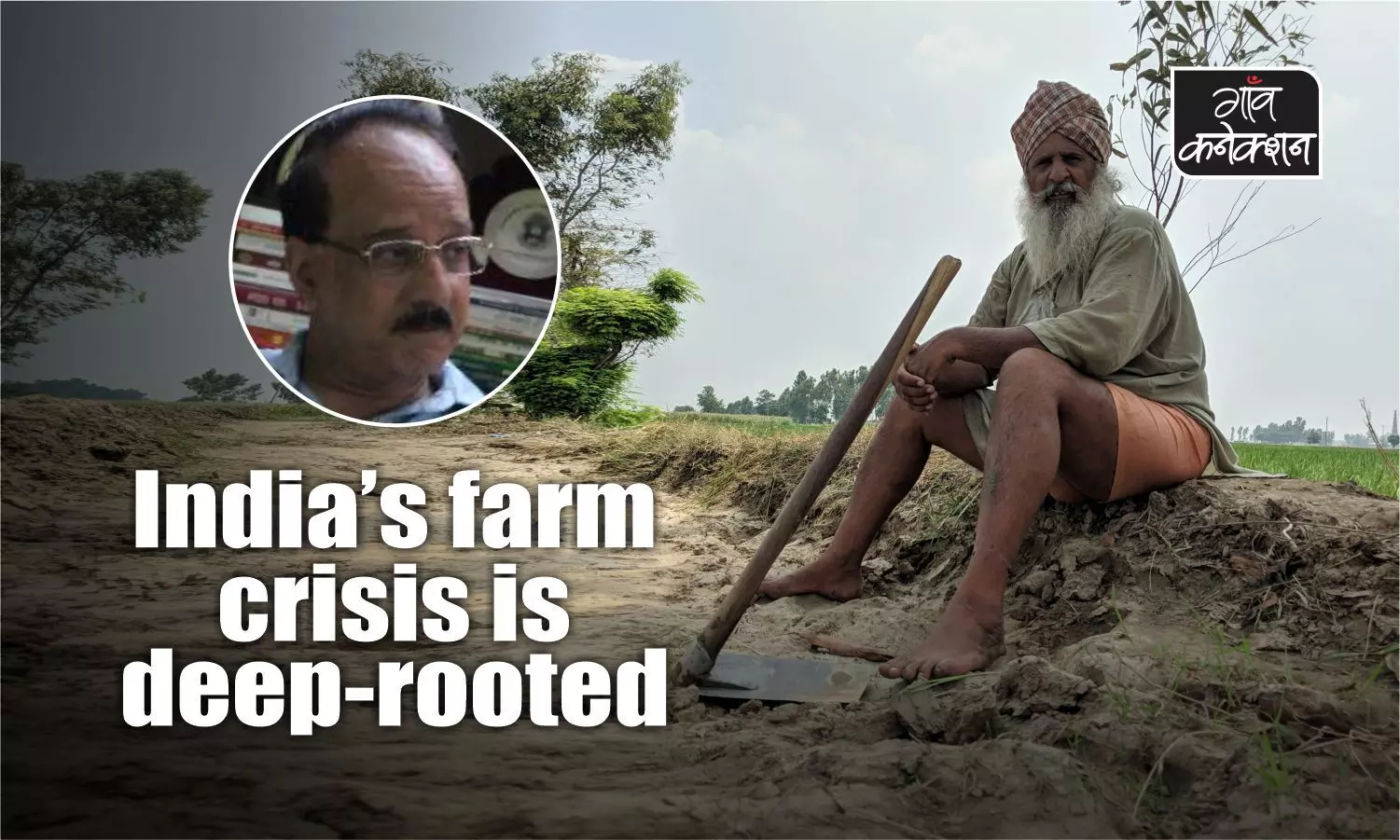
Rs 1,700 not enough to even feed a cow, how can a farmer-family survive on it? -- An interview

Rs 1,700 not enough to even feed a cow, how can a farmer-family survive on it?: Devinder Sharma


With the rising input costs and failure to get a suitable price for the crops, about 50% of farmers are resolving to drop farming. The country is witnessing a drastic fall in the agriculture development rate. Excerpts from the conversation between country's renowned food and export policy expert Devinder Sharma and deputy news editor Gaon Connection, Arvind Shukla concerning agriculture and the farmer crisis.

Be it India or the US, which is the root cause of agriculture and farmers crisis? 

While understanding the worldwide agricultural crisis one can easily discern a fact that everywhere the governments have knowingly kept the farmers at a disadvantage in terms of their income. Farmers did not get a fair price for their crops. This only caused the current crisis.In order to understand the situation, we will have to know about the economic design and cycles of India and other countries. We may compare the agriculture in the 1960s and present times in the US to find that the real income of the farmers has gone down. This is admitted by the Chief Economic Advisor of the US Agricultural Department. In 2018, the average income of the US farmers has fallen not for the first time, but for the sixth year in a row. This is the state of the US which we look up to in matters of technological advancements and policies. India too suffers from a similar crisis. Our governments have deliberately kept farmers away from better incomes to discourage agriculture because it is believed that economic transformation would only be realized upon agriculture's fall. Economists of India and elsewhere are of the opinion that people be pulled to the cities to provide cheaper labour for the industries. Industries require cheap raw materials in order to thrive. This is why the agriculture crisis is existent. The Indian Economic Survey 2016 informs that in 17 states or we can say half of India, farmer family's average annual income is Rs 20,000 which is Rs1,700 per month. Such an amount cannot even support a cow's upkeep. Now imagine how would a farmer family be managing on such a pittance?

A large portion of Indian population is directly engaged with agriculture. Is such a sizeable population then constantly being overlooked? 

The NITI Aayog had, in one of its reports, mentioned that for the past two years the farmers' real income rise was zero. In the five years prior to this, the real income of the farmer families had only increased by a mere half per cent. I know the exact figure to be 0.44%. Let us go back a little further in the past. A research revealed that for the period 1985-2005, the farm-get price (the price which a farmer receives) remained frozen. Keeping in mind the inflation, one would notice that the price which farmers got in 2005 was the same as that in 1995, rising input costs notwithstanding. It means that for over 20 years the prices remained constant. We can understand better with the help of another report. As per a report of Organization for Economic Co-ordination and Indian Council for Research on International Economic Relations (OECD-ICRIER), the farmers suffered a loss of Rs 45 lakh crore during the period 2000-2017 due to not getting a fair price for their produce. So, you can well understand the agriculture crisis where the farmer is made to survive on the same income for the past 40 years. Had the same happened to any of us, we would have long committed suicide or left the business for good. There is a need to view this crisis in terms of income versus expenditure.But instead, such a scenario was created that farming isn't economically viable because of poor yield to the farmer. This notion is false. 

But isn't it generally said that the farmers are disappointed over poor yield? 

I agree that many crops fall short at the national level, but even more important is to know what will be done of a better yield. Is it to be found dumped by the farmers on the roads due to lack of fair pricing or resulting in farmers' suicide? This means that the problems lies elsewhere and we are looking for it somewhere else. Take for example the situation in Punjab. With 98% of the area in Punjab well irrigated, there would hardly be a single field without access to water. Punjab leads the world in paddy and wheat crops output. Better irrigation, better crop output and still Punjab shocks the world by the frequent cases of farmers' suicides. In the past 10 years, more than 10 thousand farmers have ended their lives in Punjab. This shows amply that the crisis is not due to lack of irrigation or production because even in the regions having an abundance of both farmers are still resorting to suicides. Somewhere the policymakers, governments and politicians will have to really look and think what is actually wrong and find means to resolve it. It should not be that for an Indian problem we look into Europe and the US for finding the solution. Many times, we have taken the wrong lessons from foreign nations and have paid dearly for it. So, I say that we should seriously deliberate to find a localized solution. 

A big concern for the farmers is their input cost. The government now talks of zero budget natural farming. Tell us more about it. 

I believe that the term 'zero- budget' has sent across the message that we need not invest anything during farming and that the farmers needn't put in much. If the policymakers believe that a decrease in the cost of production will translate into an increase in the income then such a formula of zero budget is problematic. India has had a long tradition of natural methods and low-cost production. Even you at some point been asked what is in a name. Once I was told by the famous writer Khushwant Singh that his record-breaking novel was rejected by over 20 publishers before he renamed it as Train to Pakistan. Zero budget, therefore, seems an obvious escapist move to absolve a government of its responsibility. The RBI date for the period 2011-2016-17 reveals that the total agricultural investment in the country was a mere 0.4% of the GDP while the sector supports 50% of the population. It means that one isn't inclined to invest for 50%. So, following the 0.4% investment, the zero-budget formula of the NITI Aayog seems but natural. I believe zero-budget farming technique to be sound, it just needs the addition of agro-ecological or needs to be kept nature and environment-friendly. Many people in India have worked on natural farming—Narayan Reddy in Karnataka, Bhaskar Salve in Gujarat and Naamalvar in Tamil Nadu had taught people to cultivate without pesticides. With these three long gone, there are still many who are dedicated to promoting natural farming at their own level. Farming should involve minimum external input, whatever is available in fields or home must be used for farming. Finance Minister, Nirmala Sitaramanan had begun a new chapter by mentioning it (zero budget farming). This needed to be vocalized because the world has finally understood that it is better to keep harmful pesticides at bay. India started a dialogue when such issues are already taken up in the US and Europe. 

Does it mean that the developed nations are considering a revisioning of existing agricultural practices? 

A few days ago, there came up a report of a commission in Britain (food farming and countryside commission) advocating several major changes. The report warned that the path of intensive farming that we currently follow is not correct. People's health has suffered, the soil has suffered, input costs have risen, environment adversely affected, water drained out and even climatic changes have all been attributed to the intensive farming system which called for intensive use of fertilizers and pesticides. They say that Britain must undergo a transitional period towards agroecological systems by adopting nature-based farming.If Britain thinks on these lines that this is the right opportunity for India as we had adopted their modern farming practices and methods before. So, if they are changing so we must. All nature-based processes are beneficial. Whether organic farming or zero-budget natural farming or home therapy or bio-dynamics—we must promote and adopt them judiciously. Some process would more effective in Punjab than Karnataka, a technique used successfully in Rajasthan may not be as effective in Kerala. Therefore, varied techniques must be brought into use. We would have to show the farmers the way to resolve their woes. Pesticides anyway are poisons and their use in any crop is bound to have its ill-effects.#

Published: Sept 14, 2019

Link: https://www.gaonconnection.com/read/devinder-sharma-shares-his-views-on-the-plight-of-farmers-in-india-their-low-incomes-and-zero-budget-farming--46233  

READ MORE - Rs 1,700 not enough to even feed a cow, how can a farmer-family survive on it? -- An interview