Showing posts with label Indian agriculture. Show all posts

Wednesday, September 15, 2021

Farmers are being penalized to grow food


With an income of Rs 27 (US $ 0.37) per day, an average Indian farmer fares worse than a labourer. 
Pic courtesy: downtoearth.org.in 

A few years after the World Trade Organisation (WTO) came into existence in 1995, I was invited by The Ecologist, London, to write an essay comparing the Indian farmer with a European farmer. The idea being to see how the Indian farmer, considering the relatively low cost of production in India, had gained economically after the opening up of international trade. 

This was the general impression that mainline economists had created to justify the need to join the trade agreement, despite the growing farmers’ opposition, with one of them going to the extent of terming the immense opportunities that WTO Agreement on Agriculture will provide for farmers as a ‘big bang’ opening. With agricultural exports expected to boom, farm incomes were slated to increase thereby transforming the face of Indian agriculture. With no such evidence available, and not finding any merit in the correlation, I actually ended up comparing an Indian farmer with a European cow. 

Almost 26 years after the WTO was launched, the latest report of the National Statistical Organisation (NSO) on agricultural households and incomes in rural India, released last week, paints a rather gloomy picture. This Situation Assessment Survey (SAS) was conducted in 2018-19. While the survey report hasn’t drawn any correlation between a farmer and a cow, what it has clearly brought out is no less frightening -- an average Indian farmer fares much worse than a labourer. If 75 years after Independence, farmers are earning more from wages than from crop cultivation, it only shows that the overarching economic design of keeping farm incomes deliberately low so as to accelerate rural to urban migration, because cities need cheap labour, is on track. 

In 2012-13, when the last SAS was conducted, an agricultural household earned 48 per cent of the income from crop cultivation; which declined to 38 per cent under the 2018-19 survey. During the same period, share of farm income from wages alone rose from 32 per cent to 40 per cent. Increasingly, wages have begun to form a larger chunk of an average agricultural household income, a trend that will hopefully continue in the years to come. Calculated on the basis of ‘paid out expenses’ the total monthly income has been computed at Rs 10, 218 for an agricultural household. Compared to Rs 6,426 per month in 2012-13, and adjusted for inflation, it represents a nominal increase of 16 per cent. Using the ‘paid out expenses and imputed expenses’ approach, average income per agricultural household has been shown as Rs 8,337 in 2018-19. For this, the imputed expenses mean the input coming from home, unpaid labour, own machinery, own seed etc.   

Nevertheless, as far as crop cultivation is concerned, an average agricultural household earned Rs 3,798 in 2018-19. In real terms, when adjusted for inflation, the earnings from cultivation declined by 8.9 per cent between 2012-13 and 2018-19. Further, broken on a per day basis, a newspaper has in an interesting analysis, worked out the income from crop cultivation at Rs 27 per day. Even a MANREGA worker earns more. It only establishes what I have been saying for long – farmers are in reality being penalised to grow food. And in any case, income from cultivation is certainly less than the earnings from an average lactating cow on a per day basis, given the farm gate price of approximately Rs 30 per litre. 

Obviously, the lesser the farm income, the more is the effort to draw credit, sometimes from multiple sources. The average farm debt increased to Rs 74,100 in 2018-19 from Rs 47,000 in 2012-13. About half of the agricultural households, 50.2 per cent to be exact, carried outstanding loans. Strangely, Mizoram sees a whopping increase of 709 per cent in outstanding farm loans, followed by Assam and Tripura in the Northeast.  

More recently, Parliament was informed that by the end of March 2021, outstanding farm loans totalled Rs 16.8-lakh crore, with Tamil Nadu topping the chart. 

Considering that nearly 77 per cent of the agricultural households are self-employed, what is worrying is that 70.8 per cent of the landholdings are less than 1 hectare. Only 9.9 per cent of the landholdings are between one to two hectares. An agricultural household has been defined as a household receiving more than Rs 4,000 as value of produce from agriculture and allied activities with at least one member engaged primarily in farm activities in a year. 

With only 0.2 per cent of the rural households having more than 10 hectares of land, it belies the narrative being drummed up accusing the farm protests to be the work of big farmers.  

Big or small, the denial of rightful income to farmers’ goes well with the policy thrust being exercised by successive governments over the past few decades to push people out of agriculture. Following the World Bank/IMF emphasis on shifting population from rural areas, also resonating with the dominant economic thinking that increasing urbanisation pace will lead to faster economic growth, keeping agriculture deliberately impoverished creates conditions for farmers to abandon farming and move out. I will not be surprised if the findings of the SAS 2018-19 are used by mainline economists to call for policy changes to hasten the process of urban migration. 

This has to be reversed. While India’s foodgrain production has hit a record 308.65 million tonnes in 2020-21, with production increasing year after year, farm incomes certainly have been on a downward spiral. Take a look at the Producer Subsidy Estimate prepared by the Organisation for Economic Cooperation and Development (OECD) for the 20 year period, from 2000-02 to 2018-20. It tells us that India along with Vietnam and Argentina, are the three countries that are negatively taxing their farmers. In terms of percentage of gross farm receipts, India is taxing its farmers approximately to the tune of minus five percent. 

Farmers are aware that the central laws the government is promising will further exacerbate the agrarian crisis. What they are asking for is a rethinking in farm income policies, whereby farming, without non-farm wages to supplement farm income, becomes an economically-viable enterprise on its own. #

Source: All pain, no gain for farmers. The Tribune. Sept 15, 2021 https://www.tribuneindia.com/news/comment/all-pain-no-gain-for-farmers-311197

READ MORE - Farmers are being penalized to grow food

Monday, April 26, 2021

What India is doing today to Agriculture was done by the West with disastrous consequences


Around the mid-1980s, my interest grew in the extent of subsidies rich developed countries were giving to the agriculture sector. If farmers in rich countries were allegedly doing so well, why did these governments, all champions of the free market, have to provide subsidies to their farmers? Generally speaking, no political regime wants to subsidise Agriculture; they would rather put all the eggs in the corporate basket.

Then during my travels to the USA and Europe, especially the countryside, I witnessed the devastation market-oriented agriculture had done to rural communities in America, Canada, and in Europe. We are constantly told in India that developed countries are so prosperous and their farmers are in such good shape that we need to copy the same model. In reality I found that whatever remains of the American agriculture today is entirely due to the massive subsidies the government provides.

When WTO came into existence, I was commissioned by British journal The Ecologist to do a column on how the WTO regime would benefit Indian farmers. In that column I compared Indian farmers to a European cow, comparing the subsidies that a European cow received vis a vis an Indian farmer’s income. It became a major talking point among the economists and the UN Human Development Report by the UN and the World Development Report by the World Bank both mentioned dairy subsidiaries in comparison to developing world.

What India is doing today to Agriculture was done by the West with disastrous consequences

Dominant economic thinking is that we have to reduce the size of the population dependent on agriculture to achieve higher growth. when I visit foreign universities, economists endlessly argue that there is no other way than this. One of our former RBI Governors in fact went on record to say that the biggest reform in India would be when we can move people away from agriculture to urban areas, which need cheap labour.

If we take this migration of people to the cities as employment generation – creating an army of dihadi mazdoor - there is something fundamentally wrong with our economic thinking. There are lessons from the lockdown last year, when we saw the plight of migrant workers, as hundred million walked back long distances to their villages. I call these migrant workers ‘agricultural refugees’. They were pushed to the cities because the economic paradigm created by the dominant thinking has made rural areas economically unviable.

In America , 1.5 percent or so of the population depends on agriculture, agriculture by this warped definition should have been a lucrative profession. But it is not. Agriculture in American is facing a severe crisis, with farmers saddled with a bankruptcy of $425 billion as of July 2020. The idea that fewer people engaging in agriculture will ensure prosperity has clearly outlived its utility and it is time for economists to stop flogging this dead horse.

What India is doing today to Agriculture was done by the West with disastrous consequences

There is another flawed argument that larger the land holding size, the better the bargaining power. The average land holding size in the US is 440 acres while 86 percent of Indian farmers have land holdings of less than 5 acres. It is therefore argued that we need aggregators and contract farming, which would enhance bargaining power of farmers and there will be price discovery. My question is why did this then not happen in America? Or Or in France where the average land holding size is 135 acres? Or Canada where it is 3000 acres; or in Australia where it is a staggering 10,800 acres?

When Ronald Reagan was encouraging big corporates to replace the allegedly inefficient small farmers, the world did initially go into surplus food production, prices fell and consumers were happy . But a country where over 50 percent of the population are involved in agriculture, we do not have to follow what America did but go by what Gandhiji said, production by the masses, not production for the masses. In fact, that is what PM Modi also envisages, Sabka Saath Sabka Vikas.

As I have said before, economists have to be held accountable for the crisis the agriculture sector the world over is facing. They have misled us to believe that this model of economic growth works. They need to go beyond Economic theory and look at the ground realities. The reverse migration we saw in India should be a lesson for them to go into reverse economic thinking. Rather than pushing people to the urban areas, the challenge is how to make rural areas economically viable and profitable.

***

Indian farmers are still on the streets. Their agitation is far from over and the whole world is eagerly observing how it shapes up. The movement has moved out from the Delhi border to various parts of the country as farmers have started going to villages, holding maha-panchayats and taking their message to more and more people. This is possibly the greatest mass movement of our times.

Just two years back, the chief economist of the US Department of Agriculture admitted that since the 1960s, American farm income has seen a steep decline if you adjust for inflation. Whereas in India we are told that free market agriculture model would make farm income go up. I fail to understand why that did not happen in first world countries after they opened up?

Bedabrata mentions in his Times of India that the price American farmers get for wheat today is less than what they used to get during the American civil war. In Canada the wheat price in 1867 when adjusted for inflation was $30 per bushel. 150 years later, in 2017 the price had come down to $5 per bushel. This is what free markets have done to agriculture.

In the US, 40% of average farm income actually comes from subsidies. It clearly demolishes the argument that markets lead to price discovery. A study of cotton in America shows that around 2005 there were 20,000 cotton growers. American farmers were getting a subsidy of 4.7 billion dollars in 2005 to produce a crop which was sold at 3.9 billion dollars. It depressed global cotton prices. Farmers in Africa and India were priced out.

We were led to believe that our farmers were inefficient and unproductive; but in reality, Indian farmers were priced out because of subsidies that American farmers received from their government. On top of it, America provided an additional subsidy of 180 million dollars to the textile industry to buy the subsidized cotton. Still Brazil continues to heavily subsidize cotton growers.

According to the Centre for WTO Studies, New Delhi, America provides a subsidy of 85 lakh rupees to each cotton grower every year while in India the subsidy a cotton grower gets is Rs. 1500.

Situation is not much different in Europe. Despite the massive subsidies for the agriculture sector, every minute one farmer is quitting agriculture. EU provides a subsidy support of 100 billion Euros every year. Imagine if this subsidy is withdrawn, what would happen to the farmers in EU? Even in France, the top most agriculture producer in EU, recently farmers hung dozens of suicide dolls from trees in front of Parliament to highlight their plight.

So why do we want to borrow this failed model? It’s a question I have been repeatedly asking.

Sonny Perdue, Donald Trump’s Agriculture Secretary had said, “In America the big gets bigger, the small go out.” To illustrate in 1970s there were more than 6 lakh dairy farms in America. 93 percent of American dairy farms have closed down. Does that mean milk production has come down? No. On the contrary it has gone up, which drove the prices down and dairy farmers committed suicide. Today there is so much surplus milk with mega dairy farms, each with 7000 to 15000 cows that America is trying to find a market for its surplus milk; and that’s why the US is pushing India for market access in dairy.India is the largest producer of milk in the world and yet we are under pressure to open up our markets to dairy companies for milk..

Even for India, the Director General of International Food Policy Research Institute, Washington DC, comes up with similar advice, “Move up or move out.”

Bedabrata mentioned about the nexus between political power and big corporates in America. In fact there is another player - the economists. The mainline economists all over the world speak the language of capitalist power , a language that has failed to enhance farmers’ income anywhere in the world.

Agrarian crisis is so severe in America that one of the farmers called me up the other day asking what is happening in India. As I explained the situation he said, “We know that living in debt is living in hell. We are very happy that Indian farmers are standing up and fighting our battle.” Another farmer in France said that agriculture is being sacrificed to keep consumers happy. Not only in France or US, the crisis of farm debts is the same everywhere. It is actually caused by the denial of rightful income to farmers which is the biggest issue globally farmers are facing.

Prior to the Indian farm protests in hundreds of tractors had marched into Washington DC in Feb 1979 asking for guaranteed price. . They camped for 4-5 weeks but they could not get what they wanted. Jimmy Carter, then American President could not meet farmers demand. If he had not failed, American agriculture would have been a global model for economic viability of the farmers.

What farmers need everywhere today is a guaranteed price for their produce which alone can pull them out of the prevalent crisis. Markets would automatically adjust to it. Don’t forget when the debate about minimum wages had started, corporates had objected saying this would upset their balance sheet but eventually they had to provide minimum wages and adjust their business plans accordingly. If there can be minimum wages for workers, it is time we provide minimum support price (MSP) to the farmers as a matter of right.

Let us look at the confectionary industry with a turnover of $212 billion. Chocolate is a major component. Guess what the average income of a cocoa farmer is, it is Rs 100 per day, less than the price of a standard chocolate bar. Coffee industry is no better. There are around 50-60 lakh coffee bean farmers across the globe and 80 percent of them earn less than $1.9 per day, which the World Bank defines as acute poverty line imagine if these farmers had received a minimum support price all these years rather than being left to face the brutalities of the market.

Source: Lessons for Indian Agriculture. National Herald. April 17, 2021. https://www.nationalheraldindia.com/india/why-should-india-follow-an-agricultural-model-that-has-failed-in-the-developed-world?fbclid=IwAR1HyZFqUbmx02dpM3NO56tcVGmi60Z2smQryqLTowhP5uRGDfFEMh6dm94


READ MORE - What India is doing today to Agriculture was done by the West with disastrous consequences

Wednesday, August 5, 2020

Why resurrect a failed policy? -- My interview

Q: The ordinances passed by the Centre regarding amendments in APMC and Essential Commodities Act have been hailed as path-breaking reforms in the legal framework. On the contrary, you have called these amendments a threat to Indian agriculture.  

When several decades back a former US Secretary of Agriculture, Earl Butz, at the time when Ronald Reagan was the American President, had famously said farmers: “Get Big or Get Out” I thought it was a prescription, good or bad, meant only for American farmers. But when Dr Shengann Fan, the Director General of the International Food Policy Research Institute (IFPRI) a couple of years back spelled out the same strategy, almost same, as a readymade prescription to pull Indian agriculture out of the crisis, I never thought Indian policy makers would be more than willing to push it not even caring to know whether this prescription is what the country needs.   

He had said: “Move Out, Move Up,” which as he explained meant basically bringing in economic policies to facilitate outward migration or ‘move out’ people from rural to urban areas and those who stay back to ‘move up’ in farming. After pursuing an unwritten policy of moving out a large section of the rural population over the past several decades to meet the growing demand for dehari mazdoor in the cities, I find the three farm Ordinances in line with the remaining part of the prescription – to ‘move up’. In other words, the three farm Ordinances point to a clearly laid out roadmap towards Corporate Agriculture, with the guidelines for FPOs if read in contiguity, paving the way for a build up of supply chains for the industry and that too at the Government expense ! 

I thought the massive reverse migration that the country had witnessed after the lockdown was imposed would open our eyes to how flawed the policy prescription of ‘move out’ was. Millions of people who had walked back to their villages were in reality what I call as Agricultural Refugees. They had moved out of the villages over the years when farming failed (and that was deliberate) to economically sustain their livelihoods. The pandemic provides us an opportunity to move in the reverse direction, which means instead of keeping agriculture deliberately impoverished bring in the extra emphasis to turn agriculture into a future powerhouse of India’s economy. This is what perhaps Prime Minister implied when he talked of Atmanirbhar Bharat.  

Q:  You have stated in an interview that the recent changes made by GOI in the agriculture sector are based on the US model. What similarities do we have with the US model? 

Yes, I am surprised the way policy makers have simply gone for a cut paste. All that is now being spelled out as agricultural market reforms have been in existence in America for more than six decades. It has been ‘one country, one market’ in America; farmers can sell anywhere within and outside the country; there is contract farming; there is no stock limit on big retail and there is commodity trading. Despite all these market reforms in existence, American farmers are passing through a terrible crisis.  

If market were so efficient, the question that needs to be asked is how come it failed American/European farmers? The Chief Economist of US Department of Agriculture (USDA) is on record having stated that the farm incomes have been a steep decline since 1960s. Majority of US farmers are bankrupt, with the total bankruptcy touching $425 billion. Rural suicides are 45 per cent higher than the urban centres.   

American/European farmers in reality survive on subsidies. Ever since the WTO came into existence in 1995, US/EU agricultural subsidies had remained a bone of contention. In 2018, the OECD provided a total farm support of $246 billion. This huge subsidy support actually decks up the market inefficiency. Not only for production, even agriculture exports are heavily subsidised. I remember an UNCTAD-India study in 2007 which had shown that if the green box subsidies (protecting domestic support in agriculture) in the developed countries were to be withdrawn, agricultural exports from US, EU and Canada would drop by about 40 per cent. 

Why therefore resurrect a failed policy? Why borrow a system that has crumbled in America and Europe? Why our policy makers can’t come up with policies that suit the national interest, conform to what the country’s needs are, and meet the emerging challenges of the future?   

Q: USA ranks among global leaders in agriculture. The US model has been borrowed by India. American agriculture is considered to be in a terrible state of crisis. In Europe, every minute a farmer quits agriculture despite massive subsidies. Post the agricultural ordinances, how shall the dots join for India? 

These are the questions that I have been seeking answers for. But I wonder whether our policy makers are even aware of these harsh realities. The reason is that they rarely step out of their air-conditioned offices, and at best are seen hobnobbing with agribusiness leaders. That is why the policy direction is taking us towards corporatisation of agriculture. 

Several decades back, at a conference in London, I remember the UK Food Group telling us that every minute a farmer was quitting farming in Europe. Already less than 2 per cent of the American population is engaged in farming, which also is on its way out. This is primarily because of the economic design, a design that tells us that to attain a higher GDP growth people should be moved out of agriculture into the cities. Agriculture has to be sacrificed to keep economic reforms viable. The exodus from the cities back to the villages should now tell us how flawed that economic prescription was. It didn’t happen only in India, it happened in Bangladesh, it happened in Pakistan, it happened almost across the developing world although the scale may be not as large as India. 

The answer lies in revitalising farming operations. And that would be possible only if farmers are ensured of an assured monthly income package. After all, they too have families to take care; they too need money to take care of family’s health expense, education, travel and so on. Farmers too have aspiration, and if markets could make that possible I don’t see any reason why OECD should continue to provide such massive subsidies year after year. Just because the ideology behind neoliberal economics is built on strengthening open markets does not mean we refuse to see where it has failed.  

That is why among the several measures I have time and again suggested to prop up agriculture, I have been calling for setting up a Commission for Farmers Income & Welfare with the primary objective of ensuring how a farm family can be assured of at least an income package matching the monthly income of the lowest Government employee. My argument is very clear: Give farmers his rightful income, and he will turn farming into a powerhouse of economic growth.   

Q: Noted industry leaders have called the recent agri reforms the "1991 moment for agriculture". They have said that the reforms shall open up the markets for farmers and lead to a huge transformation of the supply chains of agricultural output. But the 14-year-old Bihar experiment of doing away with APMC mandis failed. 

You said it right. Those who compare recent agricultural reforms as the 1991 moment are in fact industry voices. They speak for what is good for the industry. It does not necessarily mean that what is good for the industry automatically turns out to be good for farmers. 

In India, only 6 per cent farmers get the benefit of MSP. The remaining 94 per cent farmers in any case have been dependent on markets. If market were so benevolent I don’t see any reason why agrarian distress should have continued to grow. I don’t see any reason why thousands of farmers should be ending their lives every year. I also see no reason why an estimated 9 million people should be abandoning farming and migrating to the cities looking for a menial job. 

Talking about the Bihar failure with market reforms. Let me explain here why the failure of market reforms in Bihar that should be a lesson for future. I remember the excitement all around when in 2006 Bihar threw away the APMC Act. We were told that Bihar would be the harbinger of a new agricultural revolution based entirely on the markets. Private investments will flow, private market yards will spring up and farmers will get able to get a price discovery, meaning will be paid a higher price. In short, it will usher in rural prosperity. For 14 years, the nation has waited for that miracle to happen. 

It didn’t. In fact, even now some unscrupulous traders are transporting large quantities of wheat and paddy to be sold in Punjab and Haryana mandis where at least they get the MSP that the Government announces every year. If only instead Bihar had laid out a network of APMC mandis and provided farmers with an assured MSP every year I am sure the outward migration from Bihar would have dropped drastically.  

Bihar is a classic example of the failure of agricultural markets, a lost opportunity. This experiment has already played out on millions of farm families in Bihar, for whom it was a lost decade and a half. Let’s not repeat the experiment again.  

Q: What do you think is the role played by public sector in agriculture? Why is it vital and non-negotiable? 

You are very right. If only India had continued with heavy public sector investment over the decades it would have laid a strong foundation for resurgence in agriculture. But unfortunately, with World Bank/IMF breathing down the neck, and with our own economists parroting the failed prescription of moving people out of agriculture into the cities, the easiest way was to reduce the investments in agriculture. According to RBI, between 2011-12 and 2017-18, public sector investments in agriculture had remained between 0.3 and 0.4 per cent of the GDP.  

Now what miracle can you expect from agriculture, which involves roughly 50 per cent of the population, when the sector is deliberately kept starved of public investments?  

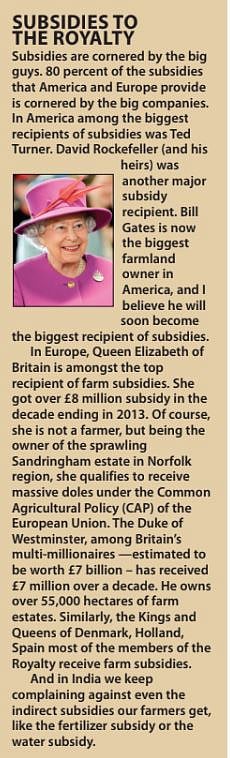
Compare this with the industry, which receives 6 per cent of the GDP by way of tax concessions alone. In fact, I have always maintained that the industry thrives on subsidies. This was very cleverly covered by a switch in vocabulary. When financial support is given for agriculture, it is termed as subsidy, a word that has been demonised. But when massive subsidies are provide to industries, these are called incentives. The general impression that has been created is that subsidies are a drain on the exchequer whereas incentives are absolutely essential for growth!  

It is all therefore a question of priorities. Since the intention was to move people out of agriculture, the investments were brought down. To restore the pride in agriculture, there has to be a renewed effort in boosting public-sector investments, large investments flowing in over the next few years. Private sector investments in agriculture will naturally follow once the Government makes its intent clear.  

For a country like India, public-sector’s role in agriculture is non-negotiable. Agriculture is the biggest employer in the country, and the effort should be to strengthen farming, which in turn will revitalise the rural artisans and the farm-based rural industries. The way to boost demand lies in improving agriculture, sustainably and economically. As I have often said agriculture alone has the potential to reboot the economy. I have failed to understand why mainline economists fail to see this simple but vital connection.  

Q: In wake of the three Ordinances, what is your suggestion for bringing prosperity to our farmers.   

The three Ordinances have already been notified. The urgency to push so called reforms, without even consulting farmers in whose name these are being pushed, has received huge farm protests in Punjab and Haryana. Interestingly, while farm protests are growing, all that the industry, the economists and the Government is saying is that farmers are being misinformed while in reality these measures will boost farm incomes.

But before we move any forward let us be first clear. I don’t want Indian agriculture to forever remain in subsistence. Economic Survey 2016 had told us that the average income of a farming family in 17 States of India, which means roughly half the country, is only Rs 20,000 a year, which means less than Rs 1,700 a month. This is not even enough to rear a cow. I shudder to think how these families survive. As if this is not enough, another study by OECD-ICRIER had clacluated that Indian farmers had suffered a loss of Rs 45-lakh crore between the years 2000 and 2016-17. This is a clear pointer to an extraordinary crisis that prevails on the farm. Later, studies by Niti Aayog have shown that growth in real farm income after 2015-16 and 2018-19 have remained almost ‘near zero’.  

This is not what Indian farmers deserve. Yes after year, farmers have worked hard to produce a bumper harvest. And yet, year after year, their incomes remain frozen or are on the decline.  

They too need a bright future. Let us therefore think of policies and measures that can pull them out of the grave agrarian crisis they live in. It is primarily a crisis of income insecurity. As I have always said, the problem is not in the crop field, but in economics. The crisis is not because of productivity shortfalls but because we have denied farmers their rightful income over the decades.  

To begin with, let’s first look at the three Ordinances. Well, if the three Ordinances are actually expected to give farmers a higher price for their produce, which means a higher income, then why a 4th Ordinance can’t be brought in which makes MSP a legal right for farmers? After all, if the reforms will lead to price discovery as everyone claims, why can’t MSP be a legal entitlement? This will assuage farmers concern, and since everyone feels the farm incomes will increase, I don’t see any reason why should the industry object to making MSP a legal right. If not, then it means the promise of a higher price is not a commitment.   

I am looking for the day when instead of just 6 per cent farmers getting MSP, the entire 100 per cent farming population become legally entitled to it (whosoever is eligible). This step alone will make farmers a true stakeholder in the resurgence of India.  

Secondly, since there are only about 7,000 APMC mandis the immediate need is to expand the network. If a mandi has to be provided in 5 kms radius, India will need 42,000 mandis. Third, the expansion of mandinetwork has to be accompanied by a nationwide programme to construct godowns at the village, panchayat and block level.  

This in my understanding should be the blueprint for ushering in Atmanirbhar Bharat. #

Source: Why resurrect a failed policy? Agriculture Today, Aug 1, 2020.http://www.agriculturetoday.in/magazine/2020/magazine-aug-2020.pdf


READ MORE - Why resurrect a failed policy? -- My interview

Friday, June 26, 2020

Make MSP a legal right for farmers -- My interview


Pic courtesy: Gorakhpur NewsLine

This is the English version of an interview I gave to the web portal hindi.newsclick.in The link of the Hindi interview is at the end. Please scroll. 


According to you what exactly is the biggest problem confronting Indian agriculture? 

Ans: For several decades now I have seen how agriculture has been deliberately kept impoverished to keep economic reforms viable. To ensure that food inflation remains under control as well as to ensure that the industry gets its raw material at a cheaper price, farm prices have been kept low. When a farmers undertakes crop cultivation what he does not realise is that he is actually going to cultivate losses. As a result of this, he is left with no option but to draw more credit, and thereby live under debt for all times to come. That is why I have always said that the answer to the severe agrarian crisis does not lie in the crop field, but in economics.  

To illustrate, let me share a study that we did some years back. In 1970, the Minimum Support Price (MSP) for wheat was Rs 76 per quintal. At that time, the salary of school teachers was as low as Rs 90 per month. In the next 45 years, in 2015, the MSP for wheat increased to Rs 1,450 per quintal which was a jump of 19 times in a period of 45 years. In the same period, the salary of government employees (only considering the basic pay and DA) increased by 120 to 150 times. The salary of College/University professors/lecturers increased by 150 to 170 times; and the salary of school teachers increased by 280 to 320 times. This tells us very clearly that if farm incomes had increased in the same proportion as other sections of the society, agriculture wouldn’t have faced the kind of crisis that exists today.

Q:  If farmer’s income had increased in the same ratio as that of employees and professors don’t you think food would have become too expensive? How would an average household manage its monthly food bill with such high food prices?

Well, it is clear that farmers are paying the real cost of keeping food prices low. In other words, to ensure that food inflation does not increase, are we not penalising farmers by deliberately paying them a low price? Have we ever thought that a farmer too has a family;  he has to educate his children; meet their health expenses and so on. He also needs a respectable income to sustain a decent livelihood. According to the Economic Survey 2016 the average income of farming families in 17 States of India, which is roughly half the country, stands at Rs 20,000 a year. This comes to less than Rs 1,700 per month. You can’t even rear a cow in Rs 1,700 in month. Have we ever thought how do these families survive? 

By denying farmers their rightful income, we have pushed farmers in a debt trap. It is time we pull them out of indebtedness, and give them a breather in the shape of a monthly income package that they deserve but have been denied. After all, a farmer too needs an assured income every month and it becomes our duty as consumers to ensure that we also stand with the family that struggles so hard to put food on our table.

Q:  You said a farmer too needs an assured income. How is that possible?

Several years back, some 10 to 12 years ago, when I first said that farmers need direct income support there was a strong opposition from economists. They couldn’t understand why I was asking for a direct income support for farmers. My argument was that since farmers have been denied their rightful income all these years it is important to compensate them for the losses incurred. Farm incomes have remained frozen or in the negative for more than two decades now and it is time to correct the income imbalance that has prevailed. Take for instance a study conducted by OECD (Organisation for Economic Cooperation and Development) which comprises the world’s richest trading block. This study in collaboration with New Delhi-based organisation ICRIER has found out that Indian farmers have lost Rs 45-lakh crore between the years 2000 to 2016-17. This was an extraordinary crisis afflicting agriculture but huge crisis being faced by farmers never became a national issue. There was a need for an economic stimulus package for farmers like the industry is given very often but no one talked about.

This tells us how severe is the economic crisis that farmers face. This often happens because of the price fluctuations farmers face. Every now and then we hear of reports of farmers throwing tomato, potato and onions on the streets. There are reports of farmers not getting the right price in the mandis. Price of almost all agricultural commodities continue to prevail low as compared to the Minimum Support Price. To illustrate, maize farmers in Shivani district in Madhya Pradesh have been sitting on a Makka Satyagrah demanding their maize crop to be procured at MSP. But what they are able to sell at is hardly between Rs 950 to Rs 1100 per quintal against the MSP of Rs 1,850 per quintal. These farmers have calculated the loss farmers in the district suffered to the tune of Rs 600-crore. Similarly, a farmer leader from Wardha in Vidharba has calculated the loss cotton farmers across the country have suffered at Rs 26,000-crore this year on account of being denied the rightful price.

It is therefore important to provide farmers with an assured monthly income. This can be by way of an assured MSP price or by adding direct income support or by bringing in some other measures. My suggestion has been to set up a Commission for Farmers Income & Welfare which should ensure that each farmer is able to get an income of Rs 18,000 per month, which equals the basic salary of the lowest level Government employee.  I don’t mean the Government should issue a cheque of Rs 18,000 per month to every farmer. But it has to work out a mechanism to ensure that’s the amount what every farmer should earn in a month.  

How does the Govt believe that amending Essential Commodity Act and bringing in amendments for contract farming will promote agriculture? 

Yes, the Government has brought in three Ordinances. These Ordinances pertain to agricultural marketing, price assurance and contract farming and removing the stock limits under the Essential Commodity Act. The idea that any farmer can sell to anyone, and anywhere, sounds very good but will it help farmers get a better price? Similarly, allowing farmers to sell anywhere in the country by removing all the inter-state barriers specially when 86 per cent farmers have less than 2 hectares land holding, and are unable to sell even within a district seems too optimistic. And finally, encouraging contract farming and hoping price contracts will give farmers a better price too needs to be first evaluated.

It is however good that the government has not diluted the APMC mandi system nor has it said anything about changing the MSP norms.

It was in 2006 when there was a similar kind of excitement. Bihar had gone in for agricultural market reforms and had thrown away the APMC Act. This was hailed as a major reform which was expected to turn Bihar into the future food bowl of the country. Economists had expressed the optimism that with APMC not coming in the way anymore, private investments will flow in, technologically advanced mandis will be set up by the private sector and farmers will get a better price discovery, which means they will get a higher price compared to the MSP the government announces. It has been 14 years since the APMC mandis were removed from Bihar. But all the claims have fallen flat, and nothing like the excitement that was projected at that time, has happened.

In the absence of any provate mandis that economists had talked about, it is some private traders who operate now. Farmers are realising low prices as a result of which every harvest we find unscrupulous traders transporting truck loads of wheat and paddy all the way to be sold in Punjab and Haryana where they at least get an assured MSP.  If only in these 14 years, Bihar had instead laid out a vast network of APMC mandis like in Punjab, its agriculture would have been in a much better condition. There would have been less out migration from rural areas in Bihar if only agriculture had been strengthened.  

According to NABARD 2015 study, the average farm income in Bihar remains low at Rs 7,175 per month. Compare this with the average in Punjab, which stands at Rs 23,133 per household. Much of it is because of a higher price realisation from the MSP system. It is therefore a missed opportunity for which Bihar continues to pay a heavy price.

But it is being said that these reforms will provide farmers with freedom to sell and thereby increase farm incomes ..  

It is important to first understand how have these markets reforms or the freedom to sell has operated in America from where we are borrowing the agricultural marketing provisions. According to the Chief Economist of US Department of Agriculture (USDA) real farm incomes in America, if adjusted for inflation, have been on a steep decline since 1960s. Since there is no APMC market nor an MSP farmers have the right to sell anywhere and to anyone. But over the years American farmers are faced with a severe economic crisis. What had saved farming all these years was the economic support through massive subsidies. If agricultural markets were so efficient I see no reason why In 2018 OECD countries should have provided agricultural subsidies to the tune of $ 246 billion. Further, despite contract farming, commodity trading and the dominance of multi-brand retail, the American Farm Bureau Federation in 2019 said that 91 per cent US farmers are bankrupt and 87 per cent farmers say they are left with no other alternative but to abandon farming.

While India is trying to hook agriculture to contract farming and commodity futures, I wonder why in the US with the biggest commodity stock exchanges, farmers should be carrying a debt of $ 425 billion. If commodity trading hasn’t worked for US farmers and for European farmers where 50% of $ 110 billion agricultural subsidies come in the form of direct income support how it will be a panacea for Indian farmers has not been explained.

So what in your thinking should be the agricultural reform that Indian farmers should be looking at?

What Indian farmers need is a commitment from the government or the industry that they will get an assured price after every harvest. This is only possible if we were to strengthen the agricultural marketing infrastructure. There are at present less than 7,000 regulated APMC markets in India. What India needs is vast network of 42,000 markets if a mandi has to be provided in 5 kilometres radius. The opportunity therefore is huge, all it requires is the ability to take up the challenge and chart a promising direction by first investing in essential infrastructure like mandis, cold chains, storage, grading, transportation etc.

Now comes the issue of price discovery. If markets were so efficient, there is no reason why farmers should be committing suicide in such a large number. After all, as per the Shanta Kumar Committee only 6 per cent farmers in India get MSP. The remaining 94 per cent farmers are dependent on free markets. If markets were so efficient in India also, there is no reason why so many farmers should have committed suicide. Their economic conditions should have improved over the years.

It is therefore time to strengthen the APMC network, and ensure that MSP becomes a legal right in the sense that no trading should be allowed below MSP. I am not against setting up private markets nor am I against competition. Pvt mandis can be set up in Bihar or in eastern UP or where there is a need for a mandi. That will provide a better competition with APMC mandis. But since it is being said that selling to anyone, and anywhere will ensure better prices to farmers, which means a price higher than MSP, I am sure the private sector will not object if MSP is made a legal right for farmers. After all, the private players are already claiming farmers will get a higher price so why not make MSP mandatory in trading for all the 23 crops for which it is announced every year. This of course should be followed by setting up a Commission for Farmers Income and Welfare.

This will not only transform Indian agriculture to meet the vision of Sabka Saath Sabka Vikas but in the process will also become a global model, the world too needs. #


READ MORE - Make MSP a legal right for farmers -- My interview

Friday, February 28, 2020

Seeds of the Next Agricultural Revolution


Pic from the web

This essay I wrote for the book: Handbook of Indian Agriculture 2020 -- Charting the way out of the farm crisis. 

At an age when young people are full of hope and aspirations, a 22-year-old young farmer in Barnala district in Punjab too attempted to turn around his small farm into a successful venture. Inheriting a small loan of Rs 8-lakh, and knowing well that farming had already taken an alarming toll in his family, he still decided to take up the challenge. Aware that entrepreneurship comes with associated risks, he still took 8-acres of land on lease at an annual rent of Rs 50,000 a year.

But in 2017, his standing wheat crop was damaged from a freak hailstorm. His dreams were shattered, and he could never recover from the battering he received. Unable to pay back the loan, and with lenders breathing down his neck, he was finally left with no option but to take the fatal route.

Lovepreet Singh was the fifth member in three generations of his farm family to have ended his life. About a year and a half ago, his father, Kulwant Singh, had hanged himself. His grandfather too had earlier committed suicide. That three generations of a Punjab farm family were sucked in by continuing agrarian distress clearly shows how prolonged the farm crisis has been. Not many will believe it, but Punjab, the seat of Green Revolution, has slowly turned into a hotbed of farm suicides. There is hardly a day when newspapers don’t carry reports of farmers committing suicide.

A house-to-house survey conducted by three public sector universities -- Punjab Agricultural University, Ludhiana; Punjabi University, Patiala and Guru Nanak Dev University, Amritsar – had computed the farm and farm workers suicide toll between 2000 and 2015 at a staggering 16,606. Another study by Punjabi University found that one in every three farmers in the State was living below the poverty line. In Maharashtra, 15,356 farm suicides have been reported in six years, between 2013 and 2018, reveals an RTI. At the national level, 11,379 suicides by farmers and farm workers were compiled by the National Crime Record Bureau (NCRB) for 2016, although the report was released three years late. This count was a little lower from the farm suicides tally for 2015, when 12,602 suicides were reported. A year earlier, in 2014, a total of 12, 360 farm suicides were officially recorded. The serial death dance on the farm has continued unabated.

While suicides reflected the acute distress that prevailed on the farm, essentially it was an outcome of the skewed economic policies that deliberately kept agriculture impoverished. Food prices had to be kept low to keep economic reforms viable. Keeping farm gate prices low to ensure affordable prices for consumers and ensuring a supply of cheaper raw material for the industry remained the political priority. In the process, the entire economic burden was very conveniently passed on to farmers. With real farm incomes remaining stagnant or declining over the decades, the match in reality was fixed against farmers.

Fifty years after the advent of Green Revolution, Economic Survey 2016 brought out the unpleasant truth. Accordingly, the average income of a farming family in 17 States of India, which means literally half the country, was a paltry Rs 20,000 a year. In other words, the average income was less than Rs 1,700 a month. At a time when it is not possible to even rear a cow in Rs 1,700 per month, I wonder how these families had been surviving year after year. Also, let’s not forget, the meagre farm income that Economic Survey mentioned was not only based on what the farmer was able to sell, but also included what they saved for household consumption, clearly pointing to the deep agrarian crisis. Several other studies had pointed to declining farm incomes. This is substantiated by an OECD-ICRIER study showing farmers lost an estimated Rs 45-lakh crore by being denied their rightful price in the 16-year period, between 2000-01 and 2016-17.

Now let us look at America. A report in The New York Times published way back in Feb 2010, showed how the US agriculture despite having high crop productivity, using state-of-art technology, and laced with heavy subsidies, had been sliding into depression over the years, forcing an increasing number of farmers to file for bankruptcy and quit farming. To illustrate, it specifically talked of a tragic suicide by a dairy farmer, Dean Pierson, who one fine morning after the milking was complete, took out his small-caliber rifle and shot all 51 cows on his farm in the head. He then sat on a chair and shot himself in the head. Falling prices and rising costs had pushed Dean Pierson into despair, a phenomenon that has engulfed a dominant section of the US farming community, increasingly encountering mental depression. As per the American Farm Bureau Federation, 91 per cent farmers and farm workers are faced with distress. Farm suicide rate is 45 per cent higher than the rest of the society. Such is the acute mental agony that farmers are undergoing that as many as 87 per cent of them fear they have little choice left but to quit farming. With median US farm income remaining in the negative for six years in a row, farm debt in 2019 was expected to rise to $ 418 billion.

With the number of small dairy farms falling by 17,000 in the 10 year period, between 2007 and 2017, the US had lost 30 per cent of its dairy farms. On an average, an America dairy farmer gets only 11 cents for every dollar of milk sold in the market. Over the years, milk prices have continuously been on the decline in America, Europe and Australia/New Zealand. Not only milk, prices of most commodities have remained subdued. Farmers have been finding it difficult to recover their cost of cultivation. Writing in his blog, Mike Callicrate, an American farmer, says the price at which his father sold corn on 2 December 1974, was $3.58 per bushel (equal to 25.40 kg). Forty-four years later, in January 2018, he sold corn at $ 3.56, down two cents from what his father had earned in 1974. “The farmer who planted his first field of corn in 1974 can expect the same prices for his corn as he retires. All the while the prices of seed, land, equipment, fertilizer, and fuel have grown exponentially,” he wrote.

With small farmers cultivating less than two hectares accounting for 86.2 per cent of the farming population, often the agrarian distress in India is blamed on fragmented land holdings. While the argument that these small landholdings are not viable does make economic sense but the larger question that still remains unanswered is how come in the US, where the average landholding is 180 hectares, farming should turn unviable? Or for that matter in Australia, where the average farm size is 4,331 hectares, why should agriculture be in crisis? The other argument I find being commonly articulated is that the continuing agrarian distress is because of lack of irrigation and low crop productivity. While this may appear to be true for the suicide-affected regions of Vidharbha and Marathwada region in Maharashtra, the fact that Punjab, which has 98 per cent assured irrigation and tops the global chart in productivity of cereal crops – wheat rice and maize – belies this explanation. Why it is that even with assured irrigation and higher productivity, Punjab has turned into a suicide prone region?     

Although the scale of farming may be quite different, from the tiny smallholdings in India to the sprawling farms in America and elsewhere, agriculture remains a victim of economic policies that have deliberately kept farm output prices low. Whether it is India, America or Australia (or for that matter any other country) the intensive farming model is built on producing surpluses, becoming globally competitive, and in the process slashing farm incomes. Even in the US, from where India borrowed the Green Revolution technology, the high rate of crop productivity has failed to translate into higher income for farmers. Farm incomes have been on the decline despite the US having the largest commodity exchange in the world, the Chicago Mercantile Exchange, and with the multi-brand retail giant Wal-Mart having completed 50 years. Addressing the 2018 Agricultural Economic and Outlook Foreign Trade Forum, Dr Robert Johannson, Chief Economist of the US Department of Agriculture (USDA) had acknowledged: ‘Real farm prices, when indexed for inflation, have fallen sharply since 1960.’ 

The two unsavoury scenarios I presented above – from two parts of the world – are necessary to understand that neither subsistence agriculture of India nor the high-tech agriculture in America is economically viable. Nor is it environmentally sustainable. Farmers in both the countries, burdened over the years with mounting debt, are faced with acute distress, and are increasingly abandoning agriculture. Small American farmers are faced with extinction, screams a headline in the Time magazine. Outcome of an economic design, this is exactly what the American policy makers had desired. This is very clearly summed up by the US agriculture secretary, Sonny Perdue, when unmindful of the raging farm crisis, he said: “In America, the big get bigger and the small go out.”

This is not what India needs. Blindly aping the economic prescriptions flowing in from the West is not what India requires or can afford. India’s next agricultural revolution has to be based on its domestic priorities. The policy contours therefore have to be desi -- something that gels with the country’s unique and varied agro-climatic conditions, and brings about a turnaround in agriculture that leads to Sabka Saath, Sabka Vikas. In a country where roughly 600 million people are dependent on agriculture, directly and indirectly, and where urban jobs have dried up, with unemployment soaring to a 45-year high, an economically viable agriculture is the only way to absorb bulk of the 1.25 million new job entrants who join the employment queue every year. The huge population in agriculture should not be seen as a burden; it should be viewed as an impeccable strength. Instead of pushing a large section of the farming population to swarm into the cities, joining the ranks of dehari mazdoor, what has to be understood is that an attractive agricultural model, based on local production, local procurement and local distribution, and having backward and forward linkages with rural industries, alone can re-energise the rural economy thereby propelling the Indian economy into a still higher growth trajectory.  

At a time when India is celebrating the 150thyear of Mahatma Gandhi’s birth anniversary, it is important to draw a roadmap for a sustainable agricultural revolution drawing from the Gandhian principles. Mahatma had once said that what India needs is a production system by the masses, and not for the masses. Considering that small farmers in India are the backbone of a healthy food system, sustaining millions of farm livelihoods therefore should become the first prerogative. For any vibrant rural economy to be sustained, the first and foremost requirement is to make farming a viable proposition. This is only possible if the dominant economic thinking is willing to look beyond the policy prescriptions which aim at sacrificing agriculture for the sake of economic growth, and have created appropriate economic conditions – by way of steep cuts in public sector investments and by deliberately keeping farm prices low – forcing farmers to abandon agriculture and migrate into the cities.   

At the heart of the transformation towards a new agricultural revolution lies a fundamental change on how income security can be assured for small farmers, and how land and water resources are used effectively through a farming system based on ecological principles. It needs a determined desi reform agenda to revitalise agriculture, usher in prosperity for farmers, and bring in a healthy food and agriculture system. 

To move away from intensive farming systems that has denuded oils, mined groundwater, contaminated the food chain, and is leading to increasing desertification is the need of the times. Especially at a time when a UN-sponsored initiative — The Economics of Ecosystems and Biodiversity (TEEB) — for agriculture and food, has in a study computed the ecological cost of the entire food and farming systems, from cutting down of forests to making land available for cultivation, from intensive farming systems to global trade in food, and further to food waste going into the landfills, accounting for 47 to 51 per cent of global greenhouse gas emissions. Considering that a shift towards agro-ecological farming systems will reduce GHG emissions in Europe by 47 per cent, as studies have shown, the shift to non-chemical agriculture in India becomes absolutely imperative. Andhra Pradesh has already shown the way, first with Community Managed Sustainable Agriculture (CMSA) and followed-up with Zero-Budget Natural Farming (ZBNF) practices which have already made 5-lakh farmers to make a shift towards regenerative agricultural practices. The proposal to make the northeast a hub for organic agriculture is a step in the right direction. The agro-ecological farming systems need to be gradually expanded to other regions as well in a phased manner. At present less than 1 per cent subsidy support goes for regenerative agriculture, which needs to grow substantially in the years to come. Skill development programmes, backed by appropriate agricultural extension and research have to be launched. But more importantly, the research focus of agricultural universities has to change towards agro-ecological farming systems. This is not easy considering the resistance shown by the top brass of the scientific community. 

Considering that a majority of the land holdings are small, collectivisation of small farmers gives them bigger bargaining power, sharing of costs and better access to resources. Whether through Farmer Producer Organisations (FPOs) or through Cooperative farming, small farms have to be aggregated. Drawing from the experience of the milk cooperatives, an equally efficient value chain for food commodities can also be built. Whatever be the approach, the underlying principle has to be on assuring farmers a profitable price thereby ensuring income security. This can be achieved by setting up a National Commission for Farmers Income and Welfare, incorporating the existing Commission for Costs and Prices (CACP), with the mandate to ensure that the minimum income a farmer receives is not less than the minimum income of the lowest government employee in hierarchy. Direct Income Support and Deficiency Payments can be the two approaches to bring about parity in incomes with other sections of the society. At no stage should farmers be left to face the volatility of markets.      

An efficient marketing system would depend upon creating an adequate infrastructure for agricultural markets. At present, an APMC mandi covers an area of 500 square kms. This has to be reduced to 80 sq kms as per the recommendations of the Swaminathan Committee. Another report says a total of 42,000 mandis are required if the objective is to provide a market yard in five kms radius. While the APMC network requires corrective measures to weed out corrupt practices, a network of village roads, like in Punjab, needs to be laid out linking them with the agricultural markets. Besides managing the huge surplus that flows in at the time of harvests, the new APMC markets infrastructure must provide a mechanism for a price incentive for good quality produce. The minimum support price (MSP) which benefits only 6 per cent of the farmers should cover the entire farming community. This will require procurement network to be expanded for all the crops for which MSP is announced. Food processing industries can be set up at places from where a sizeable quantity of the particular raw material is procured. For instance, I have never understood why Punjab should be importing wheat atta when it happens to be the biggest contributor of wheat to the central kitty.

Revitalising agriculture will require public sector investments to be significantly enhanced. Against a public sector investment varying between 0.3 to 0.4 per cent of the GDP between 2011-12 and 2016-17, at least 5 per cent of the GDP should flow to agriculture. After all, nearly 50 per cent population remains dependent on agriculture. A part of the public sector investments can go in for creating off-farm employment opportunities. In addition, like the 7,000 small and big steps laid out for ease of doing business, agriculture too needs ease of doing farming norms, at least 5,000 if not more, to be spelt out. Let us not wait for the World Bank to direct us on ease of doing farming norms. Let it be part of the desi reforms being proposed.

Delivering such a transformation will certainly be a challenge, but a new agricultural revolution based on sustainability and economic viability alone has the potential to reboot the economy. And as Nelson Mandela had once said: “it always seems impossible until it is done.”#

Source: My essay on Seeds of the Next Agricultural Revolution in the book: Handbook of Indian Agriculture 2020: Charting the way out of the farm crisis. Business Line. Feb 2020

READ MORE - Seeds of the Next Agricultural Revolution