Showing posts with label India. Show all posts

Monday, April 26, 2021

What India is doing today to Agriculture was done by the West with disastrous consequences


Around the mid-1980s, my interest grew in the extent of subsidies rich developed countries were giving to the agriculture sector. If farmers in rich countries were allegedly doing so well, why did these governments, all champions of the free market, have to provide subsidies to their farmers? Generally speaking, no political regime wants to subsidise Agriculture; they would rather put all the eggs in the corporate basket.

Then during my travels to the USA and Europe, especially the countryside, I witnessed the devastation market-oriented agriculture had done to rural communities in America, Canada, and in Europe. We are constantly told in India that developed countries are so prosperous and their farmers are in such good shape that we need to copy the same model. In reality I found that whatever remains of the American agriculture today is entirely due to the massive subsidies the government provides.

When WTO came into existence, I was commissioned by British journal The Ecologist to do a column on how the WTO regime would benefit Indian farmers. In that column I compared Indian farmers to a European cow, comparing the subsidies that a European cow received vis a vis an Indian farmer’s income. It became a major talking point among the economists and the UN Human Development Report by the UN and the World Development Report by the World Bank both mentioned dairy subsidiaries in comparison to developing world.
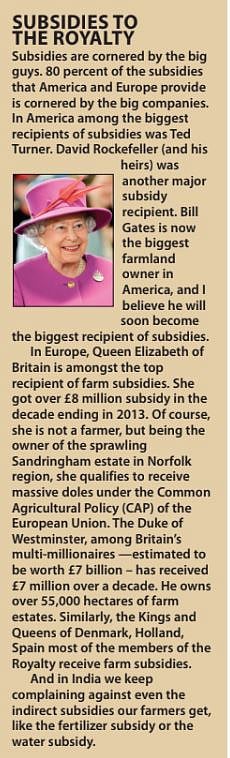
What India is doing today to Agriculture was done by the West with disastrous consequences

Dominant economic thinking is that we have to reduce the size of the population dependent on agriculture to achieve higher growth. when I visit foreign universities, economists endlessly argue that there is no other way than this. One of our former RBI Governors in fact went on record to say that the biggest reform in India would be when we can move people away from agriculture to urban areas, which need cheap labour.

If we take this migration of people to the cities as employment generation – creating an army of dihadi mazdoor - there is something fundamentally wrong with our economic thinking. There are lessons from the lockdown last year, when we saw the plight of migrant workers, as hundred million walked back long distances to their villages. I call these migrant workers ‘agricultural refugees’. They were pushed to the cities because the economic paradigm created by the dominant thinking has made rural areas economically unviable.

In America , 1.5 percent or so of the population depends on agriculture, agriculture by this warped definition should have been a lucrative profession. But it is not. Agriculture in American is facing a severe crisis, with farmers saddled with a bankruptcy of $425 billion as of July 2020. The idea that fewer people engaging in agriculture will ensure prosperity has clearly outlived its utility and it is time for economists to stop flogging this dead horse.
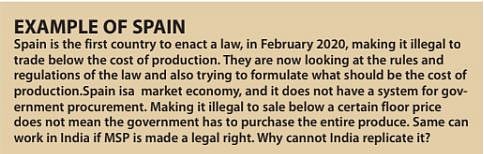
What India is doing today to Agriculture was done by the West with disastrous consequences

There is another flawed argument that larger the land holding size, the better the bargaining power. The average land holding size in the US is 440 acres while 86 percent of Indian farmers have land holdings of less than 5 acres. It is therefore argued that we need aggregators and contract farming, which would enhance bargaining power of farmers and there will be price discovery. My question is why did this then not happen in America? Or Or in France where the average land holding size is 135 acres? Or Canada where it is 3000 acres; or in Australia where it is a staggering 10,800 acres?

When Ronald Reagan was encouraging big corporates to replace the allegedly inefficient small farmers, the world did initially go into surplus food production, prices fell and consumers were happy . But a country where over 50 percent of the population are involved in agriculture, we do not have to follow what America did but go by what Gandhiji said, production by the masses, not production for the masses. In fact, that is what PM Modi also envisages, Sabka Saath Sabka Vikas.

As I have said before, economists have to be held accountable for the crisis the agriculture sector the world over is facing. They have misled us to believe that this model of economic growth works. They need to go beyond Economic theory and look at the ground realities. The reverse migration we saw in India should be a lesson for them to go into reverse economic thinking. Rather than pushing people to the urban areas, the challenge is how to make rural areas economically viable and profitable.

***

Indian farmers are still on the streets. Their agitation is far from over and the whole world is eagerly observing how it shapes up. The movement has moved out from the Delhi border to various parts of the country as farmers have started going to villages, holding maha-panchayats and taking their message to more and more people. This is possibly the greatest mass movement of our times.

Just two years back, the chief economist of the US Department of Agriculture admitted that since the 1960s, American farm income has seen a steep decline if you adjust for inflation. Whereas in India we are told that free market agriculture model would make farm income go up. I fail to understand why that did not happen in first world countries after they opened up?

Bedabrata mentions in his Times of India that the price American farmers get for wheat today is less than what they used to get during the American civil war. In Canada the wheat price in 1867 when adjusted for inflation was $30 per bushel. 150 years later, in 2017 the price had come down to $5 per bushel. This is what free markets have done to agriculture.

In the US, 40% of average farm income actually comes from subsidies. It clearly demolishes the argument that markets lead to price discovery. A study of cotton in America shows that around 2005 there were 20,000 cotton growers. American farmers were getting a subsidy of 4.7 billion dollars in 2005 to produce a crop which was sold at 3.9 billion dollars. It depressed global cotton prices. Farmers in Africa and India were priced out.

We were led to believe that our farmers were inefficient and unproductive; but in reality, Indian farmers were priced out because of subsidies that American farmers received from their government. On top of it, America provided an additional subsidy of 180 million dollars to the textile industry to buy the subsidized cotton. Still Brazil continues to heavily subsidize cotton growers.

According to the Centre for WTO Studies, New Delhi, America provides a subsidy of 85 lakh rupees to each cotton grower every year while in India the subsidy a cotton grower gets is Rs. 1500.

Situation is not much different in Europe. Despite the massive subsidies for the agriculture sector, every minute one farmer is quitting agriculture. EU provides a subsidy support of 100 billion Euros every year. Imagine if this subsidy is withdrawn, what would happen to the farmers in EU? Even in France, the top most agriculture producer in EU, recently farmers hung dozens of suicide dolls from trees in front of Parliament to highlight their plight.

So why do we want to borrow this failed model? It’s a question I have been repeatedly asking.

Sonny Perdue, Donald Trump’s Agriculture Secretary had said, “In America the big gets bigger, the small go out.” To illustrate in 1970s there were more than 6 lakh dairy farms in America. 93 percent of American dairy farms have closed down. Does that mean milk production has come down? No. On the contrary it has gone up, which drove the prices down and dairy farmers committed suicide. Today there is so much surplus milk with mega dairy farms, each with 7000 to 15000 cows that America is trying to find a market for its surplus milk; and that’s why the US is pushing India for market access in dairy.India is the largest producer of milk in the world and yet we are under pressure to open up our markets to dairy companies for milk..

Even for India, the Director General of International Food Policy Research Institute, Washington DC, comes up with similar advice, “Move up or move out.”

Bedabrata mentioned about the nexus between political power and big corporates in America. In fact there is another player - the economists. The mainline economists all over the world speak the language of capitalist power , a language that has failed to enhance farmers’ income anywhere in the world.

Agrarian crisis is so severe in America that one of the farmers called me up the other day asking what is happening in India. As I explained the situation he said, “We know that living in debt is living in hell. We are very happy that Indian farmers are standing up and fighting our battle.” Another farmer in France said that agriculture is being sacrificed to keep consumers happy. Not only in France or US, the crisis of farm debts is the same everywhere. It is actually caused by the denial of rightful income to farmers which is the biggest issue globally farmers are facing.

Prior to the Indian farm protests in hundreds of tractors had marched into Washington DC in Feb 1979 asking for guaranteed price. . They camped for 4-5 weeks but they could not get what they wanted. Jimmy Carter, then American President could not meet farmers demand. If he had not failed, American agriculture would have been a global model for economic viability of the farmers.

What farmers need everywhere today is a guaranteed price for their produce which alone can pull them out of the prevalent crisis. Markets would automatically adjust to it. Don’t forget when the debate about minimum wages had started, corporates had objected saying this would upset their balance sheet but eventually they had to provide minimum wages and adjust their business plans accordingly. If there can be minimum wages for workers, it is time we provide minimum support price (MSP) to the farmers as a matter of right.

Let us look at the confectionary industry with a turnover of $212 billion. Chocolate is a major component. Guess what the average income of a cocoa farmer is, it is Rs 100 per day, less than the price of a standard chocolate bar. Coffee industry is no better. There are around 50-60 lakh coffee bean farmers across the globe and 80 percent of them earn less than $1.9 per day, which the World Bank defines as acute poverty line imagine if these farmers had received a minimum support price all these years rather than being left to face the brutalities of the market.

Source: Lessons for Indian Agriculture. National Herald. April 17, 2021. https://www.nationalheraldindia.com/india/why-should-india-follow-an-agricultural-model-that-has-failed-in-the-developed-world?fbclid=IwAR1HyZFqUbmx02dpM3NO56tcVGmi60Z2smQryqLTowhP5uRGDfFEMh6dm94


READ MORE - What India is doing today to Agriculture was done by the West with disastrous consequences

Wednesday, March 24, 2021

Markets fail to provide farmers with higher income


Inflatable suicide dolls hung on trees outside the French Parliament by farmers.
Pic courtesy -- TRT World

It’s difficult to imagine. At a time when free markets are generally believed to provide farmers with a higher price thereby enhancing farm incomes, the farm gate price for wheat in Canada happens to be much lower in 2017 than what it was 150 years back in 1867. This is not only true for Canada. Even in the US, as per media reports, farmers say the price they receive for wheat is much lower than what was prevalent at the time the four year American Civil War ended in 1865. 

So what happened to markets? After all, wheat is a staple food and its demand, considering the population boom the world has witnessed in the past 150 years, has grown exponentially over the centuries. According to the UN Food and Agricultural Organisation (FAO), wheat production forecast is pegged at 780 million tonnes in 2020-21, an increase of 7.5 million tonnes this year. Given the food insecurity the world is faced with, FAO considers the cereal production estimates (including that for wheat) to be positive.    

Now before you wonder how this could be possible, given the fact that economic curriculum in colleges and universities teaches us that markets provide the rightful price, take a look at an analysis by the US National Farmer Unions (NFU) which explains how the continuously declining peanut prices since 1965 had pushed three out of four peanut farmers out of business in America, and that too at a time when peanut consumption was on the rise. Defying the supply demand logic, the peanut prices slumped from $1 per pound in 1965 to less than $0.25 per pound in 2020, a drop of more than 75 per cent. And if you are still thinking it probably happened because of surplus production, a Washington Post report tells us how just three companies, controlling the entire peanut market, had actually fixed the purchase price. After a lawsuit filed by 12,000 peanut growers, these companies finally agreed to pay $103 million in compensation for deliberately keeping the prices low.   

Peanut is no exception. This kind of match fixing has been going on for decades. Whether in America, Europe or India, what the farmers need to understand is that the match is already fixed. It is not without any reason that market prices, when adjusted for inflation, have remained frozen or have been on a decline over the years. 

Coming back to the issue of wheat prices, a Canadian author, critic and writer, Darrin Qualman, has in an insightful series of blog posts explained how the prices have been on a steep decline since 1867. Adjusted for inflation, the price of wheat per bushel (27 kgs) was close to $30 in 1867. Like on a ski slope, the average price had continuously been on the downward slide ever since. With global emphasis shifting to agricultural exports in the mid-1980s, the prices began to slump further. In 2017, the wheat price collapsed to a little over $ 5 per bushel. The price a Canadian wheat farmer sold his wheat for in 2017 was less by $25 per bushel than what his great grandfather sold it for 150 years back. 

No wonder, while small farmers abandoned agriculture in large numbers, the average size of a Canadian farm has grown to 3,000 acres with the big farms several times larger. While the number of farmers declined drastically, the economic argument in support of market reforms claiming that farm incomes go up when the number of farmers recedes too has turned out to be untrue. America has lost more than 5 million farms in the in less than 100 years, and Australia has lost 25 per cent of its farms between 1980 and 2002. Economists will say this is a healthy development, and will make farming profitable. But surprisingly, the speed at which farmers across the globe have got out of agriculture hasn’t increased farm incomes but on the contrary it has only worsened the agrarian crisis.   

This is the same flawed argument that Niti Aayog too is promoting, saying that farm incomes will double when the number of people on the farm comes down. If this be true, I don’t understand why in Canada, for instance, the farm debt should be exceeding $102 billion, more than double than what it was in 2000. In US, where hardly 1.5 per cent of the population remains in agriculture, farm debt has multiplied to a staggering $ 425 billion in 2020. In France, with only 7 per cent workforce employed in agriculture, more than 44 per cent farmers carry a debt burden of Euro 400,000 and 25 per cent farmers earn less than Euro 350 per month, less than the poverty line. 

While farmers have been denied the rightful price, the consumer prices have been on the rise. In another blog, Darrin Qualman explains that while the price of a bushel of wheat in Canada and US has remained static since 1975, the retail price of loaves of bread produced from each bushel in the US had increased by $ 50 on an average, from $25 in 1975 to a little over $75 in 2015. The same holds true for other food products as well. How can efficiency be only measured in terms of reducing farm gate prices whereas the food processing and retail giants continue to increase prices, walking away with a larger share of the end consumer price? If the markets were efficient, why the food processing and retail giants continue to thrive in inefficiency? 

There is nothing sacrosanct about markets. To believe that markets provide farmers with a higher price is an outdated economic thinking (and education). Markets have historically failed to prop up farm incomes anywhere in the world, a fact that economists failed to acknowledge. Demanding no trading to be allowed below the MSP, protesting farmers are actually seeking a historic correction in economic policy and thinking. This holds the future for a reverberating agriculture, and a new economic design that provides for Sabka Saath, Sabka Vikas. #

Markets have failed to prop up farm incomes. The Tribune. Mar 19, 2021 https://www.tribuneindia.com/news/comment/markets-have-failed-to-prop-up-farm-incomes-227289?fbclid=IwAR0IiGibi8oR20ULhS4y6KWFNsV99V2-H2t7uxnesiQefqKuMFOce7eOuZc

READ MORE - Markets fail to provide farmers with higher income

Thursday, March 11, 2021

Why Indian farmer protest should concern farmers all over the world.


Women on the front in farmers protest in New Delhi. 
Pic courtesy -- Indian Express

Amid the ongoing farmers’ protest, with tens of thousands of farmers entrenched at the gates of New Delhi for nearly three months now, India’s Prime Minister Narendra Modi strongly defended the three contentious farm laws saying the reforms are necessary and that is why officials are having discussion with the farmers. Speaking in Parliament, he said: “We have tried to understand what the farmers concerns are with clause-by-clause discussions. We understand that there is no harm in amending the laws if they can harm the farmers business.” 

While the Prime Minister ruled out the possibility of withdrawing the three new central laws, agitating farmers fear that these laws will bring them under corporations, which will cut into their income, take away their lands and drive them out of agriculture. As the iconic farmers movement – perhaps the biggest farmers protest seen anywhere in the world – spreads across the country, with ‘mahapanchayats’ (large congregations) setting up a new template for show of strength, agitating farmers remain steadfast on their demand for repealing the ‘three black laws’.  

As the stalemate continues, farmers are getting ready for what appears to be a long-drawn battle ahead. After having weathered the cold winters in tractor-trollies and under tents, agitating farmers are now preparing to face the harsh summers with heat wave intensifying as temperatures rise in the next few months. Nevertheless, the determination and resolve to stay put till the laws are withdrawn sees no signs of waning. More when I see a large number of women at the centre stage, protesting along with their male counterparts. “These laws are nothing but a death warrant against farmers. Therefore it is a life and death question for us,” said a visibly agitated Sukhwinder Kaur, wife of a small farmer from Punjab, whom I met recently at the Singhu border on the outskirts of New Delhi, one of the protest sites. And then she added: “I don’t want to see my husband committing suicide. Enough is enough.”

In a battle of perceptions, the real issue is not what amendments are needed to make the laws acceptable to agitating farmers but to understand what prompted farmers to put everything at stake and emerge out of their farms to launch what is now seen as a historic and an unprecedented movement. In a polarised debate that is doing the rounds, what is being conveniently overlooked is the acknowledgement of a harsh reality. For several decades now, Indian farmers had been deprived of their rightful price, with the economic design aiming to keep food prices under control and to push small farmers out of agriculture so as to provide for cheap labour in the cities. Therefore, in reality, it is the compound anger built over the decades that is finding a vent through the opposition to the new laws.

In the epicentre of the protests – comprising the north-western states of Punjab and Haryana, the country’s food bowl – farmers fear the new laws will make the regulated mandis(markets) become redundant and this will result in phasing out the price assurance they have been traditionally getting (since the days of Green Revolution) through the mechanism of the Minimum Support Price (MSP). Every year, India announces MSP for 23 crops but predominantly procures only wheat and rice to be distributed at a subsidized price to meet the food and nutrition needs of two-third of the population – approximately 800 million people -- under the National Food Security Act.

For the rest of the crops, the MSP remains more or less on paper. Since only 6 per cent farmers across the country get the benefit of MSP the remaining 94 per cent have remained dependent on markets. Farm income for this 6 per cent of the farming community is relatively higher than those dependent on markets. In any case, if markets were benevolent, there is no reason why India should be faced with a terrible agrarian distress. And this is what actually worries farmers; they fear the new laws will bring them under corporate control depriving them of an assured income by denying them a guaranteed price.

The issue of denial of an assured price resonates strongly with farmers in America and for that matter in Europe. Left to face the brutality of the markets, farmers in the rich developed world too have borne the brunt. If the markets were so good, and despite receiving monumental subsidies, I see no reason why American farmers should be saddled with a bankruptcy of $ 425 billion in 2020.  With suicides in rural areas being 45 per cent higher than the urban areas, American farmers are increasingly faced with worrying levels of mental stress. Rural communities have been left devastated, and there is a kind of eerie silence that greets you.

Ever since Earl Butz, Agriculture Secretary at the time when Richard Nixon was the American President (in early 1970s) made that infamous statement asking farmers to “get big or get out”, small farmers have quit agriculture in large numbers. To illustrate, 93 per cent of the dairy farms have closed down since 1970s. As market dominance increased, farmer share of income in every food dollar the end consumer paid has come down to less than 8 per cent. Farm incomes, when adjusted for inflation, have been on a steady decline. To prop up farm incomes, a study by Centre for WTO Studies in New Delhi shows that American farmers receive an average of $ 62,000 subsidy support every year.

In Europe, it is no better. Unable to cover the cost of production, and faced with the vagaries of markets, small farmers have increasingly quit agriculture. European Commission acknowledges that despite the importance of the food sector, farm incomes are 40 per cent lower than the non-farm sector. That is why the basic intention of the Common Agricultural Policy (CAP) has been to support individual farmers, supplementing farm incomes. Nearly 57 per cent of the average farm income comes from subsidy support.

It is clear that free markets haven’t helped increase farm incomes. No wonder, farmers everywhere are asking for fair price for their produce. What the protesting Indian farmers are demanding – making guaranteed price a legal right for farmers – therefore will have global resonance. It’s an idea whose time has come. #

Source: Why the world should watch the Indian farmer protest very closely. Fairfood.nl Feb 17, 2021. https://fairfood.nl/en/resources/indian-farmer-protests/   

READ MORE - Why Indian farmer protest should concern farmers all over the world.

Tuesday, December 8, 2020

Agriculture has the potential to turn into a powerhouse of economic growth.

As India completes 73 years of Independence, agriculture has emerged as the mainstay of the economy. Serving as a much needed lifeline during the Covid-19 crisis, Indian agriculture is poised to grow by an estimated 3 per cent in 2020-21 prompting the Reserve Bank of India (RBI) Governor Shaktikanta Das to acknowledge that at a time when the economy is shrinking, agriculture remains a “beacon of hope” 

The resilience that agriculture demonstrated at a time when the International Monetary Fund (IMF) had pulled down India’s growth projections for 2020-21 to 1.9 per cent clearly shows that the time has come to revitalise Indian agriculture to serve as a pivot for future economic growth. There can’t be a better time to resurrect Indian agriculture, especially when the nation is celebrating 150th birth anniversary of Mahatma Gandhi who had been a strong advocate of village self-reliance. 

This becomes more the need and necessity knowing that a few days after Prime Minister Narendra Modi announced the first nationwide lockdown beginning March 25, hundreds of thousands of migrant workers with small children in tow or in their laps, and clutching their meagre household possessions, preferred to defy the lockdown and walk home travelling for hundreds of kilometres. The painful long march that the country witnessed, with some estimates pointing to more than 30 million people returning home (and some experts saying that close to 70-80 million trudged back from the cities if intra-state reverse migration was to be added) was a pointer to the failure of economic policies that had encouraged rural to urban migration. 

Several studies have shown that at least 60 to 70 per cent of the migrant workers who returned to their native places are unlikely to return back to the cities, at least not in the near future. These hapless millions were essentially what I called as ‘Agricultural Refugees’ who were driven out of the villages over the past few decades because of economic policies that kept agricultural deliberately impoverished. A recent OECD study in collaboration with ICRIER, a New Delhi-based think tank, had concluded that Indian farmers suffered a cumulative loss of Rs 45-lakh crore (US$ 600 billion plus) between 2000 and 2016-17 on account of being denied their rightful income. Subsequently, the Niti Aayog itself had admitted that between 2011-12 and 2015-16 the growth in real farm incomes had prevailed at less than half a percent every year, 0.44 per cent to be exact. For the next two years, the growth in real farm income had been ‘near zero’. If farm incomes had declined or remained static for the past two decades, what else could be expected from the rural workforce, which was left with little option but to abandon farming and move to the cities looking for menial jobs as a daily wage worker? 

But despite these hardships, India farmers had toiled hard to produce a bumper harvest year after year. Saddled with overflowing food stocks, reports show that the abundance of food grains came in handy to provide subsidised rations under the National Food Security Act to over 720 million people during the four months of the lockdown. In addition, free rations were made available to the needy. This was possible only because of a buoyant agriculture despite farmers continuing to be faced with a severe agrarian crisis. With less money available in the hands of farmers, a dip in rural demand had lead to a slowdown in Indian economy prior to the lockdown. After all, in a country where the agricultural workforce accounts for nearly 50 per cent of the population, the surest way to jack up the economy is to create more rural demand, which means provide farmers with decent incomes.   

Even during the lockdown period, which coincided with the rabi (winter crop) harvest resulting in a crash in demand leading to farmers suffering huge losses in the case of perishables like vegetables, fruits, flowers, poultry, dairy and fisheries, the USDA estimates that India is poised to achieve a record wheat production and a near-record rice production in 2020-21. For the next kharif (monsoon) season, the sowing of summer crops has increased by 13.92 per cent over the previous year as on July 31. With rains expected to be normal, and with a much higher area brought under cultivation, the kharif harvest is also expected to be bountiful. No denying, in these depressing times, agriculture alone provides a ray of hope. 

As India steps into the 74th year of Independence, the coronavirus pandemic has come as a timely reminder of the dire need to acknowledge the inherent bias and blind spots in dominant economic thinking. Treating agriculture as a laggard, the economic design that the world follows had believed in sacrificing agriculture for the sake of industrial growth. In India, in addition to keeping farm incomes deliberately low, public investments in agriculture too declined over the decades. As per RBI, public sector investment in agriculture had hovered around 0.4 per cent of the GDP between 2011-12 and 2017-18 What economic miracle could have been expected from a sector, which is the largest employer in the country, but kept starved of public funds and denied the rightful income to farmers? 

It is time to overhaul this outdated economic thinking. It is time not to return to the normal, but to a new normal. It is time to strengthen the rural economy by not only taking into consideration its capacities and capabilities but also to appreciate and acknowledge the socio-economic wealth of rural enterprise, its diversity and the traditional knowledge base. Although the Prime Minister has spelled out his vision of Atmanirbhar Bharat (a self-reliant India), the route to achieve this certainly passes through agriculture. Looking at the inherent strengths of Indian agriculture, and knowing the challenges that reverse migration have thrown up, only a vibrant agriculture can absorb the influx and turn it into an opportunity. It is high time mainline economists and policy makers remove their blinkered glasses, and start looking afresh at agriculture, because agriculture alone has the potential to reboot the economy for all times to come. #

Agriculture is India's Ray of Hope in Time of Crisis. Fair Observer. Dec 3, 2020. https://www.fairobserver.com/region/central_south_asia/devinder-sharma-india-agriculture-reform-farmer-protests-covid-19-migrant-workers-economic-recovery-news-16551/?fbclid=IwAR2pwARY0w_FsRe75CaPBIyIqFwZ2vmy3vhPCv9AseaSaX8EOB6gIRy9sdo

READ MORE - Agriculture has the potential to turn into a powerhouse of economic growth.