Showing posts with label farmer suicides. Show all posts

Monday, April 26, 2021

What India is doing today to Agriculture was done by the West with disastrous consequences


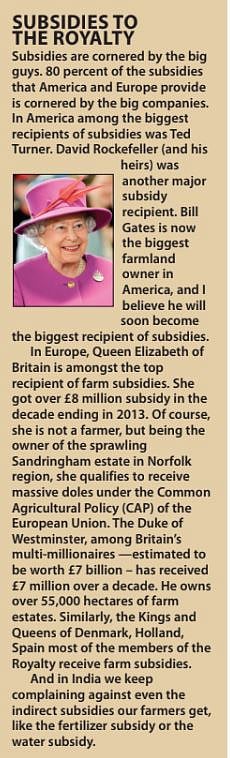
Around the mid-1980s, my interest grew in the extent of subsidies rich developed countries were giving to the agriculture sector. If farmers in rich countries were allegedly doing so well, why did these governments, all champions of the free market, have to provide subsidies to their farmers? Generally speaking, no political regime wants to subsidise Agriculture; they would rather put all the eggs in the corporate basket.

Then during my travels to the USA and Europe, especially the countryside, I witnessed the devastation market-oriented agriculture had done to rural communities in America, Canada, and in Europe. We are constantly told in India that developed countries are so prosperous and their farmers are in such good shape that we need to copy the same model. In reality I found that whatever remains of the American agriculture today is entirely due to the massive subsidies the government provides.

When WTO came into existence, I was commissioned by British journal The Ecologist to do a column on how the WTO regime would benefit Indian farmers. In that column I compared Indian farmers to a European cow, comparing the subsidies that a European cow received vis a vis an Indian farmer’s income. It became a major talking point among the economists and the UN Human Development Report by the UN and the World Development Report by the World Bank both mentioned dairy subsidiaries in comparison to developing world.
What India is doing today to Agriculture was done by the West with disastrous consequences

Dominant economic thinking is that we have to reduce the size of the population dependent on agriculture to achieve higher growth. when I visit foreign universities, economists endlessly argue that there is no other way than this. One of our former RBI Governors in fact went on record to say that the biggest reform in India would be when we can move people away from agriculture to urban areas, which need cheap labour.

If we take this migration of people to the cities as employment generation – creating an army of dihadi mazdoor - there is something fundamentally wrong with our economic thinking. There are lessons from the lockdown last year, when we saw the plight of migrant workers, as hundred million walked back long distances to their villages. I call these migrant workers ‘agricultural refugees’. They were pushed to the cities because the economic paradigm created by the dominant thinking has made rural areas economically unviable.

In America , 1.5 percent or so of the population depends on agriculture, agriculture by this warped definition should have been a lucrative profession. But it is not. Agriculture in American is facing a severe crisis, with farmers saddled with a bankruptcy of $425 billion as of July 2020. The idea that fewer people engaging in agriculture will ensure prosperity has clearly outlived its utility and it is time for economists to stop flogging this dead horse.
What India is doing today to Agriculture was done by the West with disastrous consequences

There is another flawed argument that larger the land holding size, the better the bargaining power. The average land holding size in the US is 440 acres while 86 percent of Indian farmers have land holdings of less than 5 acres. It is therefore argued that we need aggregators and contract farming, which would enhance bargaining power of farmers and there will be price discovery. My question is why did this then not happen in America? Or Or in France where the average land holding size is 135 acres? Or Canada where it is 3000 acres; or in Australia where it is a staggering 10,800 acres?

When Ronald Reagan was encouraging big corporates to replace the allegedly inefficient small farmers, the world did initially go into surplus food production, prices fell and consumers were happy . But a country where over 50 percent of the population are involved in agriculture, we do not have to follow what America did but go by what Gandhiji said, production by the masses, not production for the masses. In fact, that is what PM Modi also envisages, Sabka Saath Sabka Vikas.

As I have said before, economists have to be held accountable for the crisis the agriculture sector the world over is facing. They have misled us to believe that this model of economic growth works. They need to go beyond Economic theory and look at the ground realities. The reverse migration we saw in India should be a lesson for them to go into reverse economic thinking. Rather than pushing people to the urban areas, the challenge is how to make rural areas economically viable and profitable.

***

Indian farmers are still on the streets. Their agitation is far from over and the whole world is eagerly observing how it shapes up. The movement has moved out from the Delhi border to various parts of the country as farmers have started going to villages, holding maha-panchayats and taking their message to more and more people. This is possibly the greatest mass movement of our times.

Just two years back, the chief economist of the US Department of Agriculture admitted that since the 1960s, American farm income has seen a steep decline if you adjust for inflation. Whereas in India we are told that free market agriculture model would make farm income go up. I fail to understand why that did not happen in first world countries after they opened up?

Bedabrata mentions in his Times of India that the price American farmers get for wheat today is less than what they used to get during the American civil war. In Canada the wheat price in 1867 when adjusted for inflation was $30 per bushel. 150 years later, in 2017 the price had come down to $5 per bushel. This is what free markets have done to agriculture.

In the US, 40% of average farm income actually comes from subsidies. It clearly demolishes the argument that markets lead to price discovery. A study of cotton in America shows that around 2005 there were 20,000 cotton growers. American farmers were getting a subsidy of 4.7 billion dollars in 2005 to produce a crop which was sold at 3.9 billion dollars. It depressed global cotton prices. Farmers in Africa and India were priced out.

We were led to believe that our farmers were inefficient and unproductive; but in reality, Indian farmers were priced out because of subsidies that American farmers received from their government. On top of it, America provided an additional subsidy of 180 million dollars to the textile industry to buy the subsidized cotton. Still Brazil continues to heavily subsidize cotton growers.

According to the Centre for WTO Studies, New Delhi, America provides a subsidy of 85 lakh rupees to each cotton grower every year while in India the subsidy a cotton grower gets is Rs. 1500.

Situation is not much different in Europe. Despite the massive subsidies for the agriculture sector, every minute one farmer is quitting agriculture. EU provides a subsidy support of 100 billion Euros every year. Imagine if this subsidy is withdrawn, what would happen to the farmers in EU? Even in France, the top most agriculture producer in EU, recently farmers hung dozens of suicide dolls from trees in front of Parliament to highlight their plight.

So why do we want to borrow this failed model? It’s a question I have been repeatedly asking.

Sonny Perdue, Donald Trump’s Agriculture Secretary had said, “In America the big gets bigger, the small go out.” To illustrate in 1970s there were more than 6 lakh dairy farms in America. 93 percent of American dairy farms have closed down. Does that mean milk production has come down? No. On the contrary it has gone up, which drove the prices down and dairy farmers committed suicide. Today there is so much surplus milk with mega dairy farms, each with 7000 to 15000 cows that America is trying to find a market for its surplus milk; and that’s why the US is pushing India for market access in dairy.India is the largest producer of milk in the world and yet we are under pressure to open up our markets to dairy companies for milk..

Even for India, the Director General of International Food Policy Research Institute, Washington DC, comes up with similar advice, “Move up or move out.”

Bedabrata mentioned about the nexus between political power and big corporates in America. In fact there is another player - the economists. The mainline economists all over the world speak the language of capitalist power , a language that has failed to enhance farmers’ income anywhere in the world.

Agrarian crisis is so severe in America that one of the farmers called me up the other day asking what is happening in India. As I explained the situation he said, “We know that living in debt is living in hell. We are very happy that Indian farmers are standing up and fighting our battle.” Another farmer in France said that agriculture is being sacrificed to keep consumers happy. Not only in France or US, the crisis of farm debts is the same everywhere. It is actually caused by the denial of rightful income to farmers which is the biggest issue globally farmers are facing.

Prior to the Indian farm protests in hundreds of tractors had marched into Washington DC in Feb 1979 asking for guaranteed price. . They camped for 4-5 weeks but they could not get what they wanted. Jimmy Carter, then American President could not meet farmers demand. If he had not failed, American agriculture would have been a global model for economic viability of the farmers.

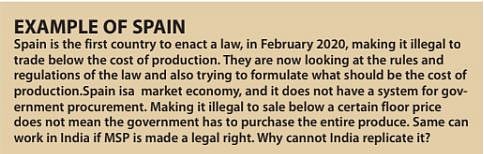
What farmers need everywhere today is a guaranteed price for their produce which alone can pull them out of the prevalent crisis. Markets would automatically adjust to it. Don’t forget when the debate about minimum wages had started, corporates had objected saying this would upset their balance sheet but eventually they had to provide minimum wages and adjust their business plans accordingly. If there can be minimum wages for workers, it is time we provide minimum support price (MSP) to the farmers as a matter of right.

Let us look at the confectionary industry with a turnover of $212 billion. Chocolate is a major component. Guess what the average income of a cocoa farmer is, it is Rs 100 per day, less than the price of a standard chocolate bar. Coffee industry is no better. There are around 50-60 lakh coffee bean farmers across the globe and 80 percent of them earn less than $1.9 per day, which the World Bank defines as acute poverty line imagine if these farmers had received a minimum support price all these years rather than being left to face the brutalities of the market.

Source: Lessons for Indian Agriculture. National Herald. April 17, 2021. https://www.nationalheraldindia.com/india/why-should-india-follow-an-agricultural-model-that-has-failed-in-the-developed-world?fbclid=IwAR1HyZFqUbmx02dpM3NO56tcVGmi60Z2smQryqLTowhP5uRGDfFEMh6dm94


READ MORE - What India is doing today to Agriculture was done by the West with disastrous consequences

Friday, January 24, 2020

Invisible Emergency


Three weeks after the kharif harvesting season began farmers were unable to get the right price for their produce. Out of the 14 kharifseason crops that were being marketed, a newspaper reported (Oct 26, 2019) that the mandi prices of at least nine of these crops had been ruling much below the minimum support price (MSP) that was announced by the government. Market prices for moong, urad, tur, niger, bajra, jowar, ragi, cotton, soybean and sunflower were about 8 to 37 per cent below the MSP. In addition, market prices of cotton too were short by an average of Rs 500 a quintal (from the MSP) while farmers had a better price realisation only in case of paddy and maize wherein a more assured procurement system operates.   

Well, isn’t that reason to celebrate? If food prices remain low, the household budget remains intact. The nation rejoices when food inflation remains in check. Never bothering to know what happens to millions of farmers who produce that cheaper food.

Let’s look a little further. The price drop in kharif 2019 was no exception. For the past two years, farmers had reportedly sold pulses, oilseeds and coarse cereals at prices that were 20 to 30 per cent lower than the MSP. Across the country, irate farmers had protested at many a places demanding purchase of the crop harvest they had brought to the mandis. Even in case of wheat and rice, the two crops that are largely procured, farmers were unable to get the procurement price except at places where a robust procurement system exists. Primarily for this reason, truck-loads of paddy and wheat are illegally transported all the way from Bihar and Uttar Pradesh to Punjab and Haryana where a vast and efficient procurement network exists. But with the World Trade Organisation (WTO) breathing down its neck, and with autonomous liberalisation in progress, India is under tremendous pressure to dismantle the food procurement and distribution network.

Suddenly, for no apparent provocation, in the midst of the paddy procurement season, the Karnal district administration in Haryana imposed a ceiling on paddy purchase beyond its quota of 13.5 lakh tonnes for the season. While no explanation    available, the government it seems is all set to withdraw from its stated commitment to buy every grain of wheat and paddy that is brought to the mandi. In Punjab too, the Chief Minister has reportedly told a meeting of arhtiyas that he would not be able to make a commitment that the procurement operations next year operates as smoothly as it used to all these years, pointing to a cut in public stock holding limits in future. Perhaps this is the beginning of an end of public procurement, a system that was so assiduously built over the years pulling the country literally out of the ‘ship-to-mouth’ trap, when food aid from across the continents would go directly to feed the hungry population.   

With granaries overflowing now, cutting down on procurement seems to be the policy approach to reduce unmanageable food surplus. But what will happen to millions of farmers, who toil hard to produce bumper harvests, only to find no buyers for their produce? Will the nation evolve a system of adequately compensating the farmers while keeping prices low?

Farmer throwing tomato, potato and onions on the streets is a recurring phenomenon. Add to it the denial of rightful price for most agricultural commodities, and that too year after year, the reasons for the continuing agrarian distress becomes all too apparent. In fact, I have always maintained that when a farmer undertakes crop cultivation what he does not realise that he is actually cultivating losses. This is appropriately illustrated in an analysis in the Down to Earth magazine (Feb 16-28, 2019) that clearly showed that against a production cost of Rs 32,644 per hectare for wheat, a farmer is able to get only Rs 7,639 leaving a huge shortfall of Rs 25,005 per hectare. In the case of paddy, the loss is Rs 36,410 per hectare; for maize, the gap is Rs 33,688 and for arhar the loss works out at Rs 26,480 per hectare.

Take another case. In response to an RTI application, the Department of Agriculture, Haryana, had replied saying that against the estimated cost of production of wheat at Rs 2074 per quintal for the 2018-19 marketing season, the procurement price was Rs 1,840 per quintal, which means a loss of Rs 234 per quintal. Similarly, for cotton the procurement price was Rs 5,450 per quintal against an average cost of production of Rs 6,280 per quintal, showing a loss of Rs 830 per quintal. With procurement prices deliberately kept low, agriculture becomes a loss making enterprise, and sooner or later farmers are left with little choice but to quit or continue to slog under distress all through life. For the Commission for Agricultural Costs and Prices (CACP) – which works out the MSP for 23 crops – the mandate is not only to provide an assured price to farmers but to maintain a balance with international prices thereby ensuring that the procurement price it fixes does not fuel inflation. The higher the food inflation, the higher will be the pressure on industries to provide higher wages to workers. The higher the wages for industrial workers, the more is the possibility of economic reforms going awry.

Farmers alone therefore are left to bear the burden of keeping food inflation low. They are silently bearing the cost of subsidising the consumers.

The cost of keeping food inflation low has been unprecedented. A brute illustration of the staggering cost farmers had to pay to keep food prices under check comes out very clearly from an OECD-ICRIER study, which computes that between 2000-01 and 2016-17 – a period of 17 years --  farmers suffered a cumulative loss of Rs 45-lakh crore on being denied the rightful price for their produce. It estimated the loss per year for farmers at Rs 2.65-lakh crore based on a negative Producer Support Estimate (PSE) Index of (-) 14.4 per cent. PSE tells us what percentage of farm revenue came from policy support. In case of India, farmers suffered because of trade restrictions, low prices and huge gaps in marketing policies, including shortfall in assured procurement. But an interesting point here is that the loss to farmers actually works out to be the gain for consumers. Perhaps that’s the reason why the shocking estimates of massive losses suffered by farmers didn’t draw any outrage from the middle class.

While the government gets a pat on the back for keeping food inflation under control, it is difficult to even visualise the trauma and suffering a farming family has to undergo after being denied the rightful price for their produce; the hardship families have to suffer when farmers dump tomato or potato or garlic onto the streets out of sheer frustration arising from a price crash in the markets. The denial of rightful income increases their dependence on farm credit as a result of which household indebtedness has multiplied over the years. The increasing debt burden is the primary reason for the spate of farm suicides the country is witnessing, and which (the data) the government has been withholding after 2016. According to the National Crime Record Bureau (NCRB) as many as 3,18, 528 farmers had committed suicide between 1995 and 2015, a stark reminder of the severity of the crisis.

When prices slump, the small farmers are first to bear the consequences, often fatal, but forcing them to abandon agriculture and migrate to the cities looking for menial jobs. On the other hand, increasing migration from rural to urban areas is seen as a sign of economic growth. In fact, the policy emphasis has remained on moving people out of agriculture into the cities which are in need of dehari mazdoor (cheap labour). The continuous slide in real farm incomes therefore has only helped create conditions that forces farmers to abandon agriculture and migrate. According to Niti Aayog, the growth in real farm incomes in the 5 year period between 2011-12 and 2015-16 has been less than half a percent every year, 0.44 per cent to be exact. In such a dismal scenario, what do we expect farmers to do except to quit farming and migrate?  

As rural distress deepened, several studies have brought out the grim realities that continue to hit farm and non-farm workforce in rural India. When farming is in deep economic crisis, it will definitely cast a shadow on the workforce it is generally dependent on. With Gross Value Addition (GVA) in agriculture dropping to its lowest in 14 years, a  report by Centre for Monitoring Economy (CMIE) showed that in the past one year, 2018-19, almost 1.1 crore people lost their jobs. “An estimated 91-lakh job were lost in rural India, while the loss in urban India was 18 lakh jobs. Rural India accounts for two-thirds of India’s population but it accounted for 84 per cent of the job losses,” the report said. Earlier, a leaked Periodic Labour Force Survey 2017-18 report of the National Sample Survey Office (NSSO) had shown that 3.4 crore casual labourers in rural areas, of which 3-crore were farm workers, had lost job between 2011-12 and 2017-18. This represented a 40 per cent drop in casual farm workforce.

The demise of agriculture therefore is clearly embedded in the economic design. Keeping food prices low has been the bane of agriculture. Besides low prices, the continuing bias against agriculture is evident from the low public sector investments. As per the Reserve Bank of India, public sector investment in agriculture hovered around 0.3 to 0.4 per cent of the GDP between 2011-12 and 2016-17. Such low public sector investment pulled private sector investments down in the process, reaching a low (in combined investments) of 2.2 per cent of the GDP in 2016-17. With low investments and low output prices it is futile to accept a miracle to happen in agriculture. It is therefore quite obvious that the decimation of agriculture over the years is the outcome of an unwritten policy of keeping agriculture deliberately impoverished. It suffers not as much from low productivity (as is often believed) as from deliberately kept low farm incomes.

The immediate challenge is to bring more money into the hands of the farming community, which will create more demand, and in the process reignite the country’s economy. Moreover, if agriculture becomes economically viable and environmentally sustainable, it can take away much of the pressure the country faces in creating additional employment. Agriculture being the largest employer, it alone has the ability to reboot the economy. Especially at a time when the bottom 60 per cent population holds only 4.8 per cent of the national wealth, and a significant proportion of this comprise farmers and farm workers, a refurbished agriculture needs to look beyond the outdated textbook prescription of reducing the population in agriculture, and instead focus on revitalising agriculture. This is the surest way to Sabka Saath, Sabka Vikas.

Since a beginning has already been made with the launch of a scheme to provide direct income support to farmers, a tectonic shift in economic thinking moving from ‘price policy’ to ‘income policy’, one measure could be to double the allocation under PM-Kisan programme. At present, an amount of Rs 6,000 per month is being provided to landowning farmers, in three equal installments. Effectively this comes to a paltry support of Rs 500 per month, and needs to be raised to make a real difference. I am hoping that sooner than later, the direct income support will be enhanced to Rs 5,000 a month. This will supplement income support measures that have been launched in several states, beginning with the innovative Ryathu  Bandhu scheme in Telengana.

This has to be followed up by setting up a more elaborate mechanism to ensure a minimum monthly assured income of Rs 18,000 per month per farming family. The idea is not to issue a cheque every month but to evolve a mechanism to provide farmers with an assured monthly income based on crop productivity and geographical location of the farm. Among several other steps to bring in structural reforms that agriculture is crying for, agriculture needs to come up with an index for ease of doing farming. If 7,000 steps, big and small, can be created for the industry under the ease of doing business norms, I see no reason why agriculture should not receive the same benefit in governance and implementation issues.    

At a time when the average farmer in the United States receives a direct income support of $ 60,586 (Rs 42 lakh); $ 10,149 in Japan; and $6 ,762 in European Union; what the Indian farmer gets is too meagre. A farmer needs to be adequately compensated for the loss he/she incurs in providing cheap food. Let’s be clear, a farmer cannot be penalised anymore for growing food. The nation must stand with the farmers in this crisis and find a suitable template to provide them with a real income (and an annual increment) that is at par with other sections of the society. #

Source: State of Environment 2020. 
READ MORE - Invisible Emergency

Friday, November 29, 2019

Low farm incomes is killing agriculture


French farmers drove to Paris to protest low farm incomes -- Al Jazeera photo

A New York farmer, who also works as a lawyer, tweeted this the other day: “Headed home, I tried to work in the law office today, but my head is full of the disasters I am seeing on the dairy farms and in rural areas. Even long time farmers in my area are trying to sell land to save the rest of the farm. Where is this headed? I don't know.” Well, if such a deepening farm crisis should dominate one of the most productive agricultural systems in the world, it’s time to pause and rethink.

The question that needs to be asked is whether the US agricultural policy is deliberately aimed at decimating the farm sector? And in that sense whether Indian agriculture too is intentionally (or unintentionally) moving in that direction? To say that the landholdings in India are too small to be economically viable is understandable but why is that even in the United States, where the average farm size is 444 acres, small family farms should be on way out? Why is that in Australia, where the average farm size is 4,331 hectares, should agriculture become unviable? Going by the economy of scale there seems to be no plausible reason why farmers in America and for that matter in Australia should be quitting farming. If small holdings are unviable how come even large holdings are becoming uneconomical, unless of course policy makers refuse to admit that farmers everywhere in the world, not only in India, are being denied real time prices, depriving them of their rightful income.   

First of all, let’s be clear. The US has always been for pushing small farmers out of agriculture. Look at it, even at a time when US agriculture is passing through turbulent times, the American Agriculture Secretary Sonny Perdue unabashedly acknowledges: “In America, the big get bigger and the small go out.” This echoes what a former US Agriculture Secretary Earl Butz, who served under President Richard Nixon and Gerald Ford, had famously said: “Get big or get out.” This was followed by a cleverly drafted narrative of “feeding the world”, pushing farmers to produce large surpluses that actually dipped prices. Such a deliberate policy has left US small farmers struggling. Many of them are going out of business and quitting agriculture in desperation.

The policy to get big serves as an invitation for an increasing corporate control over agriculture, which is also becoming an unwritten policy for the developing world to follow. In addition, whether it is the World Trade Organisation (WTO) or the Regional Comprehensive Economic Partnership (RCEP) treaty, trade policies have been very conveniently tweaked to provide an enabling environment for big agribusiness giants to step in. As competitiveness became the market mantra, developing as well as least developing countries are being increasingly forced to open up for cheaper agricultural products, thereby displacing millions of small farmers in the bargain.

To illustrate, the biggest dairy farm in China is spread over 22,500,000 acres, an area equal to that of Portugal. According to worldatlas.com, this farm houses around 100,000 cows. The second biggest dairy farm, spread over 11,000,000 acres, is also in China. The remaining eight of the top ten big dairy farms are situated in Australia, which despite the size are under stress. No wonder, the push for seeking an unfettered access into India through the regional mega RCEP treaty, which India has for the time rightly decided to stay out. Considering that 10 million people are involved in dairying in India, imagine the destruction of livelihoods from cheaper dairy imports from Australia, New Zealand and China.     

Returning back to agriculture, rural America, like rural India, is faced with a severe agrarian crisis. Like in India, where the average income of farming families in 17 states, which is roughly half the country, stands at a paltry Rs 20,000 a year, the US agriculture is not doing good either. More than half of US farmers have a negative income. According to the American Farm Bureau Federation, 91 percent farmers and farm workers face distress. Besides affecting their mental health, the severity of the crisis is such that 87 percent farmers fear they will have to abandon farming. Accordingly, farm debt in 2019 is expected to soar to $ 416 billion, the highest since 1980. For several decades, farm gate prices have remained frozen when adjusted for inflation. Prevailing onion prices for instance are no different from the prices farmers received 30 years back. Corn prices have remained static for almost five decades.

If such a worsening farm crisis is happening in a country which applies state-of-the-art technology in agriculture, and is often projected as an example to be followed by the rest of the world, isn’t it time to re-evaluate how inappropriate is the argument for pushing in more sophisticated technology (often unwanted) in Indian agriculture? No one is against technology but it has to be relevant depending on the needs, and not pushed to simply benefit commercial interests. If in a country which is completely high-tech in agriculture, the suicides rate in rural areas is 45 per cent higher than in urban areas isn’t it time to redesign Indian agriculture, focusing more on sustaining small farms thereby reducing the rural urban migration? Shouldn’t the Ministry of Agriculture and Farmers Welfare therefore embark on a fresh strategy to bring in policies tuned in more to domestic needs that make farming environmentally sustainable and economically viable?

An OECD-ICRIER study has shown that Indian farmers have been suffering a loss of 14 per cent every year in farm incomes for almost two decades, between 2000-01 and 2016-17.  This has largely benefitted the consumers who paid 25 per cent less for all agricultural commodities every year. In other words, it is the farmers who have been subsidising the country all these years. An outcome of the global economic design which aims to deliberately keep farm prices low, farmers’ anger is brewing across the world. As farm protests spill on the streets in Germany, Holland, Canada, America and India, the reason for growing farm anger was best summed up by Ian McLachlan, President of the National Farmers Federation of Australia, who had sometimes back while addressing a farmers rally said: “We’re sick and tired of subsidising the rest of Australia.” #

Farm tech bring pushed to benefit Corporates. The Tribune. Nov 30, 2019.

READ MORE - Low farm incomes is killing agriculture