Friday, November 29, 2019

Low farm incomes is killing agriculture


French farmers drove to Paris to protest low farm incomes -- Al Jazeera photo

A New York farmer, who also works as a lawyer, tweeted this the other day: “Headed home, I tried to work in the law office today, but my head is full of the disasters I am seeing on the dairy farms and in rural areas. Even long time farmers in my area are trying to sell land to save the rest of the farm. Where is this headed? I don't know.” Well, if such a deepening farm crisis should dominate one of the most productive agricultural systems in the world, it’s time to pause and rethink.

The question that needs to be asked is whether the US agricultural policy is deliberately aimed at decimating the farm sector? And in that sense whether Indian agriculture too is intentionally (or unintentionally) moving in that direction? To say that the landholdings in India are too small to be economically viable is understandable but why is that even in the United States, where the average farm size is 444 acres, small family farms should be on way out? Why is that in Australia, where the average farm size is 4,331 hectares, should agriculture become unviable? Going by the economy of scale there seems to be no plausible reason why farmers in America and for that matter in Australia should be quitting farming. If small holdings are unviable how come even large holdings are becoming uneconomical, unless of course policy makers refuse to admit that farmers everywhere in the world, not only in India, are being denied real time prices, depriving them of their rightful income.   

First of all, let’s be clear. The US has always been for pushing small farmers out of agriculture. Look at it, even at a time when US agriculture is passing through turbulent times, the American Agriculture Secretary Sonny Perdue unabashedly acknowledges: “In America, the big get bigger and the small go out.” This echoes what a former US Agriculture Secretary Earl Butz, who served under President Richard Nixon and Gerald Ford, had famously said: “Get big or get out.” This was followed by a cleverly drafted narrative of “feeding the world”, pushing farmers to produce large surpluses that actually dipped prices. Such a deliberate policy has left US small farmers struggling. Many of them are going out of business and quitting agriculture in desperation.

The policy to get big serves as an invitation for an increasing corporate control over agriculture, which is also becoming an unwritten policy for the developing world to follow. In addition, whether it is the World Trade Organisation (WTO) or the Regional Comprehensive Economic Partnership (RCEP) treaty, trade policies have been very conveniently tweaked to provide an enabling environment for big agribusiness giants to step in. As competitiveness became the market mantra, developing as well as least developing countries are being increasingly forced to open up for cheaper agricultural products, thereby displacing millions of small farmers in the bargain.

To illustrate, the biggest dairy farm in China is spread over 22,500,000 acres, an area equal to that of Portugal. According to worldatlas.com, this farm houses around 100,000 cows. The second biggest dairy farm, spread over 11,000,000 acres, is also in China. The remaining eight of the top ten big dairy farms are situated in Australia, which despite the size are under stress. No wonder, the push for seeking an unfettered access into India through the regional mega RCEP treaty, which India has for the time rightly decided to stay out. Considering that 10 million people are involved in dairying in India, imagine the destruction of livelihoods from cheaper dairy imports from Australia, New Zealand and China.     

Returning back to agriculture, rural America, like rural India, is faced with a severe agrarian crisis. Like in India, where the average income of farming families in 17 states, which is roughly half the country, stands at a paltry Rs 20,000 a year, the US agriculture is not doing good either. More than half of US farmers have a negative income. According to the American Farm Bureau Federation, 91 percent farmers and farm workers face distress. Besides affecting their mental health, the severity of the crisis is such that 87 percent farmers fear they will have to abandon farming. Accordingly, farm debt in 2019 is expected to soar to $ 416 billion, the highest since 1980. For several decades, farm gate prices have remained frozen when adjusted for inflation. Prevailing onion prices for instance are no different from the prices farmers received 30 years back. Corn prices have remained static for almost five decades.

If such a worsening farm crisis is happening in a country which applies state-of-the-art technology in agriculture, and is often projected as an example to be followed by the rest of the world, isn’t it time to re-evaluate how inappropriate is the argument for pushing in more sophisticated technology (often unwanted) in Indian agriculture? No one is against technology but it has to be relevant depending on the needs, and not pushed to simply benefit commercial interests. If in a country which is completely high-tech in agriculture, the suicides rate in rural areas is 45 per cent higher than in urban areas isn’t it time to redesign Indian agriculture, focusing more on sustaining small farms thereby reducing the rural urban migration? Shouldn’t the Ministry of Agriculture and Farmers Welfare therefore embark on a fresh strategy to bring in policies tuned in more to domestic needs that make farming environmentally sustainable and economically viable?

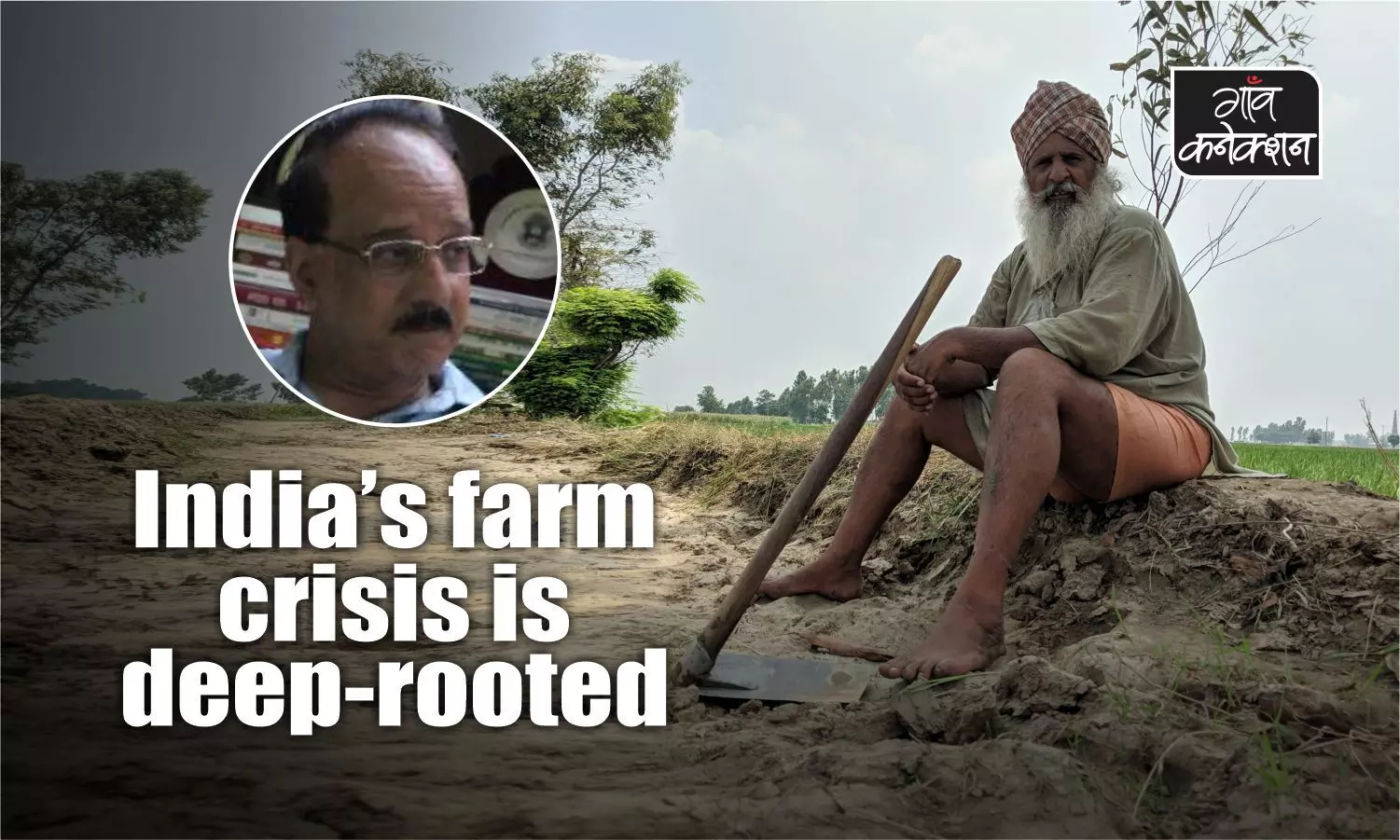
An OECD-ICRIER study has shown that Indian farmers have been suffering a loss of 14 per cent every year in farm incomes for almost two decades, between 2000-01 and 2016-17.  This has largely benefitted the consumers who paid 25 per cent less for all agricultural commodities every year. In other words, it is the farmers who have been subsidising the country all these years. An outcome of the global economic design which aims to deliberately keep farm prices low, farmers’ anger is brewing across the world. As farm protests spill on the streets in Germany, Holland, Canada, America and India, the reason for growing farm anger was best summed up by Ian McLachlan, President of the National Farmers Federation of Australia, who had sometimes back while addressing a farmers rally said: “We’re sick and tired of subsidising the rest of Australia.” #
Farm tech bring pushed to benefit Corporates. The Tribune. Nov 30, 2019.

READ MORE - Low farm incomes is killing agriculture

Wednesday, November 27, 2019

Rs 1,700 not enough to even feed a cow, how can a farmer-family survive on it? -- An interview

Rs 1,700 not enough to even feed a cow, how can a farmer-family survive on it?: Devinder Sharma


With the rising input costs and failure to get a suitable price for the crops, about 50% of farmers are resolving to drop farming. The country is witnessing a drastic fall in the agriculture development rate. Excerpts from the conversation between country's renowned food and export policy expert Devinder Sharma and deputy news editor Gaon Connection, Arvind Shukla concerning agriculture and the farmer crisis.

Be it India or the US, which is the root cause of agriculture and farmers crisis? 

While understanding the worldwide agricultural crisis one can easily discern a fact that everywhere the governments have knowingly kept the farmers at a disadvantage in terms of their income. Farmers did not get a fair price for their crops. This only caused the current crisis.In order to understand the situation, we will have to know about the economic design and cycles of India and other countries. We may compare the agriculture in the 1960s and present times in the US to find that the real income of the farmers has gone down. This is admitted by the Chief Economic Advisor of the US Agricultural Department. In 2018, the average income of the US farmers has fallen not for the first time, but for the sixth year in a row. This is the state of the US which we look up to in matters of technological advancements and policies. India too suffers from a similar crisis. Our governments have deliberately kept farmers away from better incomes to discourage agriculture because it is believed that economic transformation would only be realized upon agriculture's fall. Economists of India and elsewhere are of the opinion that people be pulled to the cities to provide cheaper labour for the industries. Industries require cheap raw materials in order to thrive. This is why the agriculture crisis is existent. The Indian Economic Survey 2016 informs that in 17 states or we can say half of India, farmer family's average annual income is Rs 20,000 which is Rs1,700 per month. Such an amount cannot even support a cow's upkeep. Now imagine how would a farmer family be managing on such a pittance?

A large portion of Indian population is directly engaged with agriculture. Is such a sizeable population then constantly being overlooked? 

The NITI Aayog had, in one of its reports, mentioned that for the past two years the farmers' real income rise was zero. In the five years prior to this, the real income of the farmer families had only increased by a mere half per cent. I know the exact figure to be 0.44%. Let us go back a little further in the past. A research revealed that for the period 1985-2005, the farm-get price (the price which a farmer receives) remained frozen. Keeping in mind the inflation, one would notice that the price which farmers got in 2005 was the same as that in 1995, rising input costs notwithstanding. It means that for over 20 years the prices remained constant. We can understand better with the help of another report. As per a report of Organization for Economic Co-ordination and Indian Council for Research on International Economic Relations (OECD-ICRIER), the farmers suffered a loss of Rs 45 lakh crore during the period 2000-2017 due to not getting a fair price for their produce. So, you can well understand the agriculture crisis where the farmer is made to survive on the same income for the past 40 years. Had the same happened to any of us, we would have long committed suicide or left the business for good. There is a need to view this crisis in terms of income versus expenditure.But instead, such a scenario was created that farming isn't economically viable because of poor yield to the farmer. This notion is false. 

But isn't it generally said that the farmers are disappointed over poor yield? 

I agree that many crops fall short at the national level, but even more important is to know what will be done of a better yield. Is it to be found dumped by the farmers on the roads due to lack of fair pricing or resulting in farmers' suicide? This means that the problems lies elsewhere and we are looking for it somewhere else. Take for example the situation in Punjab. With 98% of the area in Punjab well irrigated, there would hardly be a single field without access to water. Punjab leads the world in paddy and wheat crops output. Better irrigation, better crop output and still Punjab shocks the world by the frequent cases of farmers' suicides. In the past 10 years, more than 10 thousand farmers have ended their lives in Punjab. This shows amply that the crisis is not due to lack of irrigation or production because even in the regions having an abundance of both farmers are still resorting to suicides. Somewhere the policymakers, governments and politicians will have to really look and think what is actually wrong and find means to resolve it. It should not be that for an Indian problem we look into Europe and the US for finding the solution. Many times, we have taken the wrong lessons from foreign nations and have paid dearly for it. So, I say that we should seriously deliberate to find a localized solution. 

A big concern for the farmers is their input cost. The government now talks of zero budget natural farming. Tell us more about it. 

I believe that the term 'zero- budget' has sent across the message that we need not invest anything during farming and that the farmers needn't put in much. If the policymakers believe that a decrease in the cost of production will translate into an increase in the income then such a formula of zero budget is problematic. India has had a long tradition of natural methods and low-cost production. Even you at some point been asked what is in a name. Once I was told by the famous writer Khushwant Singh that his record-breaking novel was rejected by over 20 publishers before he renamed it as Train to Pakistan. Zero budget, therefore, seems an obvious escapist move to absolve a government of its responsibility. The RBI date for the period 2011-2016-17 reveals that the total agricultural investment in the country was a mere 0.4% of the GDP while the sector supports 50% of the population. It means that one isn't inclined to invest for 50%. So, following the 0.4% investment, the zero-budget formula of the NITI Aayog seems but natural. I believe zero-budget farming technique to be sound, it just needs the addition of agro-ecological or needs to be kept nature and environment-friendly. Many people in India have worked on natural farming—Narayan Reddy in Karnataka, Bhaskar Salve in Gujarat and Naamalvar in Tamil Nadu had taught people to cultivate without pesticides. With these three long gone, there are still many who are dedicated to promoting natural farming at their own level. Farming should involve minimum external input, whatever is available in fields or home must be used for farming. Finance Minister, Nirmala Sitaramanan had begun a new chapter by mentioning it (zero budget farming). This needed to be vocalized because the world has finally understood that it is better to keep harmful pesticides at bay. India started a dialogue when such issues are already taken up in the US and Europe. 

Does it mean that the developed nations are considering a revisioning of existing agricultural practices? 

A few days ago, there came up a report of a commission in Britain (food farming and countryside commission) advocating several major changes. The report warned that the path of intensive farming that we currently follow is not correct. People's health has suffered, the soil has suffered, input costs have risen, environment adversely affected, water drained out and even climatic changes have all been attributed to the intensive farming system which called for intensive use of fertilizers and pesticides. They say that Britain must undergo a transitional period towards agroecological systems by adopting nature-based farming.If Britain thinks on these lines that this is the right opportunity for India as we had adopted their modern farming practices and methods before. So, if they are changing so we must. All nature-based processes are beneficial. Whether organic farming or zero-budget natural farming or home therapy or bio-dynamics—we must promote and adopt them judiciously. Some process would more effective in Punjab than Karnataka, a technique used successfully in Rajasthan may not be as effective in Kerala. Therefore, varied techniques must be brought into use. We would have to show the farmers the way to resolve their woes. Pesticides anyway are poisons and their use in any crop is bound to have its ill-effects.#

Published: Sept 14, 2019

Link: https://www.gaonconnection.com/read/devinder-sharma-shares-his-views-on-the-plight-of-farmers-in-india-their-low-incomes-and-zero-budget-farming--46233  

READ MORE - Rs 1,700 not enough to even feed a cow, how can a farmer-family survive on it? -- An interview

Thursday, November 21, 2019

   A friend and colleague asked me to review his fascinating book, and I gladly obliged. That review is below. --SY

Book Review: Practical Politics
After reading “Practical Politics: Lessons in Power and Democracy” by Titus Alexander, I am convinced more than ever about the urgent need for both political literacy and media literacy.

Alexander’s book, beginning in chapter one, makes a compelling case for why universities should teach practical politics as a basic life skill (like reading and writing). He writes that practical politics-trained students will be more employable, will possess an improved ability to solve complex social problems, and can help to restore trust in democracy.

In addition, in chapter three, Alexander theorizes that a society steeped in practical politics can improve its governance. He writes,

Campaigns by the Bristol schoolgirls, Citizen UK, Brake and victims of
sexual abuse are calls for better governance, by institutions such as the
BBC, schools, road safety bodies, employers and the state. People want
‘units of rule’ to be run well and solve problems better. This is the supply
side of politics, what I call the top tier of political action, involving leaders
and decision-makers at any level. Improving governance and the ability of
political decision-making to respond better to citizens will also encourage
people to take part, the demand side of politics, because better governance
creates hope that they can make a difference.

Encouraging people to take part in society, and prodding decision-makers to act, can best be facilitated by and through a simultaneously politically and media-savvy public. 
As a communications professor, I see media literacy the same way Alexander sees political literacy: as an essential tool to restore and maintain democracies. In fact, the two are complementary, and if taught side-by-side, can serve to empower and amplify citizens’ voices.

This relationship between media and politics is explored in chapter five of the book. In this section, Alexander notes that the media are the public’s primary source for political education, the “main channel for politicians to communicate with the public,” and finally the means through which journalists can “influence the political agenda.” Alexander correctly points out that ownership, control, and use of the media are critical political battle grounds. This can be clearly seen both in the U.S. and U.K. in the ongoing political/media turmoil surrounding the Trump presidency/impeachment and Brexit. One is left wondering: If our publics know practical politics, would they be as susceptible to political disinformation, propaganda, and self-serving half-truths dished out by politicians, political pundits, and red-faced cable TV talking heads? If citizens had a more nuanced understanding  of media and politics, would they be so quick to reflexively retreat into their media bubbles, consuming only that which confirms their world view?

Later in chapter five, Alexander cites a study showing the media consumers trust the media more than politicians—hardly an accomplishment worth crowing about.  In the U.S., trust in media can be charted according to individual media outlets—viewers trust “their” channels, and distrust those outside their media bubble. Regarding the internet, Alexander writes, “Traditional political parties and campaigners are also investing heavily in using new media to reach target audiences, so it is hard to predict how far power will really shift.” Thus, simultaneous political and media literacy takes on a new urgency, one necessitated by the exponentially growing power of social media for the delivery of information, or disinformation. Alexander concludes,

Citizens need to learn media literacy to understand how it works,
how to use the media to have their say about issues of the day and how to
win and use power accountably. The press and television, particularly the
BBC, could also play a bigger role in giving citizens impartial information
on how the system works, contentious issues and how to have an effective
voice in politics.

Alexander expands on this point in chapter 10, when he discusses the media’s role in political education. He writes,

What is missing are straightforward guides (produced by media outlets)
to help people navigate issues and find the best way to have their say.
For democracy to flourish, citizens need more than commentaries
and analysis of the issues. They also need to know how they can influence
decisions. To do this, politics needs to be presented as something anyone can
do all year round, not just in elections every few years. Promoting public
participation does not mean taking sides on the issues, but siding with the
public. Citizens are ultimately responsible for how the country is governed
and need to be better informed…A free press and independent media are critical for 
democracy, providing a plurality of opinion and scrutinizing those in power. 
Here here. If citizens are empowered with political literacy, they will know that they
can participate and, ultimately, how to most efficaciously influence decisions. If
they are also endowed with media literacy, citizens will understand how to reject
disinformation and to leverage media to amplify their voices.


In chapter eight, Alexander proposes a model to teach practical politics that mimics business education in that it would “create and disseminate applied knowledge” in a manner that will fulfill Harvard Business School’s charge to “make a difference in the world.” This model has proven to be successful in business school settings, so it’s logical to believe that it could work with practical politics. In fact, my Center for Global Peace Journalism follows a similar model wherein peace journalism is taught as an academic discipline while it is simultaneously promoted, implemented, and practiced around the world.

In chapters 10 and 11, the author offers useful guidance on both creating practical political content and navigating the choppy waters of curriculum change. This advice, in fact, will prove indispensable for any academic needing guidance on how to deftly surmount curricular barriers.
In conclusion, I found “Practical Politics: Lessons in Power and Democracy” by Titus Alexander useful as a practical guide to promoting political literacy, an inspirational tool, and an important reminder about the vital interdisciplinary connections between political science and media studies.

“Practical Politics: Lessons in Power and Democracy” author Titus Alexander is the founder and director of Democracy Matters in the UK and honorary fellow at the Crick Centre at the University of Sheffield.

Reviewer Steven Youngblood is the director of the Center for Global Peace Journalism (www.park.edu/peacecenter) at Park University in Parkville, Missouri, where he is a communications professor. He is author of “Peace Journalism Principles and Practices” and editor of the “Peace Journalist” magazine.

READ MORE -

Wednesday, November 20, 2019

Students Have A Right To Postpone A School Expulsion Hearing For Up To 30 Calendar Days

By Michelle Ball, California Education Attorney for Students since 1995

Did a public school expulsion recommendation just get sprung on you?  Or is the expulsion hearing fast approaching and you don't feel you have enough time to prepare your child's defense?  Not to worry- you can push back the expulsion hearing, up to 30 calendar days, with no questions asked.  

Parents often feel helpless when they are facing an expulsion hearing.  When they finally receive a hearing date, they may have less than 10 days to prepare.

Meanwhile, parents are still recovering from the shock that their child is UP FOR EXPULSION (!), dealing with their new presence at home, rather than at school, and need to prepare for a legal hearing with evidence and witnesses.  

Parents sometimes have not even received the documents from the school for the hearing when they get the hearing date, or if they did get the expulsion packet, it can be full of falsehoods they don't know how to address.  It can all be very trying.  Postponement can help.

Per California Education Code section 48918(a), a student is entitled to at least one postponement of the expulsion hearing for a maximum of 30 calendar days.

To get the postponement, the request should be put in a formal communication (written), and receipt by the school district verified.  A parent should also follow up to get verification from the school district that the original hearing date is now OFF CALENDAR, even if a new date has not yet been set.  If something goes haywire, like the district did not receive the request for postponement, or a secretary did not pass it on, a parent needs to catch this quick.

In the request for a new hearing, a parent can list dates they may want for the new hearing, or ask that the new date not be set until both sides agree.  Districts don't always coordinate a new date, as sometimes they have set hearing times (particularly if the full school board will hear the matter), but coordination of the new date is usually possible.

There are wrinkles in this, as always, as if there is a procedural issue with the district's notice of hearing and a postponement is requested, this could potentially be waived, but parents may also attempt to reserve any of these issues when they request postponement.  Whether a postponement is advisable or not, is a fact-dependent matter.

Expulsion hearings are very important and should be approached by parents in an organized way.  If  a postponement means the difference between being prepared or unprepared, it may be wise to consider a requesting one.  

Best,


Michelle Ball

Education Law Attorney 


LAW OFFICE OF MICHELLE BALL 

717 K Street, Suite 228 

Sacramento, CA 95814 

Phone: 916-444-9064 

Email:help@edlaw4students.com 

Fax: 916-444-1209

Website, Blog, Twitter, YoutubeFacebook


Please see my disclaimer on the bottom of my blog page. This is legal information, not legal advice and no attorney-client relationship is formed by this posting, etc. etc.!  This blog may not be reproduced without permission from the author and proper attribution of authorship. This blog may not reflect the current state of the law.


Originally published 1/10/11, edited 11/20/19, 9/9/20
READ MORE - Students Have A Right To Postpone A School Expulsion Hearing For Up To 30 Calendar Days

Sunday, November 17, 2019

India stays out of RCEP treaty


15 members of RCEP --Wikipedia map

Soon after assuming office, when the US President Donald Trump withdrew from the Trans Pacific Partnership (TPP) mega-trade agreement between 12 countries, which shared a common coastline on the Pacific and made up for 40 per cent of the global GDP, it came in for a lot of criticism. Terming it as a “horrible deal” President Trump was convinced that the treaty, which was meant to remove 18,000 tariffs on agricultural and manufactured goods, would steal American jobs.

Withdrawing from another mega-trade deal -- the Regional Comprehensive Economic Partnership (RCEP) -- which covers 45 per cent of the global population and accounts for 25 per cent of world’s GDP, Prime Minister Narendra Modi in a statement a few days ago, said: “When I measure the RCEP Agreement with respect to the interests of all Indians, I do not get a positive answer. Therefore, neither the Talisman of Gandhiji nor my own conscious permits me to join RCEP.” Remarkable words, indeed. Again, like US President Trump, what perhaps weighed on Prime Minister’s mind were the massive job losses and livelihood destruction expected on removing tariffs on 92 per cent of the tradable goods, including manufacturing and agriculture.

At a time when the dominant economic thinking is swayed towards globalisation, a strong leader demonstrating political courage to withstand the tide is certainly admirable. More so, at a time when dominant economic thinking creates a fear of the unknown – how much the country will miss out by not being a part of the proposed free trade agreement (FTA), some term the phenomenon as Fear of Missing Out (FOMO), the Prime Minister’s assertion for fairness and balance is legitimate. Such a precautionary approach becomes absolutely essential knowing that in the past too India had entered into free trade agreements with 12 of these RCEP countries (including the 10-member ASEAN grouping) with the same illusion of finding an access into their markets only to register a whopping trade deficit of $ 107.28 billion. The assumption that getting into an RCEP agreement at this stage will further widen the trade deficit and hit agriculture the most therefore is not entirely unfounded.

Similarly, the over enthusiasm with which India went on signing Bilateral Investment Treaties (BITs) on the presumption that it will promote investments were in reality vague and without proper homework. As the number of arbitrations increased, India terminated 58 of these BITs.

Given this backdrop, it is quite obvious that the fear of unknown has been over-hyped. If the FTAs with the Asian countries were pushed in the search of penetrating important markets and participating in the value chains of East Asian economies, it didn’t work. To Illustrate, India’s trade deficit with the 10-member ASEAN, signed in 2010, has increased by 250 per cent. It is therefore quite obvious that the Indo-ASEAN Agreement was signed without any adequate assessment, no proper scrutiny and was perhaps based more on the unknown FOMO factor. Otherwise there is no reason that the exposure to 10 Asian countries markets should fail to provide any significant trade outcomes. It is therefore heartening to know that the Prime Minister has now called for a review of Indo-ASEAN trade agreement. In fact, not only Indo-ASEAN there is a dire need to review all the bilateral and plurilateral trade agreements that India has so far signed.

There are lessons in store. When the multilateral World trade Organisation (WTO) treaty came into effect, a lot of euphoria was generated. We were told that a multilateral trading system – based on one country one vote principle – would obliterate the need to get in cumbersome and time consuming bilateral agreements. But over the years, this was proved wrong with more than 300 bilateral free trade agreements (FTAs) signed, which in principle were WTO plus treaties with stronger intellectual property rights (IPRs) and aggressive push to open up markets. Since most countries already are into bilateral agreements – with emphasis on zero tariff imports and removal of non-tariff barriers -- I fail to understand how any incremental growth can be expected from regional treaties where majority members are already having separate FTAs. Unless of course the new grouping includes a giant like China (with which India has a trade deficit of $ 53 billion) and countries like Australia and New Zealand (like in the RCEP) which desperately eye to get a foothold into India’s dairy (and farm sectors) to pull out their own dairy sector from distress.

The extra precaution with which India wants to engage with RCEP trade partners is therefore quite justified. Although the Commerce Minister Piyush Goyal lays out three conditions – strict rules of origin, updated base duty period, from 2014 to be moved to 2019, and auto-trigger mechanism – to be addressed before re-entering the RCEP negotiations, India’s decision making should be guided by more detailed studies and more open and transparent stakeholder dialogues. The Ministry of Commerce cannot be allowed to work in isolation, and needs to take other ministries on board. Reports saying that China was upset at India opening up issues like auto-trigger at times of volume surge, changing the base duty etc a few months before the treaty was being finalised raises questions over the competence of Indian negotiators. How come for seven years of RCEP negotiations, they failed to bring up these crucial issues that India is in any case fighting for in the ongoing Doha Development Round of WTO. 

Even during the earlier days of WTO negotiations, the promise of a drastic reduction in the monumental agricultural subsidies being provided by the richest trading block – the Organisation for Economic Cooperation and Development (OECD) – was projected to act like a ‘big bang’ for India’s farm exports. This was a gigantic mistake. Except for a jugglery in the way these agricultural subsidies were very conveniently shifted between the three boxes – green, amber and blue (in WTO parlance) – these subsidies have remained more or less intact. The 28-member EU provides $ 65 billion in farm subsidies, three times of what the US gives, and any quick effort to sign an FTA with these two giants must be carefully evaluated in the light of the damage it can inflict on India’s agriculture. Considering that 600 million people are engaged in agriculture, directly or indirectly, it is important to weigh the fallout on farm livelihoods before rejoicing over the market access an FTA provides. Nor can agriculture be sacrificed anymore for some gains in the services sector. Let’s treat Mahatma’s talisman as the preamble for any future trade negotiations. #


India holds its own. The Tribune. Nov 15, 2019
https://www.tribuneindia.com/news/comment/india-holds-its-own/860892.html?fbclid=IwAR1-S3eR9t3Fg4Lcn25eVXYWSVjqbnlcnwGRu9muy4aRpdp5McRabJCG8vU
READ MORE - India stays out of RCEP treaty

Tuesday, November 12, 2019

Presenters battle disinformation with fact checking, literacy, PJ
(Strasbourg, France)—Disinformation is a menace to democracies around the world. Yet, there are those around the world who are fighting disinformation using fact checking, literacy program, and peace journalism.

These anti-disinformation efforts were detailed at a session called “Mythbusters,” which was part of the Council of Europe-sponsored World Forum for Democracy last week in Strasbourg, France.

My presentation was titled, “Disinformation, Democracy, and the Peace Journalism Solution.” I began by defining disinformation, which is the use of lies, half-truths, and irrational content to manipulate public opinion. We discussed its purposes (distracting, obscuring truth, inspiring action, and shaping the information environment) and characteristics (it works best when targeting pre-existing divides and prejudices within a society). Disinformation succeeds because trust in media is low, and because consumers embrace information that confirms their biases.
Steven Youngblood, Park U.

Then, I discussed how peace journalism is an effective tool for countering disinformation. First, PJ’s principles, as taught during hundreds of seminars around the world, are antithetical to disinformation, including seeking to unite parties (disinformation divides), carefully choosing language (disinformation leverages inflammatory, sensational language), and offering counternarratives that debunk stereotypes (disinformation relies on and reinforces stereotypes).

Other presenters in the “Mythbusters” session included Anna University (India) Prof. Sriram Arulchelvan. He discussed his university’s media information and literacy program that helps high schoolers spot fake news.
Austin Augbe, Nigeria
Austin Augbe, director of the Nigerian Centre for Democracy and Development, then presented about countering disinformation in Nigeria. He said that democracy is on the “verge of collapse” in Nigeria, and that disinformation is one reason why. His center has a project to fight disinformation through fact checking, training 500 fact checkers, spreading the word about a #StopFakeNews campaign, and conducting research on fake news.

Beatrice Simoncini then gave a different perspective on disinformation. She is a member of a working group on disinformation and spokesperson for the government of San Marino, a small nation of 33,000 surrounded by Italy. The working group’s efforts include convening conferences, fostering cooperation among entities battling disinformation, and sponsoring media literacy programs in schools.

Wrapping up the session were respondents Titus Alexander and Matthew Golozia. Alexander suggested that universities should lead the way in fighting disinformation, and act as “intelligence agencies” for democracy. This would include changing the story (in PJ terminology, counternarratives), speaking truth to power, and following the truth. Golozia concluded by opining that government regulation of internet providers and cell phone companies is needed so that everyone has equal access to information.

“Mythbusters” was hosted by the City of Strasbourg in its historic city hall in a room used for formal occasions and, frequently, for weddings. I can’t recall ever speaking in a more beautiful place.
Sriran Arulchelvan, India


From Nov. 8, 2019
World Forum: Disinformation is a threat to democracy
(Strasbourg, France)-At the World Forum for Democracy this week, the alarm sounded loudly on the threats to free press and democracy posed by disinformation.
First plenary session

In one plenary session, speakers discussed disinformation as a factor in eroding trust in the media. This session featured a spokesperson for Russia Today, RT, the Kremlin’s propaganda satellite TV channel/website aimed at an international audience. The spokesperson said RT has been unfairly labeled as disinformation, and is in fact an independent media outlet. This claim was met by groans and head shakes in the audience, and in fact sparked a one minute mini-demonstration wherein standing demonstrators loudly chanted, “Russia Today is fake!” Numerous questioners challenged the spokesperson about the true nature of RT.

After this session, discussion raged about whether RT should have been invited to the forum. My take: If we believe in the free exchange of ideas, we must not be afraid to confront propagandists.

Another authoritarian state, China, was in the spotlight in a speech by Shirley Lam of the Press Association of Hong Kong, who talked about the clash of values between mainland China and Hong Kong. Lam detailed a fake news campaign using 200,000 social media accounts to denigrate and delegitimization democracy activists and journalists, who are portrayed as unprofessional and biased. She said this disinformation is worse than physical violence because it “shakes the fundamental support for press freedom.”

The World Forum’s most poignant moment was when the names of 24 journalists killed in Europe during the last five years (including Jamal Khashoggi and Lyra McKee) were read aloud by Ricardo Gutierrez of the European Federation of Journalists. 

One recurring  theme at the forum was the conflict between those who believe disinformation can be tackled through regulating journalism and online platforms with those who prefer a more self regulated, free speech approach. The first approach might work in well developed democracies, but would surely be abused to stifle speech by authoritarian regimes, especially in the developing world.

This World Forum, titled “Is democracy in danger in the Information Age?”, also featured
Women in media session
presentations (and witty cartoons, several featuring Donald Trump) by Cartoonists for Peace, and a robust discussion about gender issues in journalism, including online harassment and how to counter it.

It was an honor to speak at the forum, and to meet so many who are engaged in the good work of battling disinformation.

The World Forum was sponsored by the Council of Europe.

READ MORE -

Monday, November 4, 2019

Conference explores human rights and journalism
If Friday’s session “Human Rights and Journalism” proved nothing else, it confirmed the deficits among media both here and abroad, particularly when it comes to reporting women and minority groups.

The Friday discussion was part of the three-day Greater Kansas City Peacebuilding Conference. The theme this year was “Human Rights: The Foundation of Peacebuilding.”

Sarah Margon from the Open Society Foundation, formerly of Human Rights Watch, led off the day by discussing why journalism matters to human rights organizations, and vice-versa. She said journalism is essential for figuring out what governments are doing, and to push for needed change. Margon noted that journalism matters to human rights organizations since journalism is a “force-multiplier” that can help set the agenda and maintain pressure for change. She cited the ongoing media pressure regarding the Jamal Khasoggi murder and the violence against the Rohingya in Myanmar as examples of beneficial media spotlights.

Lewis Diuguid; Bette Tate-Beaver at Park Univ.
Lewis Diuguid, author, lecturer, and journalist, and Bette Tate-Beaver, executive director of the National Association of Multicultural Education, continued the discussion by looking at media’s role in “continuing oppression” in society. The speakers presented information about the functions of media, then discussed how these functions (surveillance, correlation, transmission, entertainment, economic) make some minority groups (Asians, Native Americans) invisible, while relegating other minorities (African Americans, Latinos) to ne’er-do-well status--those who need to be watched closely (surveillance).

Journalist and syndicated columnist Mary Sanchez then discussed the importance of diverse newsrooms, noting that you “have to have connections to tell real stories” inside the Latino community. She said that she’s used Human Rights Watch for years as a reliable source of data. Sanchez also explored the fine line between journalist and activist.

The session ended with a call from Northern Ireland featuring veteran journalist and officer for the National Union of Journalists Kathryn Johnston. She decried journalism that re-victimizes those who have been traumatized—reporting that “strips people of their humanity.” She noted that women have been excluded from peace processes and newsrooms in Northern Ireland, to the detriment of both, and that her community overall has been desensitized to violence. When asked about Brexit, Johnston discussed the impact of a hard border. She said that this possibility has already led to violent threats. She said that if the hard border is established, she “fears” it will lead to a resumption of violence.
Overall, the presenters agreed that traditional media narratives often ignore or stereotype women and minority communities, and that the link between human rights and journalism is important if the potential of society is to be realized.

The Greater Kansas City Peacebuilding Conference began on Thursday, Oct. 31 at Avila University with a presentation by Rwandan peace activist Felix Manzi. The event concluded on Saturday, Nov. 2 at Johnson County Community College (JCCC) with a keynote from Sarah Margon, a panel discussion about the ongoing human rights challenges in Kansas City, and break-out sessions on gender and sexual orientation, human rights in conflict, global migration, and servitude and slavery.
The annual event was sponsored by the Center for Global Peace Journalism at Park University, JCCC, Avila University, and the International Relations Council.

READ MORE -

Tuesday, October 29, 2019

Greater KC Peacebuilding Conference starts Thursday
Mark your calendars for a terrific event: This Thursday, Friday, and Saturday is the annual Greater Kansas City Peacebuilding Conference. On Friday from 1-4pm at Park University, we're discussing human rights journalism Mary Sanchez, Lewis Diuguid, Bette Tate-Beaver, Sarah Margon from the Open Society Foundation, and journalist Kathryn Johnston from Northern Ireland.

For details about the conference, listen to the Danny Clinkscale podcast about the event and about peace journalism generally--https://tinyurl.com/y2k6hg4k .

You can register for free for the conference at https://secure.touchnet.com/C20110_ustores/web/product_detail.jsp?PRODUCTID=19802 .
We ask that you register especially for Saturday, since a free lunch is provided.

READ MORE -

Monday, October 21, 2019

Hunger Amidst Plenty


This strange paradox of plenty remains unexplained. At a time when grain silos are bursting at the seams, the 2019 Global Hunger Index (GHI) has ranked India at 102 among 117 countries, placing it in a category with ‘serious’ levels of hunger. As if this is not enough, the latest UNICEF report on the State of World’s Children lists India with the highest burden of death among children below 5 years age, accounting for 8.82 lakh children dying last year.  

While the Ministry of Consumer Affairs, Food and Public Distribution has reportedly written to the Ministry of Foreign Affairs to help reduce the burden of carrying overflowing food stocks with the Food Corporation of India (FCI) by looking into the possibility of providing surplus food as ‘humanitarian aid’ to deserving countries, ironically as many as 90 per cent children in the age bracket of 6 to 23 months do not get enough to eat. While acute hunger stalks the impoverished, a silent tragedy affecting our most precious resource -- children -- has been quietly unfolding. Every second child is stunted, wasted or underweight.

Reports say that against the requirement of buffer stocking norms of 307.70 lakh tonnes of foodgrains required on Oct 1, the FCI was already saddled with more than double the quantity -- 669.15 lakh tonnes of wheat and rice – a month earlier, on Sept 1. With paddy harvest now in full swing, food stocks in the central pool can be easily expected to further swell in the weeks to come. Add to it the bumper harvest of fruits and vegetables at 3.14.5 million tonnes in 2018-19; and a record milk production of 176 million tonnes, there appears to be no shortage of available nutritious food. With abundant food supplies, I see no reason why India should be harbouring the largest population of hungry in the world.

To make it simple, as someone had said, if every bag of surplus food grain was to be stacked one over the other, it will be possible to walk to the moon and come back. The surplus stock has in fact grown ever since.

Despite the huge food surplus, India’s hunger ranking is in fact much worse than the neighbouring countries. While China records an impressive standing at 25th position globally, India lags behind all the BRICS countries and its performance leaves much to be desired when compared with neighbouring countries -- Sri Lanka (66), Nepal (73), Bangladesh (88) and Pakistan (94). Even Venezuela (65), North Korea (92) and Ethiopia (93) perform much better. In fact, ever since the GHI report was first released in 2006, and 14 reports later, nothing seems to have changed in India as far as hunger and malnutrition is concerned.

It’s all a question of priorities. Over the years while the emphasis has remained on achieving a higher growth trajectory, appalling hunger and malnutrition has been simply brushed under the glare and glitter of economic growth. But hunger as well as hidden hunger continued to strongly defy the predominant economic prescription which believes that a higher economic growth will help reduce the population living in hunger. On the contrary, as economic growth grew so did hunger and malnutrition. And this, despite former Prime Minister Manmohan Singh calling malnutrition ‘a national shame’.  Earlier too, successive Prime Ministers had vowed to fight hunger but somehow hunger and malnutrition remained robustly sustainable

While I understand that removing hunger is quite a complex and challenging task, and quite a lot has been achieved over the years in addressing child malnutrition, stunting and wasting, the monumental task to make hunger history is certainly not impossible. Besides the enactment of the National Food Security Act (NFSA) 2013 which provides subsidised grains to two-third of the population, and a number of programmes and schemes to fight child malnutrition, eradicating hunger and malnutrition does not seem to be a stated objective of the macro-economic policies. Even when the NFSA was being deliberated and discussed, mainline economists had voiced concern saying any move to enhance food subsidy will increase the fiscal deficit.

This is in contrast to a ‘Zero Hunger’ programme initiated by a former Brazilian President Lula da Silva in 2003 aiming to eradicate extreme poverty and hunger. President Lula’s famed ‘Zero Hunger’ programme dovetailed a mixture of emergency aid with structural reforms in agriculture. According to The Guardiannearly 32 million people (16 per cent of the population) were pulled out of poverty by 2011 through a programme which relied on “income transfer programmes such as Bolsa Familia – which supported more than a quarter of the population – combine food safety, access to education and health, and measures to foster local development, especially in rural areas.“ Brazil is now ranked 18, even higher than China, in the GHI index.

In essence, Brazil’s ‘Zero Hunger’ programme had successfully linked food production with hunger eradication. There might be gaps, but still it offers a time bound framework that can be replicated. In India, while the policy emphasis remains on increasing food production, and the surplus is then diverted to meet the food requirement in the deficit areas, farmers’ welfare appears to be no where high on priority. With 600 million work force engaged in agriculture, directly and indirectly, a revival of agriculture is fundamental to any attempt to achieve ‘Zero Hunger’. This has to be accompanied by enhancing public sector investments in agriculture, which according to RBI had remained at 0.4 per cent of the GDP between 2011-12 and 2016-17.

A lot of promises and commitments to fight hunger and malnutrition have been half-heartedly made over the past few decades. But the fact that an alarmingly high number of casualties -- more than 2,400 children in India – are succumbing to under-nutrition and various forms of malnutrition every day, categorised as ‘burden of death’, shows how poor diets are responsible for the grave human tragedy. With no shortfall in food production, and with ability to rejix economic policies, all it requires is a strong political will to remove hunger. India cannot dream of being an economic super power with a large population of hungry and malnourished. #

Famished in land of poverty. The Tribune. Oct 21, 2019.

READ MORE - Hunger Amidst Plenty

Friday, October 18, 2019

A future for PJ in Northern Ireland? It depends on who you ask
(Belfast, Northern Ireland)-Here at Belfast Metropolitan College, there is some disagreement about the future of peace journalism.

The bright, talkative students in Prof. John Coulter’s journalism class seem to believe that PJ is a “sensible” solution for Northern Irish media. One student said he and his generation are growing weary of what he called “orange and green,” us vs. them style reporting. Another said peace journalism is possible, but that a transition will be extremely slow—generational, in fact. Their student peers in Coleraine agreed with this assessment.

Prof. Coulter, himself a former war journalist during the Troubles, showed off some of his reporting which he characterized as traditional. This included sensational stories like the one headlined, “Vigilantes plan bomb blitz.” Coulter said PJ is not possible “when you have reporters like me...who grew up with the Troubles. I can not make the transition” to peace journalism, he said.

Instead, Coulter is promoting what he calls legacy journalism, in which senior journalists would revisit their reporting from decades ago and “make what we did relevant.” He tossed out the idea of rewriting one of his stories in a peace journalism style. I encouraged him to do this.

The students and I also discussed trauma reporting. We were collectively encouraged that most of the reporting about the recent trauma of the murder of journalist Lyra Kckee was responsible, and followed the guidelines laid out by the National Union of Journalists—NUJ. (See https://victimsandthepast.org/outputs/media-training-workshops/ )


I look forward to continuing our work in Northern Ireland next March. My project, sponsored by the US Embassy London and the US Consulate Belfast, will continue with workshops that concentrate on trauma journalism.

READ MORE -

Tuesday, October 15, 2019

CIF - The Importance Of Submitting Proper Transfer Eligibility Forms To CIF- What Parents Need To Know

By Michelle Ball, California Education Attorney for Students since 1995

Time and time again, I meet parents whose child switched high schools and now can no longer play sports for months, a year, or maybe even two years.  Sometimes, by the time families arrive at my office, the sports ban may be difficult or impossible to overturn due to tight rules.  

The California Interscholastic Federation (CIF) group controls all California sports at the high school level.  However, this is not some "nice" or "pleasant" control; rather CIF tends to apply their rules in an inflexible manner, often with limited or even no appeal right.  This can be very harsh and punitive to students who switch high schools.  

Unfortunately, a student can be banned from playing at their new school for the mere fact they transferred, were recently disciplined, know a person at the new school who used to coach them, are accused of lying or being disgruntled, and for many other reasons.  

A CIF refusal to allow a student to play at the new school in many cases is not appealable.  Yet, a parent may have no idea what a denial of "transfer eligibility" means when their child enters the new school.  Not knowing anything about the harshness to come, parents may trust the new school staff (e.g. a new Coach/Athletic Director) who do not know their child or their situation, to competently convey to CIF the reason the child should be able to play varsity sports at the new school.

The new Coach will draft and submit (usually without parental input and/or without guiding the parent properly on the seriousness of the submission) a document to CIF called Form 510, the "Application For Residential Eligibility" also known as the Transfer Eligibility Form with inadequate information.  However, the CIF Commissioner upon receipt, will "investigate" and usually base their entire decision on talks with the coaches at the former school, what the Transfer Eligibility Form says, and any attachments from the Coach.  Usually the parent has no idea what a Transfer Eligibility Form is and if they are asked to give input to the new Coach prior to him/her submitting the form, the parent has little idea of the valid bases which must be demonstrated for their child to play varsity sports at the new school.

A month later, when the parent hears that their child cannot play varsity sports at their new school, and that they are out for a year or extended time, there may be no appeal and they could be OUT OF LUCK, to their shock and dismay.  If they do have an appeal right (limited cases) they would need to pursue that process.

As many Transfer Eligibility determinations have no appeal right (including hardship), it is absolutely critical that parents learn about the Transfer Eligibility Form and submit adequate arguments and documentary support with this form when it is given to CIF.

Some examples of items that could be useful as attachments to the Transfer Eligibility Form include, as relevant:

1)  Document outlining the bases on which the child should be allowed to play sports on an unlimited and/or limited basis.
2)  Parent declarations (sworn statements) outlining key facts
3)  Student declaration outlining key facts
4)  School documents proving a "hardship" (see CIF Bylaw 207B5c)
5)  Police reports
6)  Divorce documents/court orders
7)  Proof of marriage
8)  Board of Education rulings/school correspondence
9)  History of past teams/coaches versus new coaches
10)  Administrative/school records
11)  Other documents which may prove student should be able to compete

This is a huge topic.  This article only brushes the surface.  I cannot emphasize enough that parents of students playing high school sports and thinking about transferring their child from one school to another FOR ANY REASON, if the student wants to play varsity sports at the new school, MUST MUST MUST prepare their transfer arguments and work with the Coach at the new school to prepare a very good and detailed document to accompany the Transfer Eligibility Form.  It is absolutely critical.

Otherwise, it may be too late before a parent realizes that they can no longer do anything but return to the prior school if they want their child to play varsity sports.  This can present a severe strain on the child and family, particularly if they are being scouted, depend on sports for motivation, or may need a scholarship for college.  It is terrible to not be able to play sports just because you chose to change schools and even more terrible to be denied the ability to play for a short or long period of time just because the new Coach did not communicate the situation adequately to CIF.  CIF is not a group to go lightly on kids, and they won't go lightly here, unfortunately.

Best,

Michelle Ball
Education Law Attorney 

LAW OFFICE OF MICHELLE BALL 
717 K Street, Suite 228 
Sacramento, CA 95814 
Phone: 916-444-9064 
Email:help@edlaw4students.com 
Fax: 916-444-1209
[please like my office on Facebook, subscribe via twitter and email, and check out my videos on Youtube!]

Please see my disclaimer on the bottom of my blog page. This is legal information, not legal advice and no attorney-client relationship is formed by this posting, etc. etc.!  This blog may not be reproduced without permission from the author and proper attribution of authorship.

READ MORE - CIF - The Importance Of Submitting Proper Transfer Eligibility Forms To CIF- What Parents Need To Know

PJ and language: What exactly is a massacre?
(Coleraine, Northern Ireland) The most lively discussion yesterday at Ulster University (UU) in Coleraine centered around language, and specifically the word “massacre.”

I was in Coleraine visiting with UU master’s in journalism students as part of an ongoing peace journalism project in Northern Ireland sponsored by the US Embassy-London/US consulate Belfast.

One bright, skeptical student (my favorite kind) said he understood avoiding inflammatory language when reporting controversy. But he believed that using terms like “massacre” is okay in stories like school shootings since “no one is on the shooter’s side.”


At UU-Coleraine. Photo by Allan Leonardrd
Another articulate student said he thinks it’s acceptable to manipulate words and emotions in a story like a school shooting if it can stir people into action.

I disagreed with both students.

To the first student, I commented that in instances like mass shootings, the point of PJ more about rejecting subjectivity and avoiding sensationalism. “Massacre” is an imprecise term—how many killed, exactly, constitutes a “massacre?” The term also starts us down a slippery slope towards sensationalism. If “massacre” is okay, then what’s next—“bloody slaughter?” Present the facts, and let the reader decide if a massacre occurred, I said.

As for the second student who wants to stir people into action, I asked, when is it okay for journalists to feed people’s emotions? Who decides? As journalist Allan Leonard (who attended the session) pointed out, it’s ironic that peace journalism is often criticized for not being objective, yet in this instance it’s a traditional journalist who is willing to cross the line into advocacy.


I appreciated the thoughtful discussion (one of the best I’ve had) and the invitation by Prof. Milne Roundtree to come to UU. I look forward to my next visit to Coleraine.

READ MORE -