Showing posts with label Devinder Sharma. Show all posts

Wednesday, November 27, 2019

Rs 1,700 not enough to even feed a cow, how can a farmer-family survive on it? -- An interview

Rs 1,700 not enough to even feed a cow, how can a farmer-family survive on it?: Devinder Sharma


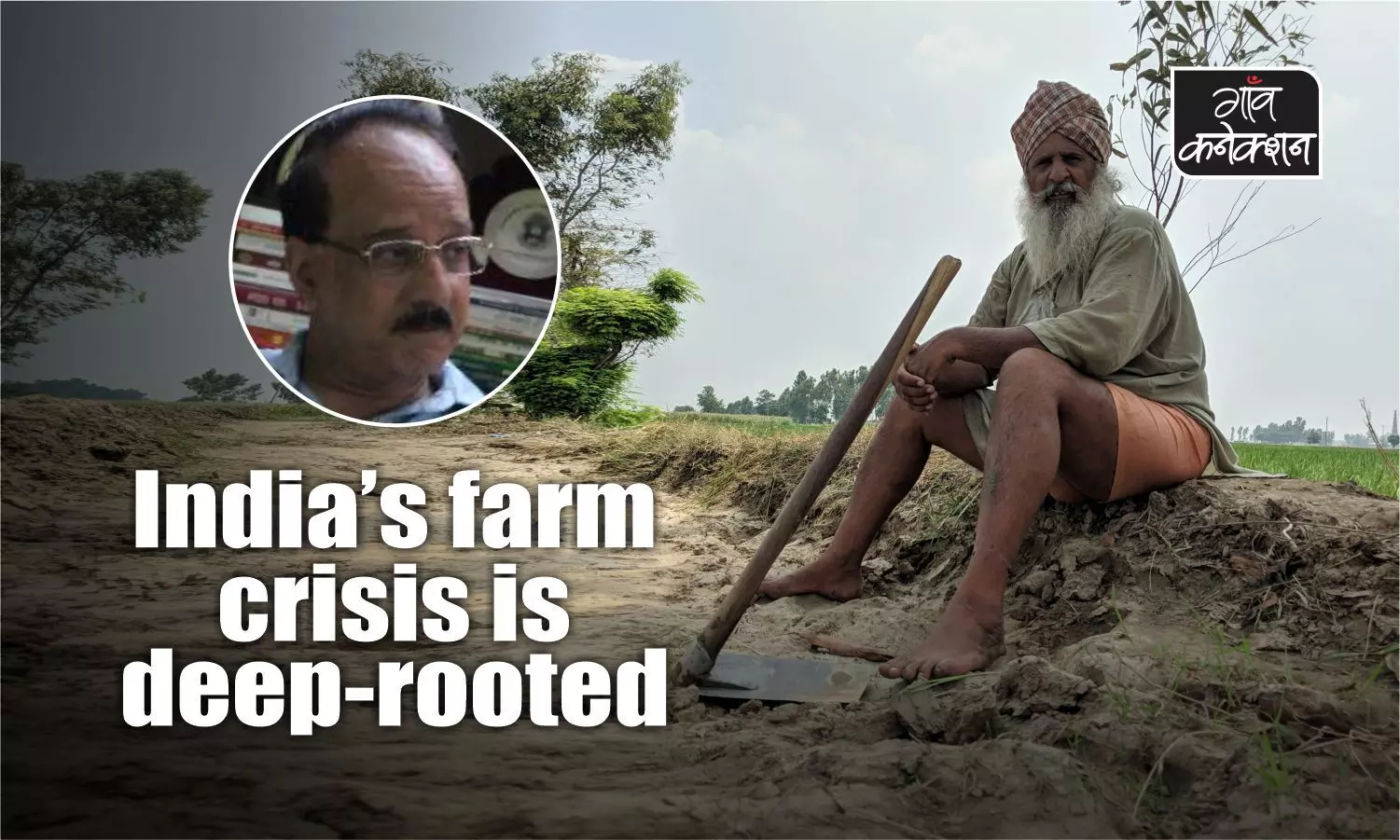
With the rising input costs and failure to get a suitable price for the crops, about 50% of farmers are resolving to drop farming. The country is witnessing a drastic fall in the agriculture development rate. Excerpts from the conversation between country's renowned food and export policy expert Devinder Sharma and deputy news editor Gaon Connection, Arvind Shukla concerning agriculture and the farmer crisis.

Be it India or the US, which is the root cause of agriculture and farmers crisis? 

While understanding the worldwide agricultural crisis one can easily discern a fact that everywhere the governments have knowingly kept the farmers at a disadvantage in terms of their income. Farmers did not get a fair price for their crops. This only caused the current crisis.In order to understand the situation, we will have to know about the economic design and cycles of India and other countries. We may compare the agriculture in the 1960s and present times in the US to find that the real income of the farmers has gone down. This is admitted by the Chief Economic Advisor of the US Agricultural Department. In 2018, the average income of the US farmers has fallen not for the first time, but for the sixth year in a row. This is the state of the US which we look up to in matters of technological advancements and policies. India too suffers from a similar crisis. Our governments have deliberately kept farmers away from better incomes to discourage agriculture because it is believed that economic transformation would only be realized upon agriculture's fall. Economists of India and elsewhere are of the opinion that people be pulled to the cities to provide cheaper labour for the industries. Industries require cheap raw materials in order to thrive. This is why the agriculture crisis is existent. The Indian Economic Survey 2016 informs that in 17 states or we can say half of India, farmer family's average annual income is Rs 20,000 which is Rs1,700 per month. Such an amount cannot even support a cow's upkeep. Now imagine how would a farmer family be managing on such a pittance?

A large portion of Indian population is directly engaged with agriculture. Is such a sizeable population then constantly being overlooked? 

The NITI Aayog had, in one of its reports, mentioned that for the past two years the farmers' real income rise was zero. In the five years prior to this, the real income of the farmer families had only increased by a mere half per cent. I know the exact figure to be 0.44%. Let us go back a little further in the past. A research revealed that for the period 1985-2005, the farm-get price (the price which a farmer receives) remained frozen. Keeping in mind the inflation, one would notice that the price which farmers got in 2005 was the same as that in 1995, rising input costs notwithstanding. It means that for over 20 years the prices remained constant. We can understand better with the help of another report. As per a report of Organization for Economic Co-ordination and Indian Council for Research on International Economic Relations (OECD-ICRIER), the farmers suffered a loss of Rs 45 lakh crore during the period 2000-2017 due to not getting a fair price for their produce. So, you can well understand the agriculture crisis where the farmer is made to survive on the same income for the past 40 years. Had the same happened to any of us, we would have long committed suicide or left the business for good. There is a need to view this crisis in terms of income versus expenditure.But instead, such a scenario was created that farming isn't economically viable because of poor yield to the farmer. This notion is false. 

But isn't it generally said that the farmers are disappointed over poor yield? 

I agree that many crops fall short at the national level, but even more important is to know what will be done of a better yield. Is it to be found dumped by the farmers on the roads due to lack of fair pricing or resulting in farmers' suicide? This means that the problems lies elsewhere and we are looking for it somewhere else. Take for example the situation in Punjab. With 98% of the area in Punjab well irrigated, there would hardly be a single field without access to water. Punjab leads the world in paddy and wheat crops output. Better irrigation, better crop output and still Punjab shocks the world by the frequent cases of farmers' suicides. In the past 10 years, more than 10 thousand farmers have ended their lives in Punjab. This shows amply that the crisis is not due to lack of irrigation or production because even in the regions having an abundance of both farmers are still resorting to suicides. Somewhere the policymakers, governments and politicians will have to really look and think what is actually wrong and find means to resolve it. It should not be that for an Indian problem we look into Europe and the US for finding the solution. Many times, we have taken the wrong lessons from foreign nations and have paid dearly for it. So, I say that we should seriously deliberate to find a localized solution. 

A big concern for the farmers is their input cost. The government now talks of zero budget natural farming. Tell us more about it. 

I believe that the term 'zero- budget' has sent across the message that we need not invest anything during farming and that the farmers needn't put in much. If the policymakers believe that a decrease in the cost of production will translate into an increase in the income then such a formula of zero budget is problematic. India has had a long tradition of natural methods and low-cost production. Even you at some point been asked what is in a name. Once I was told by the famous writer Khushwant Singh that his record-breaking novel was rejected by over 20 publishers before he renamed it as Train to Pakistan. Zero budget, therefore, seems an obvious escapist move to absolve a government of its responsibility. The RBI date for the period 2011-2016-17 reveals that the total agricultural investment in the country was a mere 0.4% of the GDP while the sector supports 50% of the population. It means that one isn't inclined to invest for 50%. So, following the 0.4% investment, the zero-budget formula of the NITI Aayog seems but natural. I believe zero-budget farming technique to be sound, it just needs the addition of agro-ecological or needs to be kept nature and environment-friendly. Many people in India have worked on natural farming—Narayan Reddy in Karnataka, Bhaskar Salve in Gujarat and Naamalvar in Tamil Nadu had taught people to cultivate without pesticides. With these three long gone, there are still many who are dedicated to promoting natural farming at their own level. Farming should involve minimum external input, whatever is available in fields or home must be used for farming. Finance Minister, Nirmala Sitaramanan had begun a new chapter by mentioning it (zero budget farming). This needed to be vocalized because the world has finally understood that it is better to keep harmful pesticides at bay. India started a dialogue when such issues are already taken up in the US and Europe. 

Does it mean that the developed nations are considering a revisioning of existing agricultural practices? 

A few days ago, there came up a report of a commission in Britain (food farming and countryside commission) advocating several major changes. The report warned that the path of intensive farming that we currently follow is not correct. People's health has suffered, the soil has suffered, input costs have risen, environment adversely affected, water drained out and even climatic changes have all been attributed to the intensive farming system which called for intensive use of fertilizers and pesticides. They say that Britain must undergo a transitional period towards agroecological systems by adopting nature-based farming.If Britain thinks on these lines that this is the right opportunity for India as we had adopted their modern farming practices and methods before. So, if they are changing so we must. All nature-based processes are beneficial. Whether organic farming or zero-budget natural farming or home therapy or bio-dynamics—we must promote and adopt them judiciously. Some process would more effective in Punjab than Karnataka, a technique used successfully in Rajasthan may not be as effective in Kerala. Therefore, varied techniques must be brought into use. We would have to show the farmers the way to resolve their woes. Pesticides anyway are poisons and their use in any crop is bound to have its ill-effects.#

Published: Sept 14, 2019

Link: https://www.gaonconnection.com/read/devinder-sharma-shares-his-views-on-the-plight-of-farmers-in-india-their-low-incomes-and-zero-budget-farming--46233  

READ MORE - Rs 1,700 not enough to even feed a cow, how can a farmer-family survive on it? -- An interview

Sunday, February 24, 2019

"I have always said that agriculture is being sacrificed to keep market reforms alive." My interview


Distinguished food and trade policy analyst, award winning journalist, writer and researcher DEVINDER SHARMA was trained as an agricultural scientists and quit journalism to write on food and trade policies. He tells SARBJIT DHALIWAL how unfairly independent India continues to treat its farming community

You have been advocating the need for a direct income support for farmers. Now that the Finance Minister has announced an income support of Rs 6,000 per year to small farmers owning less than 5 acres, do you think cash transfer is the way to address farm crisis? 

For more than four decades now farm incomes have remained more or less static. Several studies have shown that the real farm incomes have been on the decline. More recently, a  Niti Aayog study has shown that in the five-year period, between 2011-12 and 2015-16, real farm income had grown by less than half a percent every year, 0.44 per cent to be exact.

Following demonetisation, with farm gate prices slumping across board, we have seen reports of farmers throwing tomato, potato, onion and garlic on the streets. Irate farmers had re-ploughed standing crops of vegetables and reports of farmers endlessly waiting at the market to dispose off their farm produce, had appeared frequently. Farmers’ anger was clearly visible, and following the electoral debacle in the Hindi heartland, the government borrowed the idea to bring in direct income support to farmers.

Like the concept of universal basic income, I believe direct income support is a significant shift in economic thinking. For several years now, I have been asking for direct income support. Even in US and Europe, farmers have been given direct income support for long. The time has come in India to move from ‘price policy’ to ‘income policy’ which means over the next few years the government will have to further provide farmers with an assured or a guaranteed monthly income. After all, how long can we leave farmers to face the tyranny of the markets?

But many people say Rs 6,000 support is too less and too late ...

Yes, you are very right. Rs 6,000 a year actually translates into Rs 500 a month or less than Rs 17 a day. I don’t understand how the government thinks that with such a meagre amount small and marginal farmers will be able to get out of the terrible agrarian crisis that prevails. I don’t know how the government thinks Rs 500 per month will enable farmers to get out of the suicide trap. It seems the immediate objective is to ensure that the first instalment of Rs 2,000 lands in the bank accounts of small farmers before the ensuing general elections, for which a budgetary provision of Rs 20,000-crore has been made.

That there is a drought of practical ideas and thinking at the policy planning level was never in doubt otherwise there is no reason the farm crisis should have multiplied to such a severity. But to provide Rs 500 per month to a small farmer and then think it will do the miracle is a clear-cut reflection on the disconnect that prevails between policy planning and the ground realities. No wonder agriculture is in dire crisis.

The least that could have been done was to double the income support amount, from Rs 6,000 to Rs 12,000 per small farming family.

But where will the money come from?

That’s a question I hear whenever farmers loans have to be waived or they have to be given any financial support. No one has ever asked where the money will come from when huge corporate bad loans are written off. Between April 2014 and April 2018, Rs 3.17 lakh crore of corporate loans have been struck down, and no questions over fiscal imbalance caused or where from will the money come have ever been raised.

Take the case of 7th Pay Commission. Arun Jaitley has earlier informed that it will entail an additional annual burden of Rs 1.02 lakh crore which will benefit 45 lakh central government employees and another 50 lakh pensioners. But when the 7th Pay Commission is implemented by the state governments, PSUs, colleges/universities, a Credit Suisse Bank study says the annual burden will be in the range of Rs 4.5–lakh crore to Rs 4.8-lakh crore. Did you hear anyone asking from will the money come from or whether it will add on to fiscal deficit?

Now coming to income support, if only the government had doubled the income support to Rs 12,000 per year per small farmer I am aware that the budgetary allocation would have also doubled. Piyush Goyal has said that Rs 6,000 support will require an additional finance of Rs 75,000-crore in a year. If the amount had been doubled, the budgetary requirement would increase to Rs 1.5 lakh crore.

Before you raise an alarm over where will the money come from, let me tell you that the immediate need was to discontinue an economic stimulus package of Rs 1.86 lakh crore that is being paid to India Inc since 2008-09 when the global economic meltdown took place. No one knows why this stimulus package still continues to be paid. No one ever asked the fiscal implications of this package, which means the country has spent Rs 18.60 lakh crore in ten years. Is that a small amount? And look, the tap still continues to flow. Why couldn’t this economic stimulus package be stopped and diverted to agriculture? If done, I am sure the Finance Minister could have announced a direct income support of Rs 15,000 per month to farmers.

I agree, but two wrongs don’t make it right

I too agree with you. But first tell me why do you think that even one wrong makes it right? Why is that the former Chief Economic Advisor Arvind Subramanian used to say that writing-off corporate loans leads to economic growth and waiving farm bad loans leads to credit indiscipline and former RBI Chief Urjit Patel had even called farm loan waivers as a moral hazard? Isn’t that simply a way to defend the wilful corporate defaulters?

Merrill Lynch had gone to the extent of telling us that farm loan waiver, which has already touched 1.9 lakh crore, amounts to 2 per cent of GDP. But it never told us how much would an NPA of Rs 10.3-lakh crore would be in terms of GDP. That’s how the blatantly biased economic system works. When you give money to the poor, it is called subsidy, a word that has been demonised. But when you give massive doles or tax cuts to corporate, it is called incentive for growth. No wonder, I have always said that it is socialism for corporate and capitalism for farmers.

Why is that while both the corporate and the farmers draw loans from the same banks, corporate get ‘haircuts’ with bulk of the loans written off by banks, which in turn leads to economic growth, whereas the poor farmer’s assets are seized and auctioned even for small outstanding amounts Rs 1 lakh or less. I have seen farmers going to jail for defaulting on just one repayment. In Punjab, thousands of farmers have received legal notices from banks for not being able to pay back in time and hundreds of them are in jail. Why doesn’t the same happen with Corporate big wigs? Why should the banking norms be different for different people?

You have also talked of income disparity. Can you tell us why do you say that agriculture has been deliberately kept impoverished?

I have always maintained that agriculture is being sacrificed to keep market reforms alive. Why I say so is because in the economic liberalisation paradigm, agriculture plays only two roles – First, it has to provide cheaper raw material for the industry, and secondly, it must provide cheaper food to people and keep food inflation low. Therefore farmers alone have carried this burden all these years. Farmers do not realise when they cultivate crops, they actually cultivate losses. The match is invariably fixed against them.

Let me illustrate. In 1970, the MSP for wheat was Rs 76 per quintal. Forty five years later, in 2015, the wheat price was Rs 1,450 per quintal, an increase of 19 times. To understand how farmers have been deprived of their rightful price, I made a comparison with other sections of the society. The basic pay (plus Dearness Allowance) of government employees in the same 45-year period had gone up by 120 to 150 times; of university/college professors by 150 to 170 times, of school teachers by 280 to320 times. If only the basic pay of employees and teachers for instance had risen in the same proportion as the farmers, I am sure a majority would have quit their jobs and with many suicides reported.

In addition, employees get a total of 108 allowances. When was the last time you heard of a house rent allowance being included in the MSP for farmers; an educational allowance for the children; health allowance for the farmer’s family members and a travel allowance for them? Why should MSP only take care of out of pocket expenses that a farmer incurs plus family labour along with a small profit margin? Why not calculate farmers cost like the way Cost Accountants do for the agribusiness industry?

Farmers have been demanding a higher MSP, as suggested by the Swaminathan Commission, and also want a loan waiver. How justified you think are their demands?  

Farm loan waiver is the immediate relief farmers need. After all, if for four decades farmers have been denied their legitimate income, and have survived on taking credit and repay that credit draw more credit from another source, why shouldn’t the nation stand with them and see that they are relieved of their economic burden once for all. Let’s give an opportunity to farmers to get rid of the entire economic baggage they carry. Waiving farm loans is not an act of generosity or is an attempt at being politically correctness, what we need to understand is how and why farmers have been deliberately kept impoverished all these years.

A recent OECD-ICRIER study says that in the past two decades farmers have incurred a loss of Rs 45-lakh crore on account of low prices. Earlier, I remember an UNCTAD study had estimated that farm gate prices across the globe had remained frozen between 1985 and 2005 when adjusted for inflation. Can we even imagine how with all these losses has the farming community been surviving year after year? Despite living in hunger themselves, they still produced food for the country. 

Swaminathan Commission’s recommendation is for giving farmers the weighted cost of production plus fifty per cent profit. But the government has manipulated the formula treating the basic expenses in production as A2 plus family labour (A2+FL) and then given 50 per cent over it. This formula gives a much lower price than what Swaminathan recommended. Although the new improved price has been announced for all 22 crops for which MSP is announced but everywhere farmers were able to sell at a much lower price, often 25 to 40 per cent less than the announced price. As a result economic losses continued to pile up.

As per the high-powered Shanta Kumar committee even though only 6 per cent farmers get the benefit of MSP and the remaining 94 per cent farmers are dependent on the vagaries of markets, MSP must be enhanced to the level Swaminathan recommended. But I see a lot of pressure is being exerted by the industry (and their brand of economists) to dismantle the regulated markets. This will be rather unfortunate. The reason is simple. Once the APMC markets are disbanded, farmers will be ruthlessly exploited and price discovery will become an instrument for exploitation. Take the case of Bihar. It abolished APMC markets in 2006. In the absence of APMC, farmers are able to sell wheat and paddy at prices which are much lower than that in Punjab and Haryana where farmers do receive MSP because there exists an elaborate network of APMC mandis. This year, huge stocks of paddy illegally transported all the way from Bihar have been apprehended in Punjab and Haryana.

The answer therefore lies in strengthening the APMC network rather than disbanding it. There exists roughly 7,600 APMC mandis so far and what India needs is a network of 42,000 mandis for every 5 km radius.

What in your opinion should the government to do to pull agriculture out of the distress that prevails? Is there a sustainable solution that can bring back the smile on the face of farmers?

Yes, of course. Agriculture needs a holistic set of reforms, including credit policy, market reforms, trade policy etc, which must begin with the premise that agriculture too is an economic activity. In fact, at a time of jobless growth now leading job loss growth, agriculture being the largest employer alone has the potential to reboot the economy. The three steps that the government should initiate immediately in addition to what I have said earlier, so as to ensure economic security must include:  

1) Along with direct income support, the next step to augment farm incomes should be to set up a Farmers Income Commission. My suggestion is to rename the existing Commission for Agricultural Costs and Prices (CACP) as a Commission for Farmers Income and Welfare with the mandate to ensure that farmers are able to realise an assured monthly income of at least Rs 18,000 for a household owning not less than an acre. At the state level, each state should set up a Farmers Income Commission.
2) Initiate a series of steps for ease of doing farming. This involves governance, and also removing obstacles that farmers face routinely. If industry can have 7,000 steps carved for ease of doing business I see no reason why agriculture cannot get the same attention. This will need a separate monitoring wing with enough teeth, under the Ministry of Agriculture and Farmers Welfare. At the state level, Farmer Commission should be given more powers to regulate farming operations. 
3) It is time to increase public sector investment in agriculture, which has been dwindling over the years. Between 2011-12 and 2016-17, public investment has remained between 0.3 and 0.4 percent of the GDP. Considering that nearly 50 per cent population is engaged in agriculture, the total investment, both public and private, must increase every year. But this can happen only when agriculture is treated as an economic activity.#

India support socialism for industry, capitalism for farmers. National Herald, Feb 24, 2019
  
READ MORE - "I have always said that agriculture is being sacrificed to keep market reforms alive." My interview