Friday, April 12, 2019

Somber anniversary reminds journalists of responsibilities

This weekend marks a somber anniversary in greater Kansas City—the fifth anniversary of a racist-motivated shooting at the Jewish Community Center in Overland Park that killed three people.
At the time, I was concerned about coverage of the event in the Kansas City Star that “gave voice to racism and hatred,” but encouraged by a thoughtful column that ran a few days later titled, “Reporting on Extremism: Ignore it or expose it?” See my full column below.

Five years later, these same questions about how to cover extremism and terrorism remain. Just last month, I published a column in the Kansas City Star upbraiding the paper, again, for its coverage. This time, my concern was about whether the Star should have printed a lengthy piece analyzing the New Zealand shooter’s racist manifesto.  I wrote, Printing manifestos in whole or in part gives shooters exactly what they crave: publicity for their hateful ideas.”

Yesterday, the Star ran a revealing interview with a white supremacist about his transformation away from hatred. The forward looking, solution-seeking tone of the article was excellent, as was the online publication of photos of each of the victims. However, I was disappointed, once again, to see the Star publish another photo of white supremacists giving a Nazi salute with a Confederate battle flag in the background. Isn’t publishing this photo giving the haters exactly what they want?

As I said in my column about the New Zealand shooting, “Media outlets walk a fine line between providing necessary context and giving violent racists or terrorists a megaphone. Next time, and there will sadly be a next time, let’s hope journalists err on the side of choking off publicity for the haters.”


Peace Journalism Insights, April 16, 2014
Does KC shooting coverage give voice to hate, extremism?

Peace journalism is about much more than peace and war.

That lesson is being underscored this week in Kansas City, where we are in mourning over a series of shootings that killed three people last Sunday.

Peace journalists always consider the consequences of their reporting, and, at minimum, pledge to avoid exacerbating an already bad situation—to not pour gasoline on an already raging fire.
The balance, the fine line, between giving the public the information they need and fueling the fire has been on display the last few days here in Kansas City.

From a peace journalism perspective, or the perspective of journalism in general, there’s no question that this story had to be covered. Peace journalism, contrary to some misperceptions, doesn’t ignore or soft-peddle violent acts.

On Monday, the day after the shootings, The Kansas City Star ran a banner headline that read, “Black Sunday.” The front page featured an article about the shooter titled, “Racist views, a prison record.” The following day, The Star’s front page showcased a large photo of the shotgun-wielding shooter framed by KKK flags.

Was the Star’s coverage appropriate, or did they sensationalize the crime and give voice to hate and extremism?

The Star’s coverage of the victims was outstanding—thorough, thoughtful, respectful. Profiles of the victims were prominently displayed on page one on Tuesday, as they should have been.
The difficult question for the Star and others covering this was how to handle the alleged shooter. This is the same dilemma faced when covering other hateful acts. The Boston bombing anniversary, for example, has sparked new stories about Dzokhar Tsarnaev and questions about whether he deserves even one more word of press coverage.

In the KC case, Peace journalism asks, what is the consequence of giving voice to the alleged shooter’s extremist, racist views? What impact does showing a KKK photo have? Does any of this coverage give credibility, gravitas, to the alleged shooter or his racist cause?

I agree that the alleged shooter must be covered, but I disagree with the Star’s decision to cover him on page one, particularly on Tuesday, where the shooter’s profile was carelessly laid out alongside profiles of the victims. (Click here to see .pdf of Tuesday's front page). Some might believe that this implies some equivalency between shooter and victim. As for the front page photos of the shooter (mug shot on Monday; shotgun-toting KKK flag shot Tuesday), I challenge the decision to run these on page one. Does featuring a prominent front-page photo of the alleged shooter that is much larger than the tiny photos of the victims imply that the alleged shooter is of primary importance? That certainly wasn’t the Star’s intention, even though the way the page is laid out might leave some with that misimpression.

To their credit, The Star ran a thoughtful, introspective column by reporter Dave Helling in Tuesday’s paper titled, “Reporting on Extremism: Ignore it or expose it?” In this piece, Helling wrote, “It’s unlikely daily front-page coverage will stop the damage from the worst people out there. It could make it worse.” I agree. Will the kind of celebrity now enjoyed by the alleged shooter encourage others to act on extremist views?

Helling is also correct when he wrote, “The journalist’s usual answer is balance—expose what you can without overexposing the rantings of an anti-Semite.”

It’s encouraging to see Helling’s analysis of the impact of the Star’s reporting. It is this kind of reflective, deliberate decision making about coverage, as opposed to the press’ usual reflexive sensationalism, that gives me hope that journalists can operate more professionally and responsibly.
READ MORE -

Monday, April 8, 2019

Corporal Punishment: Intentionally Causing Physical Pain To A Student Is Prohibited in California

By Michelle Ball, California Education Attorney for Students since 1995

School staff willfully inflicting physical pain to students is considered corporal punishment and prohibited in California unless certain exceptions exist.  As such, hitting, pulling hair, pinching, kicking, and other forms of physically painful contact with a student, usually are unacceptable and illegal.

In California Education Code section 49001, "Corporal Punishment" is defined as: "willful infliction of, or willfully causing the infliction of, physical pain on a pupil."  This means that any PHYSICAL PAIN caused intentionally to a student, by a person employed or engaged by a school, is not okay.  Would purposefully slamming a student into a wall, spanking a student, slapping their hand with a ruler, and/or lifting a student out of a pool by their hair be considered "corporal punishment?"  To determine this, ask yourself: was physical pain caused to the student?  Was the physical pain intentionally caused by the school representative?  If the answer is yes, the conduct could constitute prohibited corporal punishment under section 49001 so long as it does not fit under an exception.

Education Code section 49001 lists the exceptions to corporal punishment as follows:

"An amount of force that is reasonable and necessary for a person ... to quell a disturbance threatening physical injury to persons or damage to property, for purpose of self-defense, or to obtain possession of weapons or other dangerous objects within the control of the pupil is not ... corporal punishment.  "

If a student were pulled by their hair to prevent drowning, knocked into a wall in an attempt to obtain a gun, or hurt when the staff member was trying to stop them from being punched, causing physical pain might not be considered prohibited under the circumstances.  But we can all see how that is different from going after a kid to cause them pain with no legitimate reason.  If there were harm caused in a justified situation, the only question then would be, was the physical pain caused "reasonable and necessary?"  That may be a matter of opinion as even in "self-defense," staff can go to far.

If parents encounter what they believe to be intentionally caused physical pain and/or harm by a teacher or other school representative, they may want to file a personnel and/or other type of complaint to ensure the person involved is corrected and the matter resolved.  Otherwise, the staff member could continue their improper conduct with even more dire consequences the next time.

Best,

Michelle Ball
Education Law Attorney 

LAW OFFICE OF MICHELLE BALL 
717 K Street, Suite 228 
Sacramento, CA 95814 
Phone: 916-444-9064 
Email:help@edlaw4students.com 
Fax: 916-444-1209
[please like my office on Facebook, subscribe via twitter and email, and check out my videos on Youtube!]

Please see my disclaimer on the bottom of my blog page. This is legal information, not legal advice and no attorney-client relationship is formed by this posting, etc. etc.!  This blog may not be reproduced without permission from the author and proper attribution of authorship.


originally published 5/16/2011, updated 4/8/2019
READ MORE - Corporal Punishment: Intentionally Causing Physical Pain To A Student Is Prohibited in California

Friday, April 5, 2019

Is Rahul Gandhi's minimum income guarantee scheme, NYAY, economically viable? My interview


Pic: from the web
Will Congress president Rahul Gandhi's proposed minimum income guarantee scheme, Nyuntam Aay Yojna, or NYAY, free India from poverty? This question was asked by India Today to six economists.  
Here is my reply. You can see the detailed response from all of us if you click on the link at the end of the interview. 
Q: Is a scheme that promises Rs 72,000 a year to 25 crore Indians below the poverty line economically viable?
Surely, implementing a guaranteed minimum income package benefitting 20 per cent of India’s poorest is economically viable. It all depends on the intent behind it. If the government wants to really help the poorest, finding adequate money is never a problem. But I find it strange that this question is invariably asked whenever some allocations are made for the poor. No one asked when the 7TH Pay Commission was announced, which when implemented across the States, PSUs, Colleges/Universities will bring in an additional annual burden in the range of Rs 4.5 to Rs 4.8-lakh crore every year. No one ever asked the same question when massive corporate bad loans are written-off by the banks, Rs 3.17-lakh crore between 2014 and 2018. Former CEA Arvind Subramanian had even said that writing-off corporate loans leads to economic growth. But on the contrary waiving farm loans for the poor farmers are viewed as credit indiscipline. This is a reflection of the inherent bias in modern economic thinking.  

Q: What do you think will be the challenges in implementing such a scheme?
Although Rahul Gandhi has still to spell out the delivery mechanism that is expected to provide Rs 6,000 every month to 20 per cent poorest households in the country, the task of indentifying the real beneficiaries will certainly be an administrative nightmare. Estimating the income level of the poor to draw out the real beneficiaries will of course be a cumbersome process. But I am sure as the scheme progresses, since it is to be implemented in a phased manner, it will be possible to iron out the bottlenecks and remove other hurdles. It has to be planned in such a manner that it turns out to be inclusive. 
Take a lesson from Telangana, which launched the much talked about Rythu Bandhu scheme, providing direct financial support twice in a year to farmers. In 2018 kharif season, Telangana government has transferred Rs 5, 257-cr to over 51 lakh farmers. Not a small achievement but before launching the scheme, Telangana officials had moved in swiftly across the districts to set the land records right and to remove other hiccups. If the will is there, a suitable pathway can always be created.    
Q: Will it address the issue of rural distress and can it boost the economy?
Investing in rural areas is the only viable long term solution to many of the problems India faces – hunger, poverty, youth unemployment, forced migration and climate change. The promise of Rs 72,000 per year to the poorest points to a significant shift in economic thinking – moving from credit to income support. More money in the hands of the rural poor means more demand will be created, and more demand will reignite the wheels of the industry thereby boosting economic growth.

Considering a decline in casual farm labour to the extent of 40 per cent between 2011-12 and 2017-18, and even the non-farm wages shrinking in the last five years, the job crisis in rural areas is certainly explosive. Added with the steeply declining farm incomes, which have already touched the lowest in 14 years, rural India is crying for attention. More so at a time when public sector investments in agriculture had remained abysmally low, hovering between 0.3 to 0.5 per cent of the GDP between 2011 and 2017.  Rural India therefore is the future. In fact, I have been saying for long that addressing rural distress, beginning with revival of agriculture alone has the potential to reboot the economy.

Q: What are the long term implications of such a scheme on poverty reduction?
In the long-term, direct income support is one of the major effective instruments to fight poverty. MNREGA in that sense is a classic example. This has to be of course accompanies by a set of economic reform measures, including investments education, health and rural infrastructure. Providing more money into the hands of the poor, who also carry dreams and aspirations like anyone else, gives them an opportunity to unleash their entrepreneurship ability.
To be born in debt and live in debt all through his life is virtually like living in a hell. Normally the poor, and that includes farmers, often are born in debt and die in debt. A direct income support provides them an opportunity to emerge out of the shackles of indebtedness. And this will have long term consequences in making poverty history.
Trickle-down theory has failed to make an impact. Trickle-up is what is desperately required.
Q: How does the promised scheme compare with existing welfare schemes of the government?
The proposed Nyay scheme should not be considered as a welfare scheme that we generally know about. It is an income augmentation scheme, and should be considered as a powerful mechanism to revitalise economic activity in the rural areas thereby reducing rural to urban migration. It will reduce inequality, help reduce rural distress, and pull out masses from abject poverty. Unlike the existing 950 central government schemes, direct income support alone has the potential to reboot the rural economy, and if executed well it may perhaps change the face of Indian economy – leading truly to Sabka Saath Sabka Vikas.
Q: Do you think it will help the Congress woo the electorate better?
Well, that depends on how the Congress is able to take the message to the masses. #

The price of NYAY. India Today. April 8, 2019.
READ MORE - Is Rahul Gandhi's minimum income guarantee scheme, NYAY, economically viable? My interview

Sunday, March 31, 2019

How agriculture has been kept impoverished.


Soon after the Economic Survey 2016 brought out a startling fact – that the average farm income in 17 States of India, which means roughly half the country, was less than Rs 20,000 a year, a newspaper reported of the ongoing squabble between officers of the Supreme Court and the defence services over washing allowance they get as part of the income package. The defence service employees were reportedly questioning why the officers in Supreme Court were getting a higher washing allowance of Rs 21,000, while the entitlement of armed forces officers stood a little less at Rs 20,000.

That makes me wonder: don’t farmers have clothes to wash?

If the average income of a farm family in half the country equals just one of the 108 allowances (in total, for all the services put together) that the government employees get as part of the 7thPay Commission, the prevailing income disparity becomes too gnawing. More so when a careful perusal of the NSSO (National Sample Survey Office) data that the Economic Survey 2016 had quoted shows how glaring is the income divide. The NSSO had deviated from the usual practice of computing farm incomes on the basis of what the farmer sold in the market to actually for the first time work out farm income on the basis of marketable surplus a farmer sold in the mandi and adding to it what he saved for his family consumption, which means it is the average of the total value of farm output in roughly half the country.

The shocking details of almost non-existent farm incomes that the Economic Survey 2016 provided failed to evoke any outrage. Perhaps it was because Prime Minister Narendra Modi had at the same time promised to double farmers income by 2022 thereby overshadowing the income reality. On various media channels, I often happened to be the only panellist citing the farm income statistics to drive home the point how income inequality was woven in the predominantly market driven economic structure. That an average farm income of Rs 20,000 a year would translate into less than Rs 1,700 a month, rarely drew an outpouring of anger at the way farming was being deliberately kept impoverished. This is further substantiated by the latest agricultural growth estimates of the Central Statistics Office showing the nominal gross value added (GVA) in agriculture in October-December 2018, to have dropped to its lowest in 14 years, clearly showing how the farm incomes have further plummeted. It failed to shake up the nations conscious. Even if the nationalism debate had not kept the nation preoccupied, I doubt if the drastic slump in farm incomes would have evoked a swift policy response. Instead, the plight and systematic decimation of agriculture over the years has for all practical purposes been taken for granted.

A study by the Organisation for Economic Cooperation and Development (OECD) in collaboration with the Indian Council for Research on International Economic Relations (ICRIER) has computed the total loss farmers have suffered, between 2000-1 and 2016-17, from being denied the rightful price at a staggering Rs 45-lakh crore. Add to it the findings of Niti Aayog which estimates that in the five year period, between 2011-12 and 2015-16, real farm incomes have increased by less than half a percent every year, 0.44 per cent to be exact, the farm distress is compete. It further admitted that the near-zero income of farmers in the last two years (after 2016) has forced the government to launch a direct income support scheme (PM-Kisan) which makes a provision for directly transferring Rs 6,000 every year to the bank accounts of small farmers.

With agriculture in such a dismal state, it is futile to expect the non-farm sector to be performing well. Latest study shows that rural non-farm wages in the past five years too have dipped to its lowest. A CMIE study said of the 56.6-lakh job losses encountered in past 12 months, almost 82 per cent or 46-lakh are from rural areas. Rural India had somehow survived the unprecedented distress conditions, and this is nothing short of a miracle. Any other business with such explicit huge losses written all over would have collapsed by now, and in fact disappeared from the economic horizon.

Not only in the past 20 years, agriculture had remained at the receiving end even prior to that. According to an UNCTAD study, global farm gate prices when adjusted for inflation had remained almost static in the 20 year period, between 1985 and 2005. In other words, farm incomes have remained frozen for almost four decades. In such a dismal scenario, I shudder to think how farming families had been surviving all these years. Just to illustrate, an American farmer, Mike Callicrate, says that the price at which his father sold corn some 44 years back, on Dec 2, 1974, was $3.58 per bushel (equal to 25.40kg). In January 2018, he sold corn at $ 3.56, down two cents from what he earned 44 years ago. Overproduction had pushed down the farm gate prices as a result of which farmers were perpetually in debt. Take the case of milk. What the farmers realise in Europe is only 19 pence for a litre of milk, which has led to closing down of a large number of small dairy farms. “To be born in debt, and live all through in debt, is like virtually living in a hell,” remarked Declercq Gilbert, a 93-year-old farmer in Leshonnelles village about 15 kms from Mons near Brussels, when I met him last year.

Indian agriculture too had slogged with farm incomes remaining almost frozen. To get an idea as to how farm incomes had remained subdued in the past five decades, I had worked out the growth in Minimum Support Price (MSP) vis a vis the basic salaries for various section of employees. This will give us a clear idea as to how farmers have been denied their rightful price all these years. In 1970, the MSP for wheat was Rs 76 per quintal. Forty-five years later, in 2015, the MSP for wheat was Rs 1,450 per quintal, an increase of 19 times. For the same period, I examined the increase in basic salary plus DA (not adding other allowances) for different sections of employees. For government employees, the increase was 120 to 150 times; for college/university lecturer/professors it was 150 to 170 times and for school teachers the increase was 280 to 320 times. If only the wheat MSP was raised in the same proportion, which means if it had gone up let’s say 100 times in the 45 years period, farmers should have received at least Rs 7,600 per quintal. What they actually got was an MSP of Rs 1,450 per quintal in 2015. In other words, it is the farmers who are bearing the cost of subsidising the consumers. The entire burden of keeping food prices low has been very conveniently passed on to farmers.

Farmers dumping tomato, potato and onion on the streets have been a frequent phenomenon. For the past three years, numerous news reports point to farmers being denied the appropriate price in the mandis, often the drop in prices ranging between 25 to 40 per cent on an average. Using the latest CACP cost of production statistics for rabi and kharif seasons and comparing this with the average income per crop as worked out by the Dalwai Committee on doubling farmers income, Down to Earth magazine (Feb 16-28, 2019) has presented a damning analysis. Accordingly, against the production cost of Rs 32,644 per hectare for wheat, the income realised by farmer is only Rs 7,639, leaving a shortfall of Rs 25,005 per hectare. In case of paddy, the gap is Rs 36,410 per hectare; for maize, the loss a farmer incurs per hectare is Rs 33, 686; and for arharit is Rs 26,480 per hectare. 

Although only 6 per cent farmers as per the high-level Shanta Kumar committee gets the benefit of MSP, the fact remains that the announcement of MSP neither helps in setting a floor price nor does it guarantee an assured price for farmers. This is primarily because the mandate for CACP, which works out the MSP for various crops, is not only to provide an assured price to farmers but also to ensure that it does not lead to inflationary pressures. Macro-economic policy therefore has a lot to do with the prevailing farm crisis. The prices have been deliberately kept low, and in most cases is actually less than even the cost of production that the farmers have to entail. The overwhelming tragedy is that when farmers cultivate crops, what they don’t realise is they are in reality cultivating losses. Whatever be the crop and the technology applied, the fact is that the match is invariably fixed against farmers.

The MSP the government announces actually includes out of pocket expenses incurred by farmers in crop cultivation (A2 cost) plus the cost of hiring farm labour (FL), including family labour, a farmer employs. In addition to this cost, which is labelled as A2+FL, the government claims the MSP being announced since the beginning of the kharif season last year contains 50 per cent profit. Although the government claims it has honoured the recommendation of Swaminathan Commission which had suggested 50 per cent profit over the comprehensive cost, but the new formula falls short of what was in reality recommended. Nor has the government been able to ensure that procurement is made at the MSP it has announced. Several farmer leaders have questioned the government claims, and the trade data showing the shortfall in prices paid to farmers in various mandis is routinely shared on social media.

It is the methodology of working out the cost of production that has somehow gone unquestioned. Although an elaborate system exists for collating statistics pertaining to cost of production, crop cutting experiments to work out the production achieved and so on, the costing falls acutely short of the way prices of agribusiness/industrial goods are worked out. While the employees get 108 allowances in addition to basic pay plus DA, and the cost of processed foods includes administrative cost, and marketing cost plus profit as it may deem fit, when was the last time we heard of farmers getting at least four allowances -- house rent allowance, travel allowance, health allowance and educational allowance for their children included in the final price? And why not, after all a farmer too has to look after his family. He too has to support his children’s education, take care of his family’s medical expenses and so. Worked out on per hectare basis, these allowances can be easily included in the MSP calculations or can be paid directly into their bank accounts.  

Denying farmers their right income (what to talk of additional emoluments) too comes with a heavy social cost, which often gets clubbed under mounting indebtedness. Take the case of a 22-year-old graduate student, Gopal Babarao Rathod, son of a small farmer from Yavatmal in Maharashtra, who committed suicide two years back. Explaining how the rural youth, like their lucky counterparts in the cities, too carry an aspiration, he wrote in asuicide note: “A teacher’s son can easily afford to pay a fee of Rs 1-lakh to become an engineer but tell me how a farmer’s son can afford so much fees?” He then went on to say: “why is it that the salaried employees get dearness allowance (DA) without even asking for it whereas farmers are denied adequate compensation for their produce?”

As per the National Crime Record Bureau, between 1995 and 2015, a total of 3,18, 528 farmers have committed suicide. Mounting indebtedness is the primary reason for the serial death dance that continues with impunity. Since the annual farm suicide statistics does not give a favourable picture of the country’s economy, the government has not released the suicide data after 2016.

All this adds to visible disruptions in social fabric. “No girl wants to marry a farmer. Young farmers are leaving farming and going to Pune and Mumbai to work as taxi and rickshaw drivers. They say that if not money, they will at least get a bride in the city,” Mohan Patil from Satara in Maharashtra told a newspaper. There are over 3,000 young men struggling to get married in Ahmednagar district alone says an article in Business Line, quoting a study. This is true of Haryana, Punjab, Uttar Pradesh, Madhya Pradesh, Chhattisgarh and many other states. Even in the prosperous apple belt of Himachal Pradesh, not many girls are willing to settle down in the villages. Low income levels and the harsh working conditions are cited as the main reason for girls unwilling to settle in rural areas. Not only in India have young farmers found it difficult to get a bride, it is not so easy even in Europe, England, Canada, Australia, and United States. Aimed at finding a suitable match for the young people in farming, a very popular French TV programme called ‘Love in the field’ has been running successfully for several years now. Enquiries revealed that similar TV shows are also being aired in England and Canada. 

As the policy emphasis remained essentially on increasing crop productivity primarily to ensure that availability of food remains comfortable, farm income never received the kind of thrust it deserved.  The decline in farm incomes is an outcome of an economic design that has been followed. As I said earlier, agriculture had been deliberately kept impoverished to keep economic reforms alive. More recently, Raghuram Rajan has said that the biggest reforms would be when we are able to move people out of agriculture, to migrate to cities which need cheap labour. Even the new Chief Economic Advisor has called for more investments in industry so as to pull the youth from agriculture. If agriculture has to be treated as a source of cheap labour in the cities, it speaks of the flawed economic thinking that has led successive governments to dismantle the strong foundations that sustained millions of rural livelihoods.

This is exactly what the World Bank had directed India way back in 1996. It had wanted India to move 400 million people from the rural to the urban areas in the next 20 years, by 2015. These are “agricultural refugees” swarming into the cities looking for menial jobs. It is primarily for this reason that over the years, in addition to more or less static farm incomes, public sector investments in agriculture were also kept deplorably low, hovering between 0.3 to 0.5 per cent of the GDP during the period 2011 to 2017. The total investments, both public and private, have also been declining steadily – from 3.1 per cent of GDP in 2011-12 to 2.2 per cent in 2016-17. Compare this with the tax concessions being given to industry, which measures 5 per cent of GDP. The best way to kill agriculture therefore is to starve agriculture, which employs 50 per cent of the country’s population, of public sector investments. #

------

Strengthen Public Procurement System

At a time when MSP benefits only 6 percent farmers and the remaining 94 per cent farmers are in any case dependent on exploitative markets, the focus has to be on strengthening the public procurement system. Besides making MSP more realistic, covering all aspects of cost calculations, the emphasis has also to be on ensuring that whatever surplus farmers bring to the markets is purchased at the official price announced. Although the government did announce assured procurement under PM-ASHAA but failed to ensure its implementation.

But there are two problems the government is encountering. First, the World Trade Organisation (WTO) is keeping a close watch on the increase in MSP prices, which are classified as farm subsidies in the international trade parlance. US, EU, Canada, South Africa, Pakistan besides others have repeatedly questioned MSP on wheat, rice and pulses saying that the prices have breached the permissible de-minimissupport limit allowed to developing countries. India is expected to keep MSP within the prescribed 10 per cent limit of the total value of a particular crop. This acts as a strong deterrent to raise MSP as per the farmers demand and not face the ire of WTO.

Not only WTO, there is strong lobby within the country that advocates dismantling the APMC mandisso as to enable farmers to realise price discovery. The underlying objective is to allow private terminals to take over instead, laying the foundation for corporate farming. Already several states have suitably amended the APMC Act removing fruits, vegetables and livestock products from the mandi operations. But this has neither helped farmers realise a better price for their produce nor reduced the arrival of fruits and vegetables into the regulated markets. In fact, Bihar had revoked APMC Act way back in 2006 with the objective of attracting private sector investments in market operations. Nothing like this happened, and even now truckloads of paddy and wheat are routinely brought and sold illegally in Punjab and Haryana mandis.  

Instead of dismantling APMC mandis, the policy emphasis should be on expanding the existing network of mandis. There are nearly 7,600 APMC markets operating at present and if a mandi has to be provided in 5 kms radius, India will need 42,000 mandis. Public sector investment must be directed towards strengthening the mandinetwork. If India can provide Rs 6.9 lakh crore for building highways I see no reason why at least Rs 1-lakh crore out of it cannot be diverted for public sector agricultural market infrastructure.

The reason is simple. Unless there exists adequate market infrastructure, no meaningful reforms are possible in agriculture. While it is generally agreed that APMC mandishave become a den of corruption with strong cartels of middlemen operating, the answer does not lie in throwing the baby with the bathwater. APMC is crying for a change, and the introduction of electronic operations (in eNAM markets) has certainly helped. But a lot more needs to be done if genuine improvement is required. Merely replacing the public sector with the private companies will defeat the very purpose. Let me make it clear, nowhere in the world, and that includes the US /EU, have the private markets helped farmers with a better price. Even the value chains, which are getting into academic fashion, have failed to prop up farm incomes. #

-----------

Agriculture Too Needs Policy Support 

Moving from ‘price policy’ to ‘income policy’ the government has brought in an element of fresh air into public policy. While doubling farm incomes by 2022 remains more less a slogan, Telengana’s ‘Rythu Bandhu Pthakam’ scheme under which farmers were initially paid a sum of Rs 8,000 per year per acre (with no upper cap), followed by KALIA scheme launched by Odisha, and since then some variants brought in by Jharkhand, West Bengal, Karnataka and more recently in Andhra Pradesh have heralded a direct income support programme for small and marginal farmers. The Union government too has chipped in with its PM-Kisan programme, which entails providing Rs 6.000 per year, in three instalments, for small farmers with landholding less than 2 hectares. While the first instalment of Rs 2,000 has already been paid to a large number of farmers, the government said it would need an additional Rs 75,000-cr every year to fund this scheme.

Whether it is because of political compulsions or driven by the dire need to augment farmers income, the introduction of a direct income measure for farmers is indeed a significant step. Even though the amount allocated is meagre, I am sure it will be enhanced substantially in the years to come. The nation must stand with farmers at these difficult times. Direct income support has to be followed with a more elaborate nation-wide programme to provide an assured income to farmers. At least a minimum of Rs 18,000 per month per farm family, linked to crop production, geographical location and inflation, must be ensured. The idea is not to issue a salary cheque every month but to work out a mechanism that guarantees an assured income package. For this, the Commission for Agricultural Costs and Prices (CACP) needs to be renamed as a Commission for Farmers Income and Welfare, with the term of references changing suitably. 

Compared to an average domestic support of $60,586 per farmer in US; $ 10149 in Japan; $ 16562 in Canada; EU $ 6,762; China $ 863; and $ 345 in Brazil, an Indian farmer barely gets a support of $ 227, which is primarily by way of indirect subsidies. On the contrary, compared with the massive subsidies doled out to the industry, referred to as ‘incentive for growth’, farm subsidies appear rather miniscule. In addition to the huge industrial subsidies, economic stimulus packages, and the corporate NPA write-off every year, the government has recently ensured 7,000 steps, big or small, for ease of doing business.

When will agriculture receive such a policy impetus? #

Give farmers a fair deal. The tribune. April 1, 2019

READ MORE - How agriculture has been kept impoverished.

Wednesday, March 27, 2019

Global reporters discuss self-censorship, inflammatory content

I had an interesting exchange with journalists at the Global Sisters Report yesterday at their Kansas City headquarters.

After my presentation on peace journalism basics, I opened up the floor for Q&A. One journalist was concerned that peace journalism amounts to no more than self-censorship. This is because it asks journalists to consider the consequences of their reporting and yes, to exclude words and images that are inflammatory without adding any value to the story. This is, incidentally, an oft-repeated criticism of PJ. My response was that I do not consider this to be self-censorship. Instead, this is journalists merely employing a filter—the same filter that journalists use hundreds of times a day to make decisions about newsworthiness, appropriateness for audience, what information to include or exclude, etc. Why not also filter out inflammatory, sensational content?


The journalist then followed up by noting, correctly, that sometimes reporters need to give raw, unpleasant details in a story. He cited a story he did on rape as an example. I agreed that stories like this, and negative, violent news in general, must be covered. The question is how. I hope journalists would ask themselves is this: are these details important for an understanding of the story, or are they merely sensational? Does including gory details re-victimize the victims? Does including these details help open the door for a possible solution, or at least a recognition generally that something must be done?

Interestingly, I've had the same exchange repeatedly with journalists in Cameroon, one of whom asked, "How can we cover a story when police shoot unarmed protesters in a way that reflects peace journalism?" My answer: sometimes the best we can do, the only thing we can do, is to report such stories without making a bad situation worse, without pouring gas on the fire.

This was my second such visit with the Global Sisters Report staff. I continue to be impressed with the quality of their journalism and with their commitment to telling stories from around the world about those who are embracing and facilitating peace, often against long odds. You can see their work at: https://www.globalsistersreport.org/.

READ MORE -

Tuesday, March 19, 2019

READ MORE -

Friday, March 15, 2019

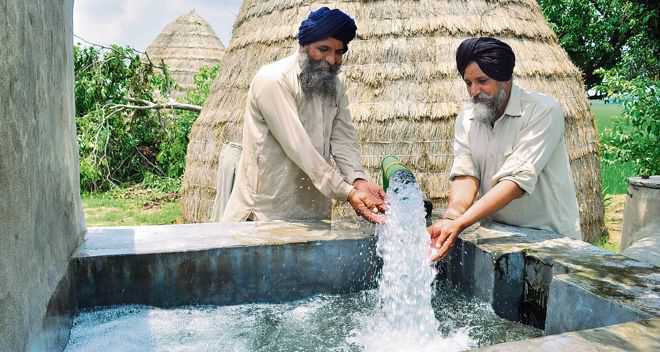
Punjab agriculture is crying for a change


Presenting this year’s budget, Punjab Finance Minister Manpreet Badal sounded an ominous warning. Not that it wasn’t known earlier but coming from him was yet again an official acknowledgement of a worrisome futuristic scenario that is fast pushing the frontline agricultural state towards desertification and an impending ecological disaster. “76 per cent of the assessed blocks are over-exploited and the estimated ground water availability for future irrigation use is negative.”

The warning had been sounded earlier. The two reports on crop diversification in 1986 and 2002, authored by the eminent agricultural economist Dr S S Johl, were essentially in response to the depleting ground water situation. I remember Dr Johl many a times making a very strong point as to how Punjab ends up virtually exporting water when it transports surplus wheat and paddy every year to the deficit areas. Later, in 2009, the observations of NASA’s Gravity Recovery and Climate Experiment (GRACE) satellite data showed an equally worrisome trend. “We don’t know the absolute volume of water in the Northern Indian aquifers, but GRACE provides strong evidence that current rates of water extraction are not sustainable, hydrologist Matt Rodell of NASA was quoted as saying. Subsequently, a number of international and even national studies by the Indian Council of Agricultural Research, Central Ground Water Board and even the Punjab Agricultural University, among others, have pointed to a grim future ahead. 

Chief Minister Amarinder Singh too has been very concerned at the depleting water resources. Speaking in the Vidhan Sabha, he sounded a poignant note when he said that the state has run out of all options and there was an urgency required to tackle the water crisis, which may include changing the cropping pattern, going in for crop diversification and so on. But after all these warnings, if the Finance Minster simply ends up reiterating the government’s resolve to address the problem of groundwater depletion using the common popular jargons like judicious, sustainable and equitable use to manage water availability and eventually informed that the government is in dialogue with the World Bank to find a workable solution, clearly showed the lack of political courage to take the bull by the horn.

Like the previous governments, the present Congress regime too has shied away from initiating any significant step to move away from water guzzling crops, primarily paddy, lest it upsets the predominant vote bank. Interestingly, almost at the same time the budget session was in progress, the Coordinator of the All India Kisan Coordination Committee, Yudhvir Singh, while addressing a series of meetings organised by the Bhartiya Kisan Union (Lakhowal) was asking farmers to shift not only from paddy cultivation to restore ground water but also move away from intensive farming to agro-ecological practices. He wanted them to devote at least one acre out of the total land area they have to non-chemical agriculture. In fact, he made an impassionate plea urging farmers to reduce crop output. “Your problem is you produce more. If you were to reduce production by 10 per cent on an average, you’ll get a better price for your crop harvest and also save on chemical inputs.”

With 98 per cent assured irrigation, and having the highest crop productivity in wheat, rice and maize – the cereal crops – Punjab has the dubious distinction of turning into a hotbed of farmer suicide. With over 16,600 farm suicides, including farm labourers, documented in a house-to-house survey between the year 2000 and 2017 by the three public sector universities – Punjab Agricultural University, Ludhiana; Punjabi University, Patiala; and the Guru Nanak Dev University, Amritsar, there was ample evidence to relook at the intensive farming model that the state had adopted. World Bank had played a crucial role in pushing the intensive and exhaustive farming model, and to expect the same institution to help in improving the management of its scarce resources clearly showed that the state had not learnt any lessons and was not willing to change.

Albert Einstein had once said: “We cannot solve problems by using the same kind of thinking we used when we created them.” I have always maintained that we cannot ask the same people who were in a way responsible for the crisis, to provide solutions. First and foremost, the time is appropriate to move away from intensive farming, which has triggered massive environmental degradation and has brought the food bowl onto the edge of sustainability. The impending ecological disaster will not be addressed by changing the cropping pattern. A recent study by the Centers for International Projects Trust (CIPT), a Columbia University initiative, has after a detailed study on water budgeting shown that crop diversification will not make much of a difference in ultimate water balance.

What Punjab needs in fact is a change in farming systems. It is time the Punjab government does a complete rethink of the integrated farming systems that needs to be evolved, if it is serious in protecting its future. If Andhra Pradesh (AP) can launch Zero Budget Natural Farming with the aim to convert all its 60-lakh farmers to non-chemical agriculture by the years 2024, I see no reason why Punjab cannot at least initiative agro-ecological methods of farming for the marginal and small farmers to begin with. Considering that every third farmer in Punjab is below the poverty line, this is the community that needs immediate hand holding. Instead of pushing more machines and more chemicals into farming, using the Rs 6,000 per year direct income support allocated under the PM-Kisan scheme, Punjab should supplement with its own contribution and like AP provide at least Rs 15,000 per year. This package should be linked to agro-ecological farming systems. In Karnataka, for instance a direct income support of Rs 10,000 per year is announced for farmers cultivating millet crops.

In Chhattisgarh, instead of going in for increasing crop productivity to emerge out of the prevailing farm crisis, the new Congress government, has incorporated the traditional “Narwa (water), Garuwa (livestock), Ghurawa (compost/biofertiliser), and Baadi (backyard cultivation)” in an interesting agro-ecological approach to be accomplished at panchayat level. These are just a couple of examples to show there exists a way out provided the state government is willing. After all, extraordinary problems need extraordinary solutions. More of the same will only acerbate the crisis.

Punjab agriculture is in fact crying for change. A change that will save it from the impending ecological disaster that Manpreet Badal warned about. It has to begin with reframing and redesigning the farming systems. But this will be strongly resisted by a powerful cartel that exists -- among politicians, bureaucrats, agricultural scientists, and economists – who will call for business as usual. Unless the Chief Minister can break through that cordon, Punjab will continue to suffer. #

Review farming methods to tackle water crisis. The Tribune. Mar 14, 2019

READ MORE - Punjab agriculture is crying for a change

Sunday, March 10, 2019

Rural investments can change the face of India.


When Rooop Singh and his younger brother Basant Singh returned after performing the last rites of their father, they didn’t know that destiny too had the same pathway reserved for them. A decade after they cremated their father, Avtar Singh, who had committed suicide unable to bear the burden of mounting indebtedness; the two sons took the same fatal route. They jumped into the Bhakra canal in Punjab. They were residents of Patiala district.

Mounting farm indebtedness had taken two generations of the family. While the two sons ended their lives in November 2017, their father had died some 10 years earlier, in 2008. Both the brothers together owned 2.5 acres of land and were cultivating another 30 acres on contract. Not an isolated case, but it tells you how a perpetually loss making farming enterprise has taken a huge human toll over the decades. As the serial death dance on the farm continues unabated in Punjab, farmer unions estimate that even after the Congress government announced farm loan waivers, more than 430 farmers had committed suicide in a year

Therefore the recent report that farm incomes have touched the lowest in 15 years didn’t come as a surprise. It only endorses what has been known for long. The Centre for Monitoring of Indian Economy (CMIE) too had predicted that the nominal farm incomes in 2018-19 would be in the negative. This is in a way an extension of the findings of the Niti Aayog which had worked out the real farm incomes in the five year period, between 2011-12 and 2015-16, to be less than half a per cent every year, 0.44 per cent to be exact.

In such a dismal scenario, I sometimes wonder how the farming communities survive year after year. Those who end their lives add up to the collateral damage but what about those who do not give up, and continue to struggle against all odds? More so when it is generally believed that the real farm incomes have been on the decline for almost four decades now. A recent study by the Organisation for Economic Cooperation (OECD) has estimated a loss of Rs 45-lakh crore that the farmers had suffered on account of being paid a lesser price for their produce between the year 2000 and 2017. Another study by UNCTAD had earlier estimated that the farm prices all over the world when adjusted for inflation had remained almost static in the 20 year period between 1985 and 2005.

It is therefore obvious that in order to keep food inflation under control, successive governments have denied farmers their rightful income. The entire burden of keeping food prices low has been very conveniently passed on to farmers. In other words, it is the farmers who are bearing the entire cost of subsidising the consumers. At the same time, farmers are being deliberately paid less so as to provide cheaper raw material for industry. A farmer therefore has only two roles – to provide cheaper food for the consumers and provide cheaper raw material for the industry.

To be born in debt and live in debt all through his life is virtually like living in a hell. Imagine being told every year that the government has enhanced the credit limit for farmers. It is generally believed that credit pe credit is the only way for farmers to survive. As the debt keeps mounting the distress grows, but I have never seen economists and policy makers ever talking of providing farmers with their rightful income. It is for the first time, confronted with farmers’ anger visible through the electoral results in the Hindi heartland, that the government has launched a direct income support programme to provide small farmers with an annual support of Rs 6,000. This meagre amount signifies a significant shift in economic thinking – moving from credit to income support.  

But what is little understood is that the decline in farm incomes is an outcome of an economic design that we follow. As I said earlier, agriculture is being deliberately kept impoverished to keep economic reforms alive. Continuing with the same flawed economic thinking, the chief economic advisor has also called for more investments in industry so as to pull the youth from the rural to the urban areas. This is exactly what the World Bank had directed India way back in 1996. It is primarily for this reason that public sector investments in agriculture have remained between 0.3 to 0.5 per cent of the GDP between 2011 and 2017. The total investments, both public and private, have also been declining steadily – from 3.1 per cent of GDP in 2011-12 to 2.2 per cent in 2016-17. Compare this with the tax concessions being given to industry, which measures 5 per cent of GDP. The best way to kill agriculture therefore is to drastically curtail public sector investments in this sector which employs 52 per cent of the country’s population.

No wonder, as per the latest CMIE calculations, of the 56.6-lakh job losses encountered in past 12 months, almost 82 per cent or 46-lakh are from rural areas. This is the outcome of an economic policy that aims at pushing the rural unemployed youth to urban areas, which are in need of dehari mazdoor. If displacing farmers so as to create a workforce of dehari mazdoor is economic growth, there is a serious need to take a relook. Shrinking land holdings are not a problem, the bigger difficulty arises by denying the farmers with a rightful price for his produce.

The deliberate neglect of agriculture has rendered farming uneconomical and environmentally unsustainable. What is not being appreciated is that investing in rural areas is the only viable long term solution to many of the problems India faces – hunger, poverty, youth unemployment, forced migration and climate change. All these have deep roots in the rural areas. Since agriculture is the predominant rural occupation, the thrust of any sensible economic policy has to begin with treating agriculture as an economic activity. It alone has the ability sustain millions of livelihoods and thereby reboot the economy. #

कर्ज माफी से आर्थिक मदद की ओर. Amar Ujala. Mar 11, 2019
READ MORE - Rural investments can change the face of India.

Tuesday, February 26, 2019

The noose of blank cheques around farmers neck


Gurpreet Singh is a small farmer from Kishangarh village in Moga district of Punjab. He owns 3.5 acres of land and had defaulted in repaying an instalment on a Rs 5.6-lakh crop loan that he had taken from State Bank of India (SBI). A year ago, he was sentenced to two years rigorous imprisonment for two years. His fault, he had failed to make repayment as per the schedule. “As I had an SBI account, they took blank cheques from me,” he told the Indian Express.

Gurpreet Singh is among thousands of farmers who have been served legal notices under Section 138 of the Negotiable Instrument Act, 1881. Hundreds of them have served jail terms over the years and numerous others are on bail and await trial. In all cases, the modus operandi is the same. Banks take blank cheques from farmers at the time when they seek loans, and fill in the amount due when it becomes apparent that farmer is unable to repay an instalment, and file for a criminal case. What should otherwise be a civil case thereby turns into a criminal offence, which I think is patently wrong. “Almost 99 per cent farmers’ who draw loans from the banks, whether private, cooperative or nationalised, and fail to pay back face this ordeal, “says Bharti Kisan Union (Ugrahan) leader Sukhdev Singh Kokrikalan.

Seven farmer unions had joined hands against the unsavoury practice by banks of using blank cheques to recover the unpaid dues. “These days, banks are taking triple securities from farmers – pledging of land, signing by a guarantor and blank/post-dated cheques, “Buta Singh Burjgill, president of the BKU (Dakunda) faction was quoted in a newspaper. While numerous reports have appeared from Haryana, Uttar Pradesh, Rajasthan and Madhya Pradesh of public auction of farm lands or tractors mortgaged with the banks, it is invariably the blank cheques that land more and more defaulting farmers behind bars in Punjab. This is primarily because Punjab has banned auction of mortgaged land or ‘kurki. Even this is denied by farmers who say that ‘kurki’ orders are issued frequently but it’s only because of pressure from farm unions that auctions are not allowed.

Now compare this with Mudra loans. Minister of State for Finance Shiv Pratap Shukla informed Parliament that loans worth Rs 7,277.31-crore of public sector banks till March 2018 under the Pradhan Mantri Mudra Yojna (PMMY) had turned bad. Subsequently, an RTI revealed that Rs 11,000-crore of Mudra loans belonging to 13.85 lakh account holders had turned into non-performing assets (NPA) till Aug 3, 2018. Interestingly, while the government has set up a Credit Guarantee Fund for Micro Units (CGFMU) which guarantees payments against default in micro loans up to Rs 10 lakh to eligible borrowers, no such provision exists for defaulting farmers. Bad loans of Punjab farmers are in reality far less when compared with Mudra loan defaults.

Strange, while post dated/blank cheques are taken from farmers at the time of applying for bank loans, there is no such condition for Mudra loans. In fact, borrowers don’t need to pay processing charges or offer any collateral. Or else 13.85 lakh borrowers who have defaulted on Mudra loans would have been served legal notices, and hundreds of them would have been behind bars. Therefore the question that arises is why the practice of taking blank cheques at the time of granting a loan only confined to farmers? Is it because given the level of illiteracy and economic depravity, farmer is a soft target?   

Take the case of the new scheme offering loans up to Rs 1-crore within an hour, or 59 minutes to be exact. For the medium, small and micro-enterprises (MSME) an automated, contact-less provision has been enacted for providing loans from Rs 10-lakh to Rs 1-crore. For these loans, collateral is not mandatory considering that these loans are covered with a Credit Guarantee Fund Trust for Micro and Small Enterprises (CGFTMSE).  Again, if the State can act as a guarantee for defaults for MSME business loans, I see no reason why a similar guarantee fund should not be created for farm loans. After all, farmer is an entrepreneur and farming too is a business activity.

Bank’s argument that the practice of obtaining blank cheques serves as a security for farm loans is in fact discriminatory. The high handedness being shown by banks to use the blank cheques from gullible farmers so as to easily convert these civil cases into criminal, defies any logic. Meanwhile, Punjab’s Cooperation Minister Sukhjinder Singh Randhawa, who after prolonged negotiation with agitating farmers and bankers, has assured that banks will withdraw cases and return blank cheques back to farmers owning up to 5 acres of land and loan up to Rs 10-lakh. Roughly about 6,000 small farmers will benefit if the bounced checks are returned back, but protesting farmers want this practice to be withdrawn completely.  

Although banks have promised before the Punjab & Haryana High Court to return blank cheques for the small farmers in a week or so, I don’t see any reason why the practice of drawing blank cheques is not completely dispensed with. Banks cannot be allowed to wilfully exercise a discriminatory policy against farmers. There have been cases when banks have attached farmer’s pension to recover outstanding dues. According to National Crime Record Bureau statistics, 80 percent indebted farmers who committed suicide in 2015 had taken loans from banks and registered microfinance institutions. This defies the common understanding which blames private money lenders for adopting unlawful recovery tools.

Farming is a risky enterprise, which operates under difficult economic as well as climatic conditions. But the dual approach adopted by banks to recover outstanding farm loans from farmers using coercive means, while going soft on massive corporate loan defaults besides other business loans, clearly shows that the credit policy is designed to benefit the rich at the cost of the poor. Let me illustrate. As per a report presented by the Public Accounts Committee of Parliament the total outstanding loans of the public sector banks, termed as NPAs, stood at Rs 6.8 lakh crores in March 2014. Out of this, 70 per cent belonged to the corporates whereas only 1 per cent default was of the farmers. Corporate NPAs presently stand at a whopping 10.3 lakh crores. Did we ever hear of any of the corporate defaulter going to jail for bounced cheques? #

The noose of blank cheques around around farmers. The Tribune. Feb 26, 2019
https://www.tribuneindia.com/news/comment/the-noose-of-blank-cheques-around-farmers/734792.html?fbclid=IwAR3GHTLP6-veVt3aw4klj-eqTIoeZHo8s0aHN99j8YzjEOqfbV0LFZx8HA0
READ MORE - The noose of blank cheques around farmers neck

Monday, February 25, 2019

When Your Child Tells You School Staff Are Treating Them Wrong- Should You Believe Them?

By Michelle Ball, California Education Attorney for Students since 1995

Has your son or daughter told you they are being punished by school staff while other kids doing the same things are not?  Do they complain often about being treated bad in class or being excluded by the teacher?  Did you believe them?  Should you?

As parents we know our children.  We know they are fantastic, wonderful, amazing, and also that they can be troublemakers and sometimes make things up.  We also naturally trust school staff as revered authority figures.  The schools know this and use this to their advantage.  

I know when I was a kid I never thought schools or school staff could do wrong.  I thought schools were safe places and the staff would always help me.  It is this viewpoint that keeps parents doubting their kids when they may actually be reporting a REAL problem.  As parents we may tend to doubt them if they say a teacher wronged them, as we think: "Teacher X would never do that!"  I am sorry to say, sometimes Teacher X may "do that."

I have met with many parents who find their child is an inappropriate target of staff at their school.  They have either been labelled a troublemaker, and are then blamed for everything happening around them; or a staff member just does not like them, and as a result picks on them or excludes them.  Neither case is appropriate.

But what should a parent do about it?  There are some basic steps which could help.

First, get all the information from your child on what is happening, who is involved, and the circumstances.  

Next, investigate further.  Can you schedule a visit to the classroom or campus to observe?  Can you speak with staff about how your child is doing and what is going on in class?  It is possible this may solve it.  

If this does not put an end to the situation, a parent may want to have a meeting with the school administration to discuss.  A written submission of the situation could be a good idea and daily email of issues may be needed to keep a record, as well as put the school on notice.

The District is a resource as well if things cannot be resolved at the school level.  

Often I find that parents are not believed either, as school/district personnel may have the "No staff member would do wrong" syndrome.  Schools also tend to believe their own staff over a parent, and definitely pick and choose when to believe a child.  One minute the kid is the source of all knowledge (for example when they accuse another kid of selling drugs or bullying) and another time the child will not be believed when they are the victim.  Who knows which time this is.

Ultimately, you may end up needing to file a formal investigation request and/or personnel complaint on the situation.

If all else fails, you can also seek an intradistrict transfer, but often for parents this is a last resort.  However, your child and their safety is important and if things can't or won't get corrected, sometimes we need to do something else.

I think the message I have for parents is that you SHOULD listen to your kids on allegations they have.  At least listen then investigate for yourself.  Too much bad stuff goes on at school that parents find out too late.  What I have heard over the past 20+ years from parents is enough to make any parent run far away from any school.... but I only hear the bad stuff and am a tad jaded as a result.  There is plenty of good in schools, but we need to help our kids when they tell us something bad is occurring.  As, oftentimes they may be right!

Best,

Michelle Ball
Education Law Attorney 

LAW OFFICE OF MICHELLE BALL 
717 K Street, Suite 228 
Sacramento, CA 95814 
Phone: 916-444-9064 
Email:help@edlaw4students.com 
Fax: 916-444-1209
[please like my office on Facebook, subscribe via twitter and email, and check out my videos on Youtube!]


Please see my disclaimer on the bottom of my blog page. This is legal information, not legal advice and no attorney-client relationship is formed by this posting, etc. etc.!  This blog may not be reproduced without permission from the author and proper attribution of authorship.

READ MORE - When Your Child Tells You School Staff Are Treating Them Wrong- Should You Believe Them?