Showing posts with label water crisis. Show all posts

Sunday, June 23, 2019

Cities drought-proofed, farms and farmers left to die.


Water trains can provide relief to residents in Chennai. But what about 600 million people reeling under drought in rest of the country? 

As millions of Chennai residents are faced with a severe water crisis, Tamil Nadu is requesting Kerala to supply two million litres of drinking water every day. Chief Minister E K Palaniswami said his government has also decided to ferry by train 10 million litres of drinking water daily from Vellore to Chennai for the next six months. While extraordinary steps are being taken the meet the water exigency in the metropolis, in neighbouring Karnataka, a few kilometres outside Bangalore city, life comes virtually to a standstill. With 88.6 per cent of Karnataka -- 156 of the 176 -- hit by a raging drought, it will take several years for the rural economy to bounce back if the rain gods do not play truant in future.

Karnataka’s Economic Survey 2018-19 has painted a distressing scenario. It has projected a negative growth rate of minus 4.8 per cent in agriculture. With a shortfall of 22 per cent pre-monsoon rains between March to the end of May, and a total deficit of 41 per cent in southwest monsoon rains till June 19 across the country, agriculture in the southern peninsula – Tamil Nadu, Karnataka, Kerala, Andhra Pradesh, Telengana and Goa – has been badly hit because the rainfall deficit encountered in these areas is a lot higher at 56 per cent. A joint survey to access the loss suffered in the rabi season is underway in most places. Delayed and scanty rains expectation in the weeks to come may add on to the prevailing rural distress.

While Bangalore is among the four metropolis -- the other three being, Chennai, Hyderabad ad Delhi -- that will run out of ground water by 2020, as per a NITI Aayog report, the city requires 1,400 million litres per day with reports penning the current availability at an average of 65 litres per capita per day. Strangely, while the rest of the state has been reeling under a series of drought – at least for 12 years in the past 18 years at a stretch, Bangalore city remains insulated. This is despite 79 per cent of its water bodies drying up in the past four decades. Hyderabad too doesn’t give an iota of the terrible water crisis prevailing on either side of the city in Telengana and Andhra Pradesh – a clear reflection of the drought-proofing accomplished over the years in urban areas.

In Maharashtra, where 72 per cent of the state is engulfed in a severe drought, some consider it to be the worst since 1972, the total crop loss in rabi production has been pegged at 63 per cent as compared to a year before. The output of cereals has fallen by 68 per cent, pulses by 51per cent, oilseeds 70 per cent, wheat 61per cent, and maize by 75 per cent. As per Economic Survey 2018-19, agricultural output in Maharashtra had declined by minus 8 per cent. Such is the magnitude of the water crisis that more than 50,000 farmers in Ahmednagar district alone have abandoned their homes and migrated to live in the 500 makeshift cattle camps that have been set up. When there is no water for daily use, and crop fields had turned barren what else could have been expected from the villagers, who find it safe to move into the cattle camps. There are at least 10 lakh cattle in the 1,500 cattle camps that have been set up across the state.

Numerous reports have highlighted the grave water crisis that prevails in Maharashtra where water guzzling sugarcane crop alone consumes as much as 76 per cent of the available ground water. And yet I haven’t seen any effort to encourage farmers to shift from sugarcane to other less water consuming crops. Ironically, not more than 6 per cent of Maharashtra’s cultivable land is occupied by sugarcane. This is primarily because of the politically powerful sugar lobby, which is not willing to make a change in business proposition. 

Since While 60 per cent of the orange orchards have also reportedly dried up in Marathwada region, the prediction of a shortfall in monsoon rains expected in the central regions of the country adds up to the prevailing rural misery. No wonder, Maharashtra has officially recorded 12, 021 farmer suicides in the past four years. Yet, farmers have not given up on hope, returning to their villages to plough their land and be prepared in time for the rains to arrive. Cotton sowing in the famous black cotton soils should finish by the first week of July, any further delay in sowing would be detrimental.

With 43.4 per cent of the country reeling under a drought affecting 600 million people, the continuing drought in several parts of the country – Jharkhand for instance had faced seven consecutive years of drought till 2017 – the prevailing rural misery and continuing distress over the years cannot be even imagined. But with the cities being increasingly insulated from the drought that prevails in the countryside, the dominant narrative very conveniently shifts to the decline in rural consumption as if it is a measure of rural deprivation. That the tractor sales have fallen by 31 per cent in the southern states is being seen as economic fallout of the continuing drought. Similarly, the slump in sales of cars and automobiles occupies larger space in the media.

The human cost of the resulting rural tragedy has never been estimated. Perhaps an indication was provided by the Economic Survey 2016 when it worked out the average farm income in 17 states of India, roughly half the country, at Rs 20,000 a year. In other words, on an average a farm family was somehow surviving in half the country on less than Rs 1,700 per month. That is why farmers in Maharashtra have been quoted as saying in the media: “People have stopped expecting a decent life.” #


Cities drought-proofed, farms and farmers left to die. Deccan Herald. June 23, 2019
https://www.deccanherald.com/specials/sunday-spotlight/cities-drought-proofed-farms-and-farmers-left-to-die-742224.html?fbclid=IwAR331h_G7JFjV1lw8qDojH7b7nzws_9dAQmP4rmbdJ7HvUzsmTAmFx7pqo0 
READ MORE - Cities drought-proofed, farms and farmers left to die.

Wednesday, June 12, 2019

Drought getting more pronounced in India, while cities in drought affected regions remain like an oasis.


The struggle for getting water
pic courtesy Livemint

As drought looms large in many parts of the country, more than 50,000 farmers from Ahmednagar district in Maharashtra have moved to nearly 500 makeshift cattle camps that the district administrated has built across eight talukas. “This has been our home since March this year. Problems galore at these cattle camps but we have little choice,” Dagru, a farmer told the media. They cook their meals at the camp and during the day go out looking for job.

At present, there are 1,501 cattle camps across Maharashtra.

As parts of Maharashtra faces its worst drought since 1972, another news report warns of fodder supplies running out for an estimated 10 lakh cattle housed in these camps. While the state government is thinking of setting up more cattle camps, this time for sheep and goats as well, I shudder to think how the farming families are surviving in these cattle camps. And yet I marvel the sensitivity and compassion some well know economic writers have demonstrated by saying there is no visible farm crisis !

Maharashtra Chief Minister Devender Fadnavis has allocated Rs 1,300-crore for these cattle camps. With the prices of cattle feed soaring, the government has raised the daily allowance for cattle contractors to Rs 100 per cattle per day and Rs 50 for each calf. The cattle are milked twice daily, but over the weeks the milk yield is coming down. Obviously, with the fodder supplies getting scarce in a worsening drought situation is beginning to take its toll. Water is supplied regularly by tankers.

Writing in The Wire, journalist Sukanya Shantha brings out the pain and agony that hapless families, including women who carry their children along, are undergoing: “What can we do, anyway? We would also like for our children to continue going to school but there is no one to feed them in the village right now,” Lalitabai Jhimmal was quoted. Her three children, in Classes VII, V and III, have been squatting at the camp along with her, intermittently attending their school. “There is no water in the village. Here, at least, we have water to drink,” says the eldest one.

With the houses locked, many nearby villages have become empty as the villagers have moved along with their cattle to the cattle camps. This is despite the fact Maharashtra had vowed to become drought free by 2019.  Instead, with 72 per cent Maharashtra hit by drought, and approximately 43.4 per cent of the country reeling under drought, an estimated 600 million people have been hit hard by an acute water crisis in the country. As crop land become parched, most of the land lying fallow, crops wither and fail, the soaring temperature has made life difficult in the drought-affected villages.

But the biggest tragedy is the appalling disconnect that such a devastating drought has with the city dwellers. People living in Ahmednagar in Maharashtra, which has 500 cattle camps in the district, are by and large oblivious of the severity of the drought only a few kilometres outside the city premises. Life goes on as usual, as if everything is normal in the rest of the district. Not only in Ahmednagar, every time I go to Bangalore I have never even remotely felt that people in the city even realise that Karnataka too has been reeling under a severe drought. In 2017, a severe drought prevailed, and as many as 139 of the 176 taluks were declared drought hit. And this year too, nearly 82 per cent of Karnataka is reeling under a drought. But go to Bangalore, you will not even get a hint of a terrible human suffering that continues to be inflicted year after year. Karnataka has suffered drought for 12 out of the past 18 years. But life in Bangalore has never been affected.

Such is the disconnect that life in any mega city does not even give an inkling of a severe drought prevailing just 10 kms away. I find it too strange. After all, have you ever pondered why is it that while drought hits the region as a whole it is only people living in the villages who bear the brunt? Why is that drought rarely, if at all, strikes the cities and towns? For instance, I travel to Bangalore very often, at least four times a year, and never have I returned with a feel of an acute water-stress that the people are faced with.

But how long will the cities continue to be like an oasis in an otherwise dry and parched landscape? That’s a big question. But a recent report by Niti Aayog warns that 21 cities – including the four metropolis Bangalore, Chennai, Hyderabad and Delhi -- will run out of ground water by 2020, just a year away. Since ground water provides for 40 per cent of the water needs, about 100 million people are expected to be hit. I am not sure whether water availability will be down to a trickle in these cities, but for sure the emphasis will shift to farmers advising them not to waste water.

Farmers have always been a soft target. I wouldn’t be surprised if the entire blame shifts to farmers. In Punjab, free power and water guzzling crop like paddy have always been the target. They are now being advised to go in for drip irrigation for which the government is being asked to provide 80 per cent subsidy. But a fact no one wants to acknowledge is that the consumption of water in the cities is no less a culprit. At a price of about 4 paise a kg, water supply is almost free for the urban consumers. While the farmers are being asked to go in for drip irrigation to reduce water wastage when was the last time you heard urban consumers being asked to do away with showers in their bathroom?

Every time someone uses the shower for about ten minutes roughly 264 litres of water goes down the drain. A typical bathtub, of the size 30 inches wide and 60 inches long, can contain 300 litres of water. If a luxury hotel has on an average 100 rooms, imagine 30,000 litres of water being drained simply for bathing every day. This is not fair. We can’t force the poor farmers alone to make sacrifices while we allow the rich to bathe in luxury.
READ MORE - Drought getting more pronounced in India, while cities in drought affected regions remain like an oasis.

Friday, March 15, 2019

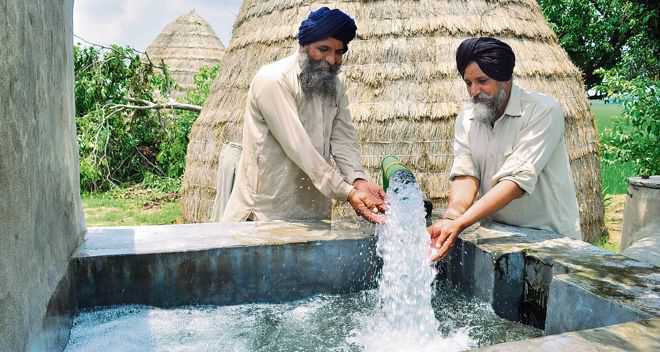
Punjab agriculture is crying for a change


Presenting this year’s budget, Punjab Finance Minister Manpreet Badal sounded an ominous warning. Not that it wasn’t known earlier but coming from him was yet again an official acknowledgement of a worrisome futuristic scenario that is fast pushing the frontline agricultural state towards desertification and an impending ecological disaster. “76 per cent of the assessed blocks are over-exploited and the estimated ground water availability for future irrigation use is negative.”

The warning had been sounded earlier. The two reports on crop diversification in 1986 and 2002, authored by the eminent agricultural economist Dr S S Johl, were essentially in response to the depleting ground water situation. I remember Dr Johl many a times making a very strong point as to how Punjab ends up virtually exporting water when it transports surplus wheat and paddy every year to the deficit areas. Later, in 2009, the observations of NASA’s Gravity Recovery and Climate Experiment (GRACE) satellite data showed an equally worrisome trend. “We don’t know the absolute volume of water in the Northern Indian aquifers, but GRACE provides strong evidence that current rates of water extraction are not sustainable, hydrologist Matt Rodell of NASA was quoted as saying. Subsequently, a number of international and even national studies by the Indian Council of Agricultural Research, Central Ground Water Board and even the Punjab Agricultural University, among others, have pointed to a grim future ahead. 

Chief Minister Amarinder Singh too has been very concerned at the depleting water resources. Speaking in the Vidhan Sabha, he sounded a poignant note when he said that the state has run out of all options and there was an urgency required to tackle the water crisis, which may include changing the cropping pattern, going in for crop diversification and so on. But after all these warnings, if the Finance Minster simply ends up reiterating the government’s resolve to address the problem of groundwater depletion using the common popular jargons like judicious, sustainable and equitable use to manage water availability and eventually informed that the government is in dialogue with the World Bank to find a workable solution, clearly showed the lack of political courage to take the bull by the horn.

Like the previous governments, the present Congress regime too has shied away from initiating any significant step to move away from water guzzling crops, primarily paddy, lest it upsets the predominant vote bank. Interestingly, almost at the same time the budget session was in progress, the Coordinator of the All India Kisan Coordination Committee, Yudhvir Singh, while addressing a series of meetings organised by the Bhartiya Kisan Union (Lakhowal) was asking farmers to shift not only from paddy cultivation to restore ground water but also move away from intensive farming to agro-ecological practices. He wanted them to devote at least one acre out of the total land area they have to non-chemical agriculture. In fact, he made an impassionate plea urging farmers to reduce crop output. “Your problem is you produce more. If you were to reduce production by 10 per cent on an average, you’ll get a better price for your crop harvest and also save on chemical inputs.”

With 98 per cent assured irrigation, and having the highest crop productivity in wheat, rice and maize – the cereal crops – Punjab has the dubious distinction of turning into a hotbed of farmer suicide. With over 16,600 farm suicides, including farm labourers, documented in a house-to-house survey between the year 2000 and 2017 by the three public sector universities – Punjab Agricultural University, Ludhiana; Punjabi University, Patiala; and the Guru Nanak Dev University, Amritsar, there was ample evidence to relook at the intensive farming model that the state had adopted. World Bank had played a crucial role in pushing the intensive and exhaustive farming model, and to expect the same institution to help in improving the management of its scarce resources clearly showed that the state had not learnt any lessons and was not willing to change.

Albert Einstein had once said: “We cannot solve problems by using the same kind of thinking we used when we created them.” I have always maintained that we cannot ask the same people who were in a way responsible for the crisis, to provide solutions. First and foremost, the time is appropriate to move away from intensive farming, which has triggered massive environmental degradation and has brought the food bowl onto the edge of sustainability. The impending ecological disaster will not be addressed by changing the cropping pattern. A recent study by the Centers for International Projects Trust (CIPT), a Columbia University initiative, has after a detailed study on water budgeting shown that crop diversification will not make much of a difference in ultimate water balance.

What Punjab needs in fact is a change in farming systems. It is time the Punjab government does a complete rethink of the integrated farming systems that needs to be evolved, if it is serious in protecting its future. If Andhra Pradesh (AP) can launch Zero Budget Natural Farming with the aim to convert all its 60-lakh farmers to non-chemical agriculture by the years 2024, I see no reason why Punjab cannot at least initiative agro-ecological methods of farming for the marginal and small farmers to begin with. Considering that every third farmer in Punjab is below the poverty line, this is the community that needs immediate hand holding. Instead of pushing more machines and more chemicals into farming, using the Rs 6,000 per year direct income support allocated under the PM-Kisan scheme, Punjab should supplement with its own contribution and like AP provide at least Rs 15,000 per year. This package should be linked to agro-ecological farming systems. In Karnataka, for instance a direct income support of Rs 10,000 per year is announced for farmers cultivating millet crops.

In Chhattisgarh, instead of going in for increasing crop productivity to emerge out of the prevailing farm crisis, the new Congress government, has incorporated the traditional “Narwa (water), Garuwa (livestock), Ghurawa (compost/biofertiliser), and Baadi (backyard cultivation)” in an interesting agro-ecological approach to be accomplished at panchayat level. These are just a couple of examples to show there exists a way out provided the state government is willing. After all, extraordinary problems need extraordinary solutions. More of the same will only acerbate the crisis.

Punjab agriculture is in fact crying for change. A change that will save it from the impending ecological disaster that Manpreet Badal warned about. It has to begin with reframing and redesigning the farming systems. But this will be strongly resisted by a powerful cartel that exists -- among politicians, bureaucrats, agricultural scientists, and economists – who will call for business as usual. Unless the Chief Minister can break through that cordon, Punjab will continue to suffer. #

Review farming methods to tackle water crisis. The Tribune. Mar 14, 2019

READ MORE - Punjab agriculture is crying for a change