Showing posts with label Lockdown. Show all posts

Wednesday, May 20, 2020

Agriculture needs an economic stimulus


After listing a host of measures that have been taken in the past, Finance Minister Nirmala Sitharaman in her series of press conferences has come up with 11 specific measures on Friday, besides two measures she had spelt out a day earlier, to provide help to farmers as part of the Rs 20-lakh crore economic package for Covid-19. But it did not contain any special measure to provide direct cash transfer into the hands of farmers reeling under distress.   

While most of these measures have already been listed in the budget proposals in the past, Sitharam also announced three measures to ease up agricultural marketing and remove the stock limits under the Essential Commodity Act, a move that will help processing industry and wholesale trade. Except for exceptional times when a disaster strikes or when the prices for perishables go up beyond 100 per cent or 50 per cent in case of cereal crops, traders have now been allowed to hoard. A central law to provide farmers with various options to market their produce and laws to facilitate contract farming will soon be formulated.  

A fund of Rs 1-lakh crore to be created for strengthening post harvesting infrastructure like cold chains, storage was provided. Similarly there were proposals for developing marine and inland fisheries for which an allocation of Rs 20,000-cr was announced; another Rs 15,000-crore for dairy infrastructure, a continuing scheme; Rs 13,343-crore for control of animal diseases like foot and mouth disease, 100 per vaccination for all animals, which was approved by the Cabinet in may 2019; schemes for medicinal plants, honey bees, micro-food enterprises engaged in nutritional food, health and wellness etc. While I agree that these are important measures and are required to boost the rural economy, and help farmers, fishermen and dairy farmers but are steps that are part of a continuing process to improve agriculture activities in the long term.  

But in these extraordinary times when the lockdown has severely restricted economic activity, it is only agriculture which served as a lifeline. Agriculture, in true sense, reinforced its image as the mainstay of the Indian economy. With urban demand collapsing, with hotels, restaurants and dhabas closed for almost 50 days now, agriculture took the brunt of the lockdown, and still continued to keep the supplies moving. Reports of farmers spilling milk on the streets, poultry birds being buried alive, flowers being re-ploughed, fish rotting in the markets, and agitated farmers throwing away vegetables before cattle and with prices of almost all crops crashing in the market because of supply chain constraints have regularly poured in. Several estimates have put the losses suffered by vegetable growers alone at Rs 25,000-crore; dairy farmers at Rs 10,000-crores; poultry loss at Rs 15,000-crores besides there were huge losses suffered by flower growers, plantation crop, fruit growers and a massive hit suffered by fishermen. In other words, across the country, farmers have suffered a huge loss.

Despite all odds, farmers have also harvested nearly 106 million tonnes of wheat, and have already sown more area under kharif crops and are also getting ready for paddy transplantings in the weeks to come. Adhering to the safety norms, which meant staggering of dates to bring produce into the mandis, procurement of wheat is heading towards a record. Agriculture being already in distress, the expectation was for an immediate relief package to partly offset the losses they have suffered, and provide an incentive for the sowing operations to be undertaken. Here was an opportunity for the government to stand with farmers in distress, and provide a stimulating economic stimulus package. Farmers are in need of an immediate relief package, and providing more cash in their hands would have also helped create more demand.

Even earlier, when the Finance Minister had announced a package of Rs 1.70- lakh crore for farmers and other marginalised sections of the society, the only commitment for farmers was to frontload an instalment of Rs 2,000 under the PM-Kisan scheme, benefitting 8.19-crore farmers, which in any case was due to them. Under the PM-Kisan farmers get a direct transfer of Rs 6,000 per year, in three instalments. The first instalment was in any case due for April-June quarter. In other words, farmers have so far been deprived of any direct support. My proposal therefore is to provide a direct income transfer of Rs 10,000 per farmer, including the tenant farmers, without disturbing the PM-Kisan scheme allocations. In addition, considering the enormous difficulties farmers faced at the time of wheat harvest and procurement, they need to be given a bonus of Rs 100 per quintal over and above the minimum support price (MSP) for wheat procurement. Considering that several lakh migrant workers have returned to their villages, agriculture needs to be strengthened so as to absorb the additional workforce.

The pandemic provides immense opportunities to realise the Prime Minister’s vision of Atmanirbhar Bharat Abhiyan. Revitalising agriculture and turning farming into an economically viable proposition forms the basis of the campaign. The additional allocation of Rs 40,000-crore for MNREGA is a welcome step.

It’s also time to learn from other countries. The US has provided a support of $ 3 billion to purchase vegetables, fruits and milk directly from the farmers and supply it to consumers. A similar strategy can be worked out for perishable crops in India, wherein the government provides at least a support of Rs 10,000-crores (like it is providing for the purchase for pulses/oilseeds) to the state governments directing them to make purchases directly from farmers by using the official machinery, cooperative agency outlets, Mother Dairy outlets, FPOs, organised retailers and also activating the supply chain. Extra-ordinary crisis needs out of box solutions, and it is time the government ushers in steps that are beneficial to farmers. After all, farmers have demonstrated that at this difficult time, they are the real backbone of the economy. #

READ MORE - Agriculture needs an economic stimulus

Tuesday, May 19, 2020

The solutions to the continuing distress in agriculture lie outside the crop fields, in economics --A brief interview


A brief interview in Kannada. I am sharing the English version. This interview was conducted by Nagesh Kn for One World Kannada. 


1. What is the approximate loss incurred by Indian farmers in this Lock down? volume of Agriculture produce and the cost of it...

A: A farmers from Kerala wrote. He said he has unsold stock of 49 drums of latex (approximately 10,000 kg) valued at Rs 3.25 lakh. His question is what should he do with this produce that is going waste. This is not an exceptional case. We have already read reports of farmers spilling milk on the streets, poultry birds being buried alive, flowers being re-ploughed, fish rotting in the markets, and agitated farmers throwing away vegetables before cattle and with prices of almost all crops crashing in the market because of supply chain constraints have regularly poured in. Several estimates have put the losses suffered by vegetable growers alone at Rs 25,000-crore; dairy farmers at Rs 10,000-crores; poultry loss at Rs 20,000-crores, sugarcane arrears at Rs 18,000-crore besides there were huge losses suffered by flower growers, plantation crop, fruit growers and a massive hit suffered by fishermen. In other words, across the country, farmers have suffered a huge loss. Even now farmers continue to incur losses. It will take some time to compute the total loss that farmers have suffered.  

2. What in your opinion is the best possible solution to be given to farming sector by respective govt's and Center in the present crisis?

A: In these extraordinary times when the lockdown severely restricted economic activity, it is only agriculture which served as a lifeline. Agriculture, in true sense, reinforced its image as the mainstay of the Indian economy. With urban demand collapsing, with hotels, restaurants and dhabas closed for almost 50 days now, agriculture took the brunt of the lockdown, and still continued to keep the supplies moving. At this difficult time, farmers needed immediate relief. They needed direct income support, more cash in their hands. My proposal therefore is to provide a direct income transfer of Rs 10,000 per farmer, including the tenant farmers, without disturbing the PM-Kisan scheme allocations. In addition, considering the enormous difficulties farmers faced at the time of wheat harvest and procurement, they need to be given a bonus of Rs 100 per quintal over and above the minimum support price (MSP) for wheat procurement. In addition, for a year at least they should not be hauled up for any default on bank loans, and the interest rate on bank loans be written off for the same period of one year. Considering that several lakh migrant workers have returned to their villages, agriculture needs to be strengthened so as to absorb the additional workforce. While the additional financial allocation of Rs 40,000-crore is welcome, but I think there is also an urgent need to extend the minimum guaranteed employment period to 200 days. 

3. Do you endorse the opinion of few organic farming promoters " People lost resistance to diseases and lost immunity due to the food they eat grown using chemicals (pesticides, fungicides, weedicides  etc)

A: While the Finance Minister has also announced Rs 10,000-crore fund for formulation of micro-food enterprises -- mostly for nutritional foods, organic foods, health and wellness and also building cluster approaches for makhana in Bihar, Kesar in Kashmir, Ragi in Karnataka and some others, the realisation that healthy, nutritious organic foods builds natural immunity and provides resistance against diseases is being articulated for quite some time. Intensive farming techniques have pulled down the nutritious contents, including minerals and vitamins, from the foods we normally eat. When we breed crop varieties for still higher productivity, we underplay a harsh reality -- yield is inversely proportionate to plant nutrition. In addition, by adding chemicals and hormones, we actually produce foods which are nutritionally hollow. It is therefore an appropriate time to re-imagine the food system, to pause and reflect whether the food we eat is primarily responsible for weakening our immune system against the diseases. The Coronavirus epidemic has given a knock at the proper time, now whether we hear the loud knock and make radical changes in the way we grow food, and the diets we consume, is something that depends on us. Instead of blaming the governments and policy makers, it is high time we as consumers raise our voice. 

4. When we talk about crisis we have three things Pre Corona Agri crisis, Corona time agri crisis and Post corona agri crisis ? What governments need to do to bring hope in farming sector, instead of keeping agriculture sector deliberately impoverished (your most frequent statement)

A: Whether before the coronavirus pandemic struck or after the lockdown eases, the stark reality that has emerged is that agriculture has been a victim of policies that have primarily kept farming impoverished. The basic objective of keeping farmers deprived of their rightful income was to create enabling conditions for the rural poor to migrate to the cities, which were needing cheaper labour. Estimates show that some 14-crore people work as urorganised workers in the cities, and I have always referred to them as Agricultural Refugees. These are the people who were in reality pushed out of the villages in the past few decades. By denying them their rightful income, they were left with little choice but to migrate to the cities looking for menial jobs. 

When do I mean by saying denying them their rightful income? Well, to illustrate, an OECD-ICRIER study shows that in the 17-year period, between 2000 and 2017, India farmers incurred a loss of Rs 45-lakh crores. Imagine the magnitude of loss the farmers were inflicted with. This was an extraordinary crisis, but the nation didn't even blink an eye. Imagine of the farmers had earned Rs 45-lakh crore more in 17 years (or Rs 2.64 lakh crore ever year), I am sure the number of people who migrated would have been far far less. The reverse migration that we now see actually provides us a visual of the agricultural refugees, who came to the cities looking for better options, now returning back after being disowned by the urban class. The long traumatised walk these millions have taken back to their villages clearly shows that the immediate need is to rebuild the village economy, make agriculture economically viable, which is only possible if we provide farmers with the rightful income. It is therefore high time to overhaul the economic design that pushed the poor from the villages to the cities, and instead replace it with an economic system that make farming viable, restores the lost pride in agriculture, and turn agriculture into the mainstay of the economy. 

This is possible only if you, my dear reader, wakes up to accept this harsh reality. Unless you too raise your voice, ask for policy course correction, and use social media to build up the voice of the voiceless, I don't think this can we done. Your silence is no longer a virtue, but a reflection of your failure to stand up and be counted. 
  
5. Whats your advise to farmers?  for self sustainable farming and life?

A: To my fellow farmers, my advise is to stop being greedy. In the race to achieve higher production, you have been misled to believe that higher the productivity, higher would be your income. You know very well that the chemical fertiliser you use or the pesticides you spray are harmful for the environment. You know that despite investing heavily in intensive farming techniques your incomes have fallen. A majority of farmers live in debt, and I know living in debt all through your life is hell. With every passing year, you are being pushed deeper and deeper into a debt trap. farm suicide rate constinues to be soaring, and you know of many farmers in your own neighbourhood who have ended their life unable to carry the burden of debt anymore. Take the case of Punjab. It has 98 per cent area under assured irrigation, which means every crop filed is irrigated. It has the highest productivity of cereal crops -- wheat, rice and maize -- in the world. every State is trying to emulate the example of Punjab. But what is little known is that Punjab, despite the bountiful harvests, has turned into a hotbed of farmer suicides. Between 2000 and 2015, the total number of suicides by farmers and farm workers stood at 16,600. 

It is time you learnt your lessons. Don't be in a mad race to compete with your neighbouring farmer who uses excessive doses of fertiliser and pesticides. Move away from these chemicals. Produce food safely, which can be consumed safely. And in addition, shift your focus to know how you have been deprived of your rightful income over he past few decades. Educate yourself, and also educate your fellow farmers. Your focus should shift to getting the right price for your produce, which means getting the rightful income. You may have heard me before giving an example of how the basic salary of government employees has gone by 120 to 150 times in the 45 years period, between 1970 and 2015. The basic salary of college teachers and professors has gone up by 150 to 170 times in the same period. But the wheat MSP in the same 45 years period has been increased by only 19 times. I am sure you will agree that if the basic salary of the government employees and college/university professors has gone in the same proportion many of them would have quit their jobs, and many would have committed suicide. What you need to learn now is that the distress you face is not because you don't know how to do farming but how your income was deliberately kept low to provide cheaper food for the consumers.

The solutions to the continuing distress in agriculture lie outside the crop fields, in economics.  #

ಕೃಷಿ ಬಿಕ್ಕಟ್ಟಿಗೆ ಪರಿಹಾರ ರೈತರ ಹೊಲದಲ್ಲಿಲ್ಲ, ಬದಲಿಗೆ... OneWorld Kannada. May 18, 

READ MORE - The solutions to the continuing distress in agriculture lie outside the crop fields, in economics --A brief interview

Thursday, April 23, 2020

Covid-19 provides an opportunity to re-imagine a New Normal


Pic courtesy: ICRISAT

This was unexpected. The world’s leading global business publication, the Financial Times, wrote in an editorial: “Radical reforms – reversing the policy direction of the last four decades – will need to be put on the table.” After four decades of following a policy direction that relies extensively on free markets, it took a brutal assault by the Corona virus pandemic for the world to realise that it wasn’t working well. The fault lines are clearly visible.    

Historically, the aftermath of pandemics have led to a changed eco-system. Once the Corona virus pandemic reduces in intensity, and the world returns back to its daily routine, it is expected that the government will be back on the table with renewed emphasis on human welfare. With markets tottering in the wake of the pandemic, decades of underfunding of public health and education for instance will now receive priority. It may also radically overhaul the urban landscape with working from home becoming an increasing norm, more because it reduces the overhead costs for the companies. 

But whether the post Covid-19 will see a perceptible change in the neoliberal economic policies that the world has continuously followed for four decades, which has acerbated income inequality and led to a massive destruction of natural resources, is something that we will have to wait and watch. More importantly, whether the reduction in air pollution levels leading to clear blue skies, the cleaning of river Ganges and Yamuna which seemed almost impossible, the return of the birds in our balcony we had almost forgotten about, and numerous other subtle but substantial changes that people had begun to cherish during the lockdown will disappear once it is back to business as usual is again a question that only time can answer.  

Corona virus outbreak has brought economies to a virtual standstill, with only agriculture serving as the lifeline. At a time when aggressive consumerism the world has witnessed over the past few decades was down to a trickle, it is the abundance of global food reserves – and more importantly in India – that kept the war against the pandemic focused. With overflowing food stocks, totalling 77 million tonnes, three times the public distribution system requirement, India is in a much comfortable position. Despite the efforts, as part of the market driven economic reforms, to dismantle public procurement limiting it to the food needs of only 20 per cent of the population (from 67 per cent served under the National Food Security Act), the redeeming feature is that India’s food supplies can last for over a year.

At a time of burgeoning food stocks, the tragic images of lakhs of migrant workers, carrying their children in laps and their meagre possession on their head, trudging back to their villages had filled media spaces. Walking hundreds of kilometres at a stretch and that too without any assurance of food these migrant works are in reality agricultural refugees, who were driven out of their villages when agriculture failed to provide them enough to survive. Migrating to the cities with the hope of making a decent living, these workers were in reality living only by their daily wages; whatever they earned, they spent. And when the cities disowned them after the lockdown was imposed, they were desperate to return home because that is where they belonged to.

Again, a fallout of faulty economic policies. Agriculture has been deliberately kept impoverished to enable farmers to abandon farming and move to the cities. Over the years agriculture is being sacrificed to keep the economic reforms viable. This is what the World Bank had prescribed. At a conference I attended in 1996 at the MS Swaminathan Research Foundation in Chennai, the then Vice President of the World Bank, Dr Ismail Serageldin had said that the bank estimates the number of people migrating from the rural to urban areas in India in the next 20 years, which meant by 2015, to be equal to twice the combined population of UK, France and Germany.

Given that the combined population of the three countries at 200 million, 400 million people were expected to move out of rural areas in India. This is the price the poor were made to pay to keep the economic reforms viable. And when even that didn’t work for them, they preferred to return home.  

Now that the avalanche of migrant workers returning home has struck a strong visual in our minds of the large number of agricultural refugees walking home, Covid-19 provides an opportunity to re-imagine a New Normal -- where agriculture becomes economically viable and sustainable, where farming is not stifled to prepare a workforce for the industry, where agriculture becomes the pivot of the economy providing the rightful income into the hands of farmers. This will only be possible if along with public health and education, revival of agriculture too receives a priority in policy planning. A regenerating agriculture alone has the ability to reboot the economy, protect nature, bring back birds and butterflies, and save the planet from the catastrophic effects of climate change that awaits us.   

Reversing the policy direction of the past four decades, as the Financial Times had said, is an urgent necessity. It requires bold decision making along with the courage to redraw a new development pathway. It also requires immense political backing to thwart the lobbying pressure from the market players, both in the media as well as academia. It requires an exceptional ability to challenge the dominant economic thinking, to disband the model of economic growth which has relied solely on wealth creation. It has sucked income from the bottom to the top, enabling the rich to amass wealth. But to expect the present dispensation of mainline economists to make an attempt towards an everlasting change – so as to prepare for a new normal -- is perhaps asking for the impossible.

There is no dearth of saner voices. It is time to find them, and acknowledge their role. After all, as someone rightly said, it is the normal that we don’t want to return to. #

Agriculture offers lifeline amid pandemic. The Tribune. April 24, 2020

READ MORE - Covid-19 provides an opportunity to re-imagine a New Normal

Saturday, April 18, 2020

Lockdown: Agriculture serves as the lifeline


When people across the country are confined to their homes the only pressing requirement they have is for food – and that too three times a day. Whether you are rich, sitting comfortably in your homes and trying out new recipes to prepare a fresh dish every other day or you are a poor migrant struggling to find a banana that you can still eat from the rotten heap lying on the banks of Yamuna river, food is after all a basic human necessity.

It is at this difficult time of a lockdown that the often repeated phrase -- agriculture is the mainstay of the Indian economy – not only becomes obvious, but is firmly established.

But imagine the chaos if the country didn't have enough food at these testing times? Imagine if we had followed the prescription of our mainline economists who had wanted food stocks limit to be reduced to feed only 20 per cent of our population? Imagine if we had dismantled the APMC mandis and done away with crop procurement as the industry had always wanted us to do? Even despite having a record foodgrain surplus – 77 million tonnes, at least three times more than the requirement -- still 96 per cent of the lakhs of migrants did not get their share of dry rations, says a study.

The avalanche of migrants heading back home after the lockdown was imposed, travelling on foot for hundreds of kilometres, without an assured supply of food, has provided a visual image to a monumental crisis that was building up for decades. The massive reverse migration, and subsequent efforts being made by the state governments to provide temporary shelter and food to those struck on the way, has brought forth another hidden dimension of the ongoing agrarian crisis. Urban centres had failed to ‘absorb’ the migrant workforce, maintaining a clear cut social distance from the migrants, and when the daily wage link was suddenly snapped the teeming work force felt abandoned.  

A majority of these migrant workers are unlikely to return soon. The fact that they took the hard decision to tread back home to be with their families, where they wouldn’t be at least facing hunger, speaks volumes of the flawed economic thinking which actually pushed people out of the rural areas to migrate into the cities because the cities needed cheap labour. With farm prices kept low to keep food inflation under control, and at the same time provide cheaper raw material to the industry, agriculture was deliberately kept impoverished. Despite being denied their rightful income, farmers continued to produce a surplus for the country year after year.

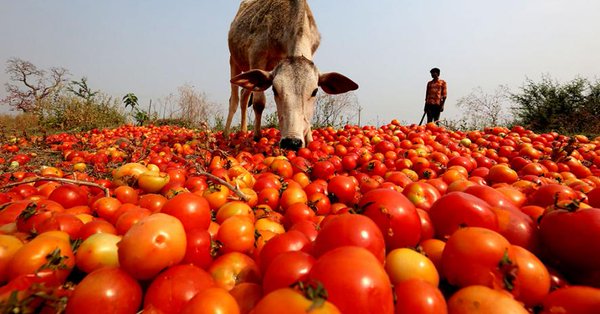
The lockdown coincided with the rabi harvest season. This year, despite unseasonal rains, production was expected to be bountiful. But with people asked to stay indoors, and with restaurants, hotels and dhabaspulling down the shutter, the demand for perishable vegetables and fruits collapsed. Reports of farmers re-ploughing fields of cabbage, cauliflower, raddish, peas and other vegetables poured in. Tomato farmers dumped the harvest in the crop fields. Premier products like strawberry had to be fed to cows. Button mushroom rotted. The demand for premier Alphonso mangoes, grapes, banana and even plantation crops like coffee, tea, cashew nuts and spices faced price crash. Poultry suffered the worst. Milk, fisheries and flowers were similarly badly hit.

Shortage of farm labour compounded the existing crisis. Even in case of wheat, where a record 106 million tonnes of grain is to be harvested, paucity of farm workers has hit harvesting operations. Although the government has for all practical purposes kept agriculture, horticulture, plantation crops, fisheries and animal husbandry out of the lockdown provisions from April 20, procurement of wheat is slowly picking up. But interestingly, while it is agriculture that suffered a severe blow during lockdown 1.0, the impression being generated is that the rural areas are relatively better off.

This crisis apart, the bigger question is whether the pandemic will change the way we look at agriculture? Whether agriculture will receive priority in public policy? Or once the fire-fighting operations are over, it will be back to square one. While the State’s role in health and education is expected to expand, will agriculture also emerge on the top of dominant economic thinking? Will a relook at agriculture bring back the focus on making agriculture economically viable? These are questions that need to be seriously deliberated because the policy changes after Covid-19 will determine the future of agriculture.

Corona virus pandemic therefore has come as a loud knock at a time when the dominant economic policies were aimed at propping up the industrial sector. Over the past few decades, agriculture had been systematically ignored in policy planning. The best reflection for this perhaps comes from the declining public sector investments in agriculture. Between 2011-12 and 2017-18, public sector investments in agriculture hovered between 0.3 to 0.4 per cent of the GDP for a sector which employs 50 per cent of the total workforce. It is futile to expect a miracle in agriculture without providing adequate investments commiserating with the population involved.

With agriculture emerging as the strong pillar of the economy at these difficult times, it should be abundantly clear that any further effort to marginalise farming will be politically suicidal. While agriculture will need a total revamp, and with huge investments the challenge will be to provide farmers with a remunerative price and being assured a monthly income. At the cost of repeating again, an OECD study had shown Indian farmers lost Rs 45-lakh crore between 2000 and 2016-17 by being denied their rightful income. Imagine if Rs 45-lakh crore (or Rs 2.6 lakh crore every year) was paid to farmers, there would have been hardly any possibility of farmers abandoning agriculture and migrating to the cities. Post Covid-19, let’s aim at Sabka Saath Sabka Vikas and Sabka Vishwas.

This is not a wishful thinking. It is an idea whose time has come. #

Saved by Plough. Orissa Post. April 18, 2020
https://www.orissapost.com/saved-by-the-plough/ 
READ MORE - Lockdown: Agriculture serves as the lifeline